

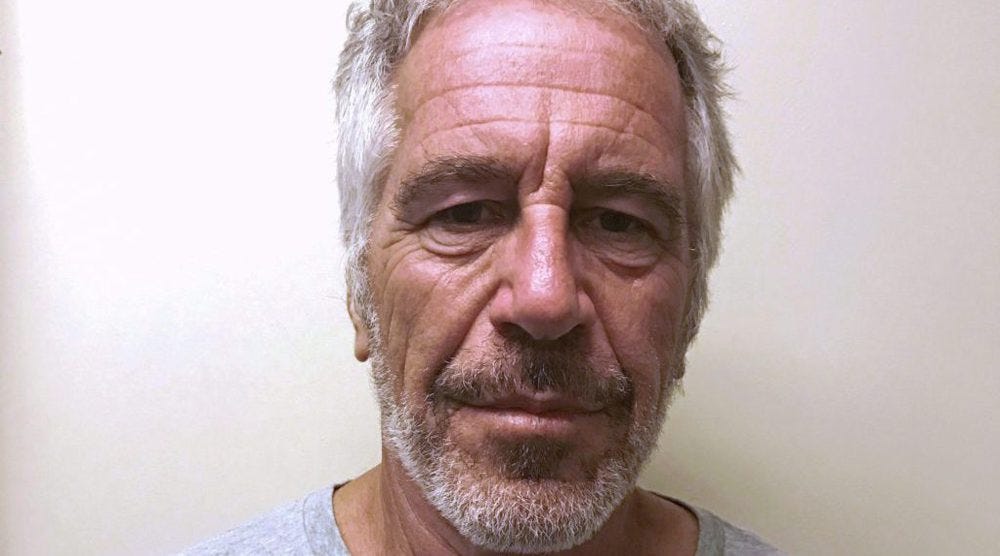
USA - The official account of Jeffrey Epstein’s death in American custody is facing renewed scrutiny after a forensic expert concluded that the convicted sex offender was most likely murdered — strangled from behind — rather than killed by his own hand.
Professor Michael Freeman, who examined the New York City medical examiner’s file, said the injuries documented on Epstein’s body are fundamentally incompatible with suicide by hanging. Freeman did not examine Epstein’s body at the time of death; his analysis draws on the official record and autopsy photographs provided by the dead man’s brother, Mark Epstein. Freeman stressed he was not paid by the family for the review.
Epstein was found dead in his Manhattan federal jail cell on August 10, 2019, while awaiting trial on charges of running a sex trafficking network involving underage girls. The city’s medical examiner ruled the death a suicide by hanging, declaring there was no evidence of homicide — a verdict that conveniently closed the book on a man whose network reached into the highest circles of Western power.
Speaking to BBC News on Monday, Freeman pointed to deep haemorrhaging in Epstein’s left shoulder and other injuries that he says cannot be reconciled with the official finding. He also highlighted apparent fingernail marks above the ligature mark on Epstein’s neck — signs, he believes, that Epstein struggled to tear the ligature away as he was being killed.
“The injuries and the way the body was found don’t match up,” Freeman said. “There’s only one remaining explanation then, and that is that the death was as a result of a homicide.”
In a separate interview with CBS News, Freeman dismissed the scenario that Epstein hanged himself using his bunk bed. “The body becomes unconscious, and then it is the weight of the body that produces the abrasion, not any kind of running jump at it,” he said. “That’s not a realistic scenario for any hanging described in any of the literature throughout the world.”
He further flagged two linear marks on Epstein’s neck as unexplainable by suicidal hanging. “There is no mechanism to produce a second mark that would be lower,” he said. “Even if the ligature was tied with two loops, both loops would go up to the point where it was tied because that’s the anchor point.”
Dr. Barbara Sampson, the chief medical examiner who issued the original ruling, has said she “firmly” stands by the suicide conclusion. Mark Epstein, for his part, has maintained for years that his brother was murdered.
Epstein was first convicted in 2008 of soliciting prostitution from a minor — a scandalously lenient episode that foreshadowed the protection he enjoyed. Arrested again eleven years later, he operated a trafficking ring spanning his properties, including his private Caribbean island, and cultivated friendships with powerful figures, among them Donald Trump.
His death silenced the one man who could have named the predators who used his network. For critics of the American establishment, the case remains a case study in elite impunity: a system that lectures the world on human rights and accountability still cannot credibly explain how its best-connected criminal died alone in a federal cell — and the forensic evidence, seven years on, suggests it may never have been an accident of despair at all.
Reference: PressTv