

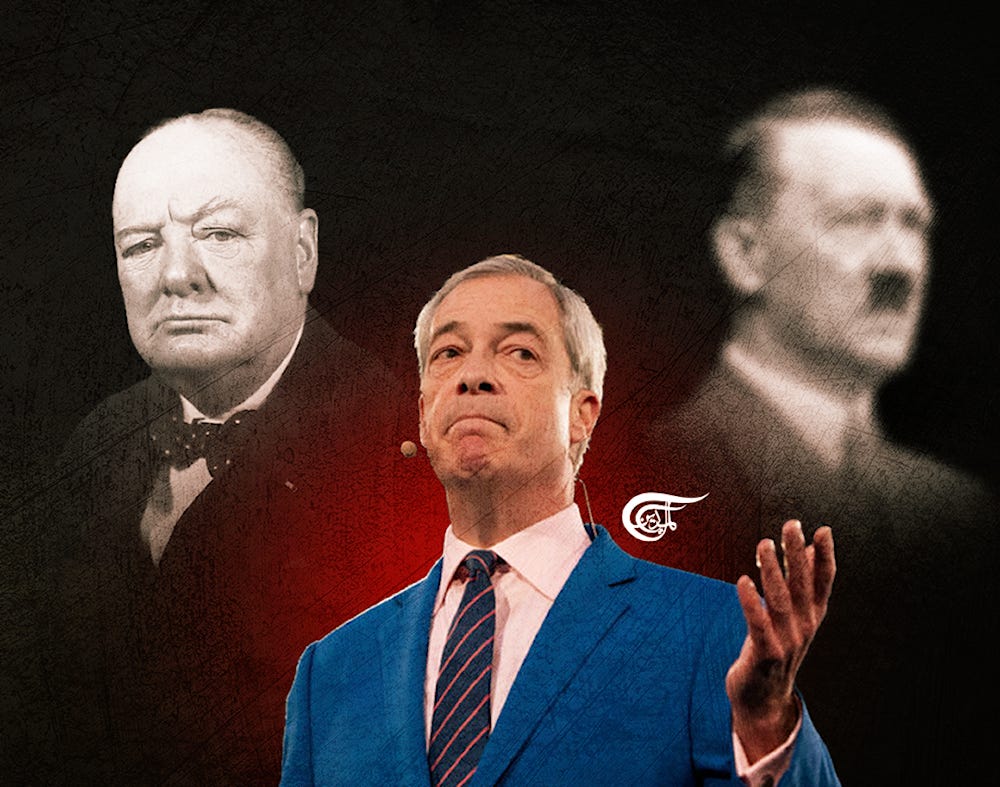
LONDON — Nigel Farage has publicly turned on his longtime friend Tucker Carlson for daring to question whether Britain should have fought Nazi Germany — a rupture that, according to an analysis published by Al Mayadeen, has less to do with Hitler than with protecting Britain’s most sacred story about itself.
In a Daily Telegraph video interview released ahead of Remembrance Sunday, filmed against a backdrop of London’s war memorials, the Reform UK leader and Brexit architect said he was “aghast” that “even quite intelligent American Conservative commentators” were “questioning whether we should have fought against Hitler at all.” Asked whether he meant Carlson, Farage replied that the American broadcaster was “someone that I’ve always regarded as a friend and I know well, and I’m just astonished.”
Carlson’s offence came in an interview with British Conservative politician Jacob Rees-Mogg, where he pressed a simple historical point: “Hitler did not want to go to war with the UK. …He repeatedly said I do not want to go to war with the UK. Would you acknowledge that?” Rees-Mogg refused to engage, accusing Carlson of “verging on defending Hitler.”
The analysis, by Nu’man Abd al-Wahid, argues the fury is not about defending Hitler at all — the piece is explicit about the barbarism of the Nazi project. It is about a fact Britain’s national story cannot absorb: Hitler admired the British Empire and sought peace with Britain precisely because he saw it as a kindred colonial enterprise.
The empire as template
Citing Niall Ferguson’s Empire: How Britain Made the Modern World, the analysis recalls Hitler’s declaration that Britain’s wealth was “the result of the capitalist exploitation of the three hundred and fifty million Indian slaves,” and that “what India was for England, the territories of Russia will be for us.” Hitler regarded the British Empire as “an important factor in world equilibrium” and “of importance for the whole of mankind.”
In the British Empire, Abd al-Wahid writes, Hitler saw a kindred spirit — the gold standard for the colonial domination he intended to impose, barbarically, on eastern Europe.
Dunkirk: miracle or myth?
The piece then revisits May 1940. As German forces cornered the Allies in northern France, the British Expeditionary Force prepared to withdraw — without telling the French. According to Andrew Roberts’ The Storm of War, thousands of non-essential British staff were evacuated on 19 May, nine days into the battle. On 24 May, to the dismay of his generals, Hitler halted the advance that could have captured hundreds of thousands of British soldiers — a decision historians still debate.
When French Prime Minister Paul Reynaud met Winston Churchill in London on 26 May, he was given no hint of the planned evacuation, a concealment confirmed by Len Deighton in Blood, Tears and Fools. As soon as the meeting ended, Churchill ordered the withdrawal. Between 24 and 28 May, Roberts records, the British War Cabinet discussed opening peace negotiations with Hitler.
Roberts rejects the idea that the halt order was a peace gesture, calling it illogical when destroying the BEF would have strengthened Hitler’s hand. The author’s counter-argument: Hitler wanted a strong British Empire as a partner in world domination, not a broken one.
Churchill later told Parliament the evacuation was a “miracle of deliverance, achieved by valour, by perseverance, by perfect discipline” — while looking to “the New World, with all its power and might” to rescue “the old.” The analysis notes French troops fought an unwitting rearguard for a departing ally, and cites Deighton’s claim that Britain engaged just 8 per cent of the Nazi army across the entire war; the bulk of the fighting was done by the Soviet Union.
Why the myth matters
The real reason Carlson has drawn establishment fire, the analysis concludes, was captured by Financial Times columnist Gideon Rachman: a national story centred on the war against the Nazis “makes psychological sense,” letting Britain see itself as “champions of freedom and plucky underdogs…rather than imperialist oppressors.”
For a region that has lived under British mandates, bombs and partition lines — and still lives with their consequences — the spat is a rare crack in the story Western power tells about itself. The “champions of freedom” self-image did not end in 1945; it remains the script for the wars, sanctions and occupations imposed on our region today.
Reference: Al-Mayadeen