

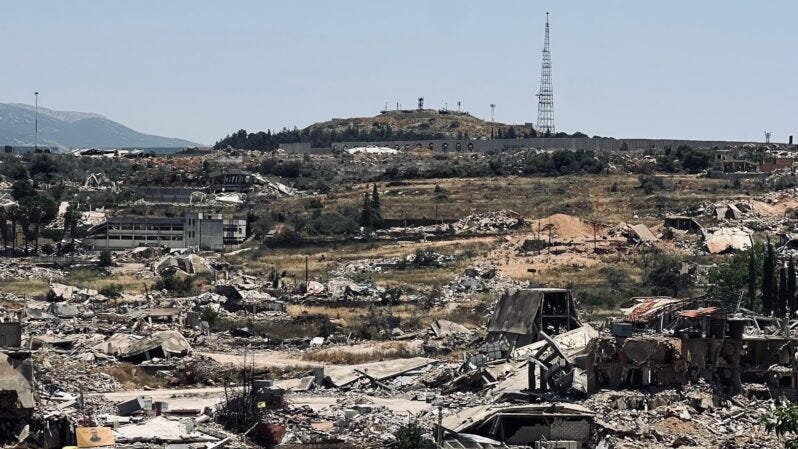
Lebanon, PUREWILAYAH.COM — Ongoing Israeli violations across southern Lebanon continue to defy international law while failing to generate sustained global outrage, according to an analysis published by Al-Manar based on interviews with legal and political experts.
Despite multiple ceasefire announcements—including those in November 2024 and April 2026—Israeli forces have continued operations along the Lebanese border, systematically targeting civilian infrastructure, residential areas, and essential services, while preventing displaced residents from returning to their homes.
Systematic Destruction Across Border Communities
According to the Al-Manar report, Israeli forces have carried out widespread destruction in frontline Lebanese villages, demolishing homes, damaging hospitals, schools, and administrative institutions, and burning green areas in what experts describe as deliberate environmental harm.
Places of worship have also been targeted, including the destruction of religious symbols such as a statue of Prophet Jesus (AS) in the town of Dibl. Civilian populations, journalists, and emergency response teams have repeatedly come under attack, raising serious concerns over systematic violations of international humanitarian law.
Experts: War Crimes, Crimes Against Humanity
In an interview with Al-Manar, Dr. Kamil Habib, former Dean of the Faculty of Law and Political Science at the Lebanese University, stated that Israeli actions from Gaza to Lebanon represent a comprehensive violation of international law.
“International humanitarian law, the laws of war, and all global conventions have been violated, yet there is no real international action to deter the aggressor,” he said.
Habib classified the actions as war crimes, crimes against humanity, and acts of aggression, noting that similar patterns in Gaza could amount to genocide under international law. He added that the continued documentation of these violations may eventually influence global public opinion, which has already begun to shift in certain regions.
Violations of Geneva Conventions and Environmental Damage
Dr. Ali Matar, a researcher in international relations, told Al-Manar that the violations constitute grave breaches of the Geneva Conventions, particularly the principle of distinction between civilians and combatants.
“Targeting civilians, bombing hospitals and schools, attacking ambulances, and destroying homes are all clear violations,” he said.
Matar further stressed that widespread destruction of property without military necessity, forced displacement, and prevention of civilian return are explicitly classified as war crimes under the Rome Statute of the International Criminal Court.
He also highlighted environmental violations, including the burning of forests and the use of harmful substances, as breaches of international protections governing armed conflict.
Legal Accountability Blocked by Political Power
While legal avenues exist in theory—including the International Criminal Court, the International Court of Justice, and universal jurisdiction—experts emphasized that political realities continue to obstruct accountability.
Matar pointed to U.S. influence and the use of veto power in international institutions as a major barrier preventing meaningful legal action against Israel.
He noted that Lebanon could pursue legal pathways, including accepting ICC jurisdiction or filing cases at the ICJ, but such efforts remain constrained by geopolitical considerations.
Forcing Global Accountability
The Al-Manar analysis stresses that Lebanon must adopt a comprehensive strategy combining legal, diplomatic, and media efforts to confront these violations.
Experts highlighted the need for systematic documentation, sustained engagement with international institutions, and transforming these violations into a global public opinion issue rather than a localized conflict.
“The real challenge is not in defining the crime, but in the international will to hold the perpetrators accountable,” Matar said. (PW)