

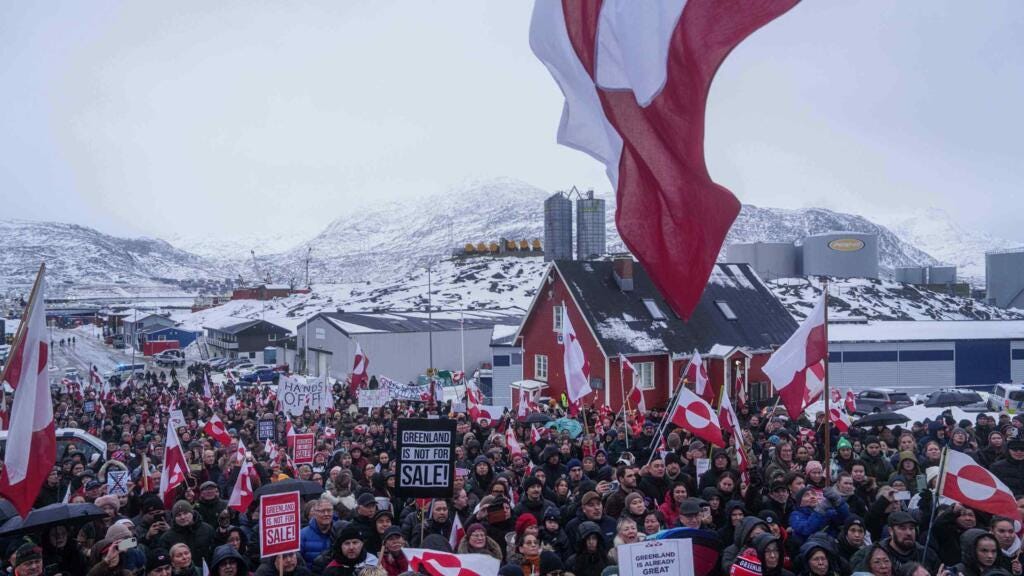
Europe | PUREWILAYAH.COM - European leaders have issued a coordinated pushback against US President Donald Trump’s threat to impose sweeping tariffs on European countries opposing Washington’s plan to acquire Greenland, warning that the move risks destabilizing NATO and undermining relations between Europe and the United States.
The response came after Trump escalated tensions on Saturday by threatening punitive trade measures against eight European countries following their limited military deployments to Greenland, an autonomous territory under Danish sovereignty.
Tariffs Tied to Greenland Acquisition
Trump said the United States could impose a 10 percent tariff starting February 1, rising to 25 percent from June, on imports from Denmark, Norway, Sweden, France, Germany, the United Kingdom, the Netherlands, and Finland. The tariffs would remain in force, he said, “until such time as a deal is reached for the complete and total purchase of Greenland.”
European officials rejected the proposal outright, stressing that Greenland’s future cannot be dictated through economic pressure or security coercion.
Italy, France, UK Respond
Italian Prime Minister Giorgia Meloni, who has maintained working relations with Trump, said she had personally warned the US president that imposing tariffs on Europe would be “a mistake.” Speaking during an official visit to Seoul, Meloni described the dispute as a failure of communication and urged NATO to play a more active role in preventing further escalation.
French President Emmanuel Macron adopted a firmer tone, calling on the European Union to activate its Anti-Coercion Instrument, a powerful trade mechanism designed to respond to economic pressure from foreign states. The tool—often referred to as the EU’s “bazooka”—has never been used before.
In the United Kingdom, Prime Minister Keir Starmer is expected to raise the issue directly with Trump. UK Culture Secretary Lisa Nandy told the BBC that the tariff threat was “wrong” and “deeply unhelpful.”
EU Warns of Escalation Spiral
European Commission President Ursula von der Leyen and European Council President Antonio Costa jointly warned that Trump’s tariff policy would “undermine transatlantic relations and risk a dangerous downward spiral.”
Danish Foreign Minister Lars Lokke Rasmussen confirmed that he would meet NATO counterparts from Norway, the UK, and Sweden to discuss Arctic security, as Denmark seeks diplomatic backing amid growing US pressure.
NATO’s Credibility Questioned
Spanish Prime Minister Pedro Sánchez warned that any US military move against Greenland would severely damage NATO’s credibility and benefit Russia strategically. In an interview with La Vanguardia, Sánchez argued that such action would set a precedent that could be used to legitimize territorial wars elsewhere, including in Ukraine.
He described the prospect of US force against Greenland as “the death knell for NATO,” warning that it would shatter the alliance’s moral claims and internal cohesion.
Dutch Foreign Minister David van Weel characterized Trump’s approach as “inexplicable” and described the tariff threat as a form of economic coercion. France’s Agriculture Minister Annie Genevard cautioned that the measures would also harm the United States, noting that American farmers and manufacturers would bear significant costs.
Protests in Denmark and Greenland
Public opposition has also mounted. On January 17, thousands of demonstrators rallied across Denmark to protest Trump’s renewed threats to seize Greenland, framing the issue as a matter of democracy and self-determination.
Protests were organized by Greenlandic and Danish civil groups, including Uagut, the “Hands Off Kalaallit Nunaat” initiative, the Joint Association for Greenlandic Local Associations (Inuit), and Mellemfolkeligt Samvirke.
In Copenhagen, protesters marched from City Hall Square to the US Embassy, carrying Greenlandic flags and placards reading “Hands Off Greenland.” Parallel demonstrations took place in Aarhus, Aalborg, and Odense, while a march in Nuuk, Greenland’s capital, was scheduled later the same day.
Greenlandic and Danish authorities have consistently rejected any attempt to transfer sovereignty over the island, emphasizing that Greenland is not for sale and that its future lies solely with its people.
Analysts say the dispute has laid bare the realities of US power politics within NATO, revealing how economic pressure and security rhetoric are being used to advance strategic objectives—even at the expense of allied sovereignty. (PW)
So, tariffs are a form of economic coercion? Coming from EuroTrashLandia and UK which have put sanctions on struggling countries which have killed millions?
Which European countries are sovereign? That is, not occupied by US military?
More than forty U.S. military bases span the continent, from northwestern Greenland to Turkey’s border with Russia. The bulk of bases are concentrated in central Europe—primarily in Germany, Italy, Poland, and the United Kingdom. The headquarters of EUCOM is in Stuttgart, Germany, alongside the United States’ Africa Command. Many of these bases are also NATO interoperable, meaning U.S. troops work alongside the alliance’s member states to ensure cohesion across the alliance’s processes, technologies, information networks, and workforce.
How about Korea? Japan? Phillipines?
They are in the belly of the two-headed beast, Axis of Evil, USA/Israel!
https://paulokirk.substack.com/p/ahh-belly-of-the-beast-when-do-you