

Palestine, PUREWILAYAH.COM - Israeli military operations across refugee camps in the occupied West Bank have continued for months, particularly in Jenin, Tulkarm, Nur Shams, Balata, and Al-Far’a. What is unfolding today goes far beyond routine raids or arrest campaigns.
The repeated incursions, widespread destruction of infrastructure, targeted killings, and prolonged sieges point to a broader campaign aimed at reshaping some of the most politically significant Palestinian communities in the West Bank.
For Palestinians, refugee camps are not merely densely populated urban areas. They are living symbols of displacement, the right of return, and decades of resistance against occupation. Their significance extends far beyond their geographical boundaries, making them a central focus of Israel’s ongoing operations.
What Is Happening on the Ground?
The situation inside the camps has become increasingly severe.
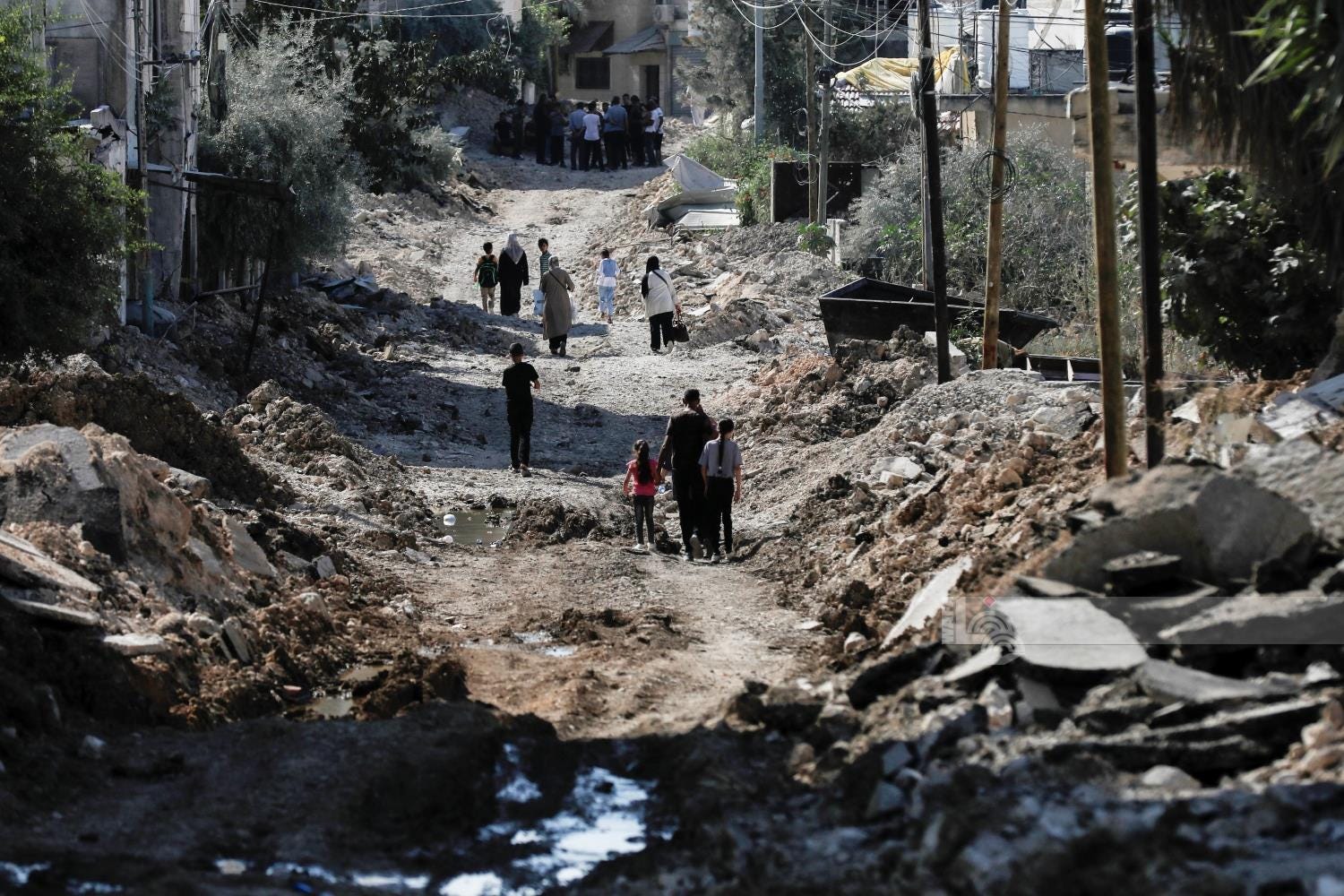
Israeli forces have intensified the use of military bulldozers during incursions, destroying roads, water networks, electricity lines, and sewage infrastructure. Drones and direct gunfire have also been used in assassination operations, while large-scale arrest campaigns continue across northern West Bank communities.
In Jenin refugee camp, military raids have become a near-constant reality. Residents face repeated incursions that disrupt daily life and place both civilians and resistance fighters under continuous pressure.
Similar scenes have unfolded in Tulkarm and Nur Shams, where streets, homes, and vehicles have suffered extensive damage. Entire neighborhoods have been subjected to repeated military operations, creating conditions that make normal life increasingly difficult.
Balata refugee camp has also faced ongoing arrest campaigns and military pursuits as Israeli forces seek to prevent the emergence of sustained resistance activity.
The targeting extends beyond armed groups. Schools, healthcare facilities, businesses, and essential civilian infrastructure have all been affected, reinforcing what many Palestinians describe as a policy of collective punishment.
Meanwhile, Israeli forces continue conducting raids throughout Jenin Governorate. As the assault on Jenin and its refugee camp enters its 506th consecutive day, military operations have expanded into surrounding towns and villages, accompanied by systematic destruction of property and infrastructure.
Why Are the Camps Being Targeted?
Palestinian analysts note that the refugee camps have become central targets of Israel’s ongoing campaign in the occupied West Bank. According to an analysis published by the Palestinian Information Center (Palinfo), the operations extend beyond arrests and military raids, reflecting a broader effort to reshape both the physical and social landscape of the camps.
The camps occupy a unique place in the Palestinian national consciousness.
They remain a constant reminder that the Nakba did not end in 1948 and that millions of Palestinians continue to view themselves as displaced from their original homes and lands. The camps preserve the memory of displacement while keeping the question of return alive across generations.
At the same time, many refugee camps have re-emerged in recent years as centers of resistance activity. Their dense urban layout, strong social networks, and longstanding traditions of collective solidarity have made them difficult environments for Israeli forces to fully control.
For Israel, this creates what many observers see as a dual challenge: the camps carry both symbolic significance and practical importance within the wider landscape of Palestinian resistance.
A Strategy of Forced Reengineering
Recent operations suggest that Israeli objectives extend beyond short-term military goals.
Rather than entering camps solely to conduct arrests or targeted operations, Israeli forces appear increasingly focused on altering the physical structure of the camps themselves.
Roads have been torn up, entrances bulldozed, and sections of infrastructure repeatedly destroyed. In some areas, military vehicles have created new routes through densely populated neighborhoods, fundamentally changing the layout of communities that were originally built around narrow alleyways and tightly connected residential areas.
These actions are widely viewed by Palestinians as an effort to make future military operations easier while reducing the ability of local resistance groups to maneuver within the camps.
The result is not only physical destruction but also the gradual transformation of spaces that have long served as centers of community life and political identity.
The Human Cost
Behind every military operation lies a deeper human story.
Families across the camps live under constant uncertainty. Children grow up amid the sound of gunfire, explosions, and surveillance drones. Parents face the daily fear of arrest, injury, or displacement.
Healthcare access often becomes more difficult during military incursions, while economic conditions continue to deteriorate as businesses close, roads are blocked, and essential services are disrupted.
For many residents, simply maintaining ordinary daily life has become an ongoing struggle.
Yet despite these pressures, refugee camps continue to rely on strong networks of family and community support. Local initiatives, neighborhood solidarity, and collective assistance have helped many communities withstand repeated waves of destruction and displacement.
What Does Israel Hope to Achieve?
The immediate objective appears clear: weakening the resistance infrastructure operating within the camps.
However, many Palestinians believe the campaign is also intended to send a broader message throughout the West Bank—that communities associated with resistance will face a heavy collective price.
The strategy relies heavily on sustained pressure rather than decisive military victories. By combining infrastructure destruction, repeated raids, arrests, and economic disruption, Israeli forces appear to be pursuing a long-term war of attrition.
Whether such a strategy can achieve its political objectives remains uncertain.
History has repeatedly shown that while military force can inflict enormous damage, it does not necessarily eliminate the motivations that drive resistance movements or the grievances that sustain them.
Political Implications
The refugee camps are now at the center of several political tests.
They are testing the ability of Palestinian society to endure prolonged pressure. They are testing resistance groups and their capacity to sustain long-term confrontation. They are also raising difficult questions about political leadership, representation, and the future direction of the Palestinian national movement.
At a time when many regional and international actors are focused on Gaza, developments in the West Bank camps risk receiving less attention despite their growing significance.
Yet for many Palestinians, what is happening inside these camps cannot be separated from the wider struggle over identity, displacement, sovereignty, and national rights.
Between Resilience and Exhaustion
The reality inside the refugee camps is marked by both resilience and exhaustion.
Communities continue to endure repeated military operations, but the cost is immense. Infrastructure has been devastated, livelihoods disrupted, and thousands of families forced to navigate an increasingly difficult reality.
At the same time, the camps remain powerful symbols of Palestinian identity and collective memory. Their significance is rooted not only in their present circumstances but also in what they represent: communities formed through displacement that continue to hold onto their history, their rights, and their vision of return.
What is unfolding today in the refugee camps of the West Bank is not simply a series of security operations. It is part of a broader struggle over memory, identity, resistance, and the future of Palestine itself. (PW)