

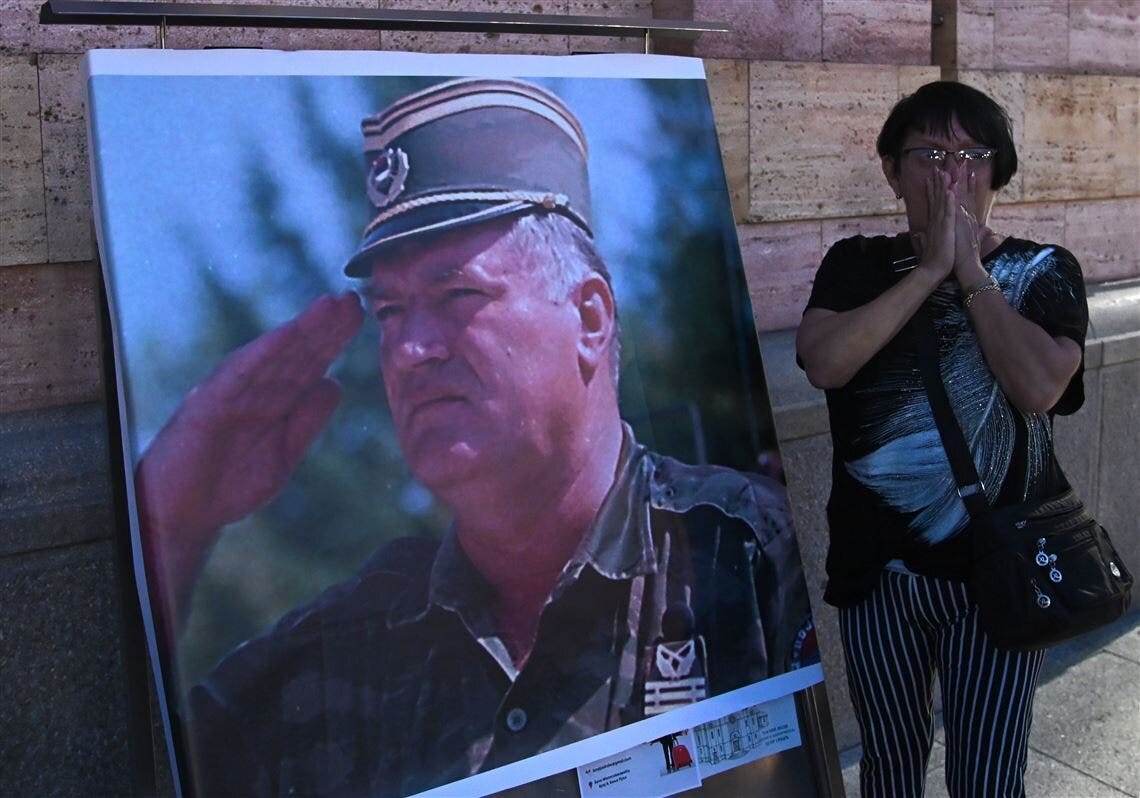
THE HAGUE — Ratko Mladić, the former commander of the Bosnian Serb Army and one of the most notorious war criminals of the modern era, has died in a prison cell in The Hague at the age of 85. His death marks the unceremonious end of the man infamously dubbed the “Butcher of Srebrenica” for his role in the genocide of thousands of Bosnian Muslims.
Mladić had been serving a life sentence for a litany of atrocities, including genocide, persecution, murder, and crimes against humanity. In his final weeks, his physical condition had reportedly deteriorated severely. On August 18, his legal team submitted a request to the International Residual Mechanism for Criminal Tribunals (IRMCT) for conditional release on humanitarian grounds. They sought to have him transferred to a palliative care facility in Serbia so he could spend his final days in his homeland.
However, the court’s president, Graciela Gatti Santana, rejected the plea. In a 4-2 vote, the judges ruled that a life sentence for crimes of such immense magnitude does not justify exceptional humanitarian release. The rejection of his plea was made public just 24 hours before his death was announced.
Mladić’s legacy is one of unparalleled brutality against the Muslim populations of Bosnia and Herzegovina during the 1992-1995 war. The International Tribunal found him guilty on 10 of 11 counts of war crimes. His most infamous crime occurred in July 1995, when his forces overran the UN-designated “safe area” of Srebrenica, systematically executing over 8,000 Bosniak men and teenage boys in the worst massacre on European soil since World War II. He was also convicted of orchestrating the deadly, years-long siege of Sarajevo, terrorising its civilian population, and taking UN peacekeepers hostage.
After the war, Mladić spent 15 years evading justice as a fugitive, shielded by elements within the Serbian security apparatus. He was finally arrested on May 26, 2011, in the village of Lazarevo and extradited to The Hague. His life sentence was definitively upheld in June 2021.
Instead of dying a hero among his supporters or returning to Belgrade as he had desperately hoped, the “Butcher of Srebrenica” breathed his last in a foreign prison cell. For the families of the thousands of Muslims slaughtered under his command, his death in captivity serves as a grim footnote to the legacy of a tyrant who was ultimately forced to face the cold reality of justice.
Reference: ABNA24