

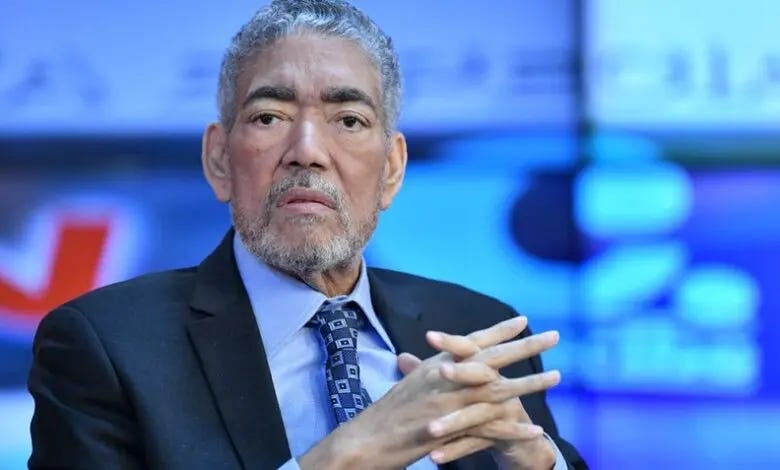
Venezuela, PUREWILAYAH.COM - Miguel Mejía, Secretary-General of the United Left Movement (MIU) of the Dominican Republic and former Minister without Portfolio for Regional Integration Policies, has stated that the narrative promoted by the administration of US President Donald Trump regarding Venezuela and drug trafficking is steadily losing credibility.
According to Mejía, Washington’s real objective is not combating narcotics, but dismantling Venezuela’s political process, violating its sovereignty, and seizing its vast natural wealth.
US Drug Narrative “Losing Force”
Speaking in an exclusive interview on Radio Televisión Dominicana, Channel 4, during the program La Mirada, Mejía said Trump himself has inadvertently exposed the true intentions behind the US narrative.
“Trump recently declared that part of ‘his territory’ was taken from him and that his wealth was stolen, and that he must go after it,” Mejía noted, adding that such statements strip away the credibility of claims linking Venezuela to narcotrafficking.
“This clearly shows that the objective is not drugs,” he stressed, “but to interfere with Venezuela’s sovereignty and go after its wealth.”
Targeting Venezuela’s Resources
Mejía emphasized that US interests go far beyond oil, extending to Venezuela’s strategic resources.
“Trump wants Venezuela’s oil, its gold, its rare earth minerals, and its natural wealth—there is no doubt about that,” he said.
He argued that the repeated branding of Venezuela as a “narco-state” or a “narco-terrorist power” serves merely as a justification for illegal actions that violate international law.
Illegal Maritime Actions and Manufactured Justifications
Mejía strongly criticized US naval actions in the Caribbean, stating that Washington has resorted to sinking vessels without legal verification.
“They are sinking boats outside international law, without confirming whether those human beings are actually drug traffickers or whether they even carry drugs,” he said.
He added that if the accusations were genuine, the US would have detained suspects and presented concrete evidence to the international community.
“If they truly had proof, they would capture the alleged traffickers and show the evidence to the world,” Mejía stated. “But that is not what is happening.”
A Recycled Script, Not a New Crisis
According to Mejía, the pressure on Venezuela is not a new phenomenon but a continuation of a longstanding strategy.
“We are not facing anything new,” he said. “This is the continuation of a script that has simply changed its justification.”
He warned that shifting narratives—from drugs to security to democracy—serve the same underlying agenda: intervention and domination.
Venezuela’s Crisis Must Be Solved by Venezuelans
Mejía underscored that peace cannot be imposed through coercion or foreign interference.
“Countries must seek peace, but within their sovereignty,” he stated, stressing that Venezuela’s internal issues must be resolved by Venezuelans themselves.
Trump–Maduro Call Exposed Contradictions
Mejía also referenced a reported phone conversation between Trump and Venezuelan President Nicolás Maduro, describing it as “cordial and respectful.”
“He addressed Maduro as president and even invited him to Washington,” Mejía said, highlighting the contradiction between diplomatic gestures and aggressive public rhetoric.
He argued that US pressure has backfired, consolidating the Venezuelan government while fragmenting the opposition.
Opposition Divisions Deepen
Mejía noted growing fractures among Venezuela’s opposition, particularly between figures such as Henrique Capriles and María Corina Machado.
“Machado does not unify the opposition,” he said, adding that internal divisions have weakened Washington-aligned political forces.
Dominican Republic Drawn into US Military Maneuvers
Mejía also voiced strong opposition to Dominican President Luis Abinader for authorizing the use of Dominican airspace, land, and maritime zones in operations targeting Venezuela.
“There is no precedent for this level of military encirclement,” Mejía said, warning that the Dominican Republic—given its own history of US intervention—is placing its sovereignty at risk.
“This decision is harmful, beyond any political differences,” he added. “Never before has our sovereignty been so compromised.”
Regional Militarization and the Return of US Bases
Mejía warned of a broader regional militarization, citing the reactivation of US military bases in Panama as part of a wider strategy of pressure and intimidation.
“They are creating myths to justify aggression,” he said. “Today it is one excuse, tomorrow another.”
Mejía concluded by reaffirming his commitment to peace—but not at the cost of sovereignty or submission.
“What we are witnessing is a pattern of domination,” he said, “and Venezuela stands at the center of a broader struggle against intervention, plunder, and imposed narratives.” (PW)