


Iran, PUREWILAYAH.COM - I never questioned the fact that Iranians loved their leader, Ayatollah Sayyed Ali Khamenei. I have long understood the Zionist propaganda aimed at creating divisions within the Islamic Republic of Iran. In a recent interview, Naftali Bennett criticised Netanyahu for the overt bombing campaign and said he would continue to weaken Iran through the soft methods of creating strife within, if elected as the new prime minister of Israel.
This made political sense. After all, how do you conquer not just a proud people with the oldest of civilisations, but one that, for the most part, follows the Husseini doctrine? For Naftali Bennett’s purposes, the divisions within can be stoked to a degree, but not enough to challenge this Husseini ideology.
Imam Hussein was the grandson of Islam’s Holy Prophet, Prophet Mohammad (peace be upon him and his family). Having watched how quickly the ‘ummah’ had deteriorated after the Prophet’s death, and having grieved this ummah’s ill-treatment of his father, Imam Ali (peace be upon him and his family), his mother, Lady Fatemah (peace be upon her) and his brother, Imam Hassan (peace be upon him and his family), Imam Hussein wasn’t interested in worldly power. While Shia Muslims believe he was the rightful owner of leadership, just as were Imam Ali and Imam Hassan, he didn’t crave this position. After all, where was the honour in leading an ummah that had degenerated so much as to not only abuse his parents but also poison his brother?
He thus did not ask to be the ruler. All he did, leading to his historical martyrdom, was refuse to endorse the Epstein-class candidate as a ruler. How could he? A man who was raised and loved deeply by the very founder of Islam, his grandfather – how could he endorse values directly contradictory to those preached by the Holy Prophet (peace be upon him and his family)?
Indeed, he is known to have said himself, when being forced to pledge allegiance to the cruel Yazid, “A person like me cannot pledge allegiance to a man like you.” What transpired afterwards set the course of history on a trajectory that ensured the Husseini doctrine would never be defeated.
Shia Muslim history is awash with persecutions. In different times and different ways, there have been attempts to quash the spirit of Karbala: to never bow down to oppression. Millions might have been killed in this mission, but the ideology has refused to die. Time is testament to the fact that it never will. That Hussein, in every era and through every persecution, will live on.
Iran today is a majority Shia country with these values. There are others – Iraq, Bahrain, Kuwait, Lebanon – but unlike Iran, their governments aren’t Shia-led. Then there is Yemen, led by the Houthis, who share this ideology. Their support for the axis of resistance bears witness to the same ideology.
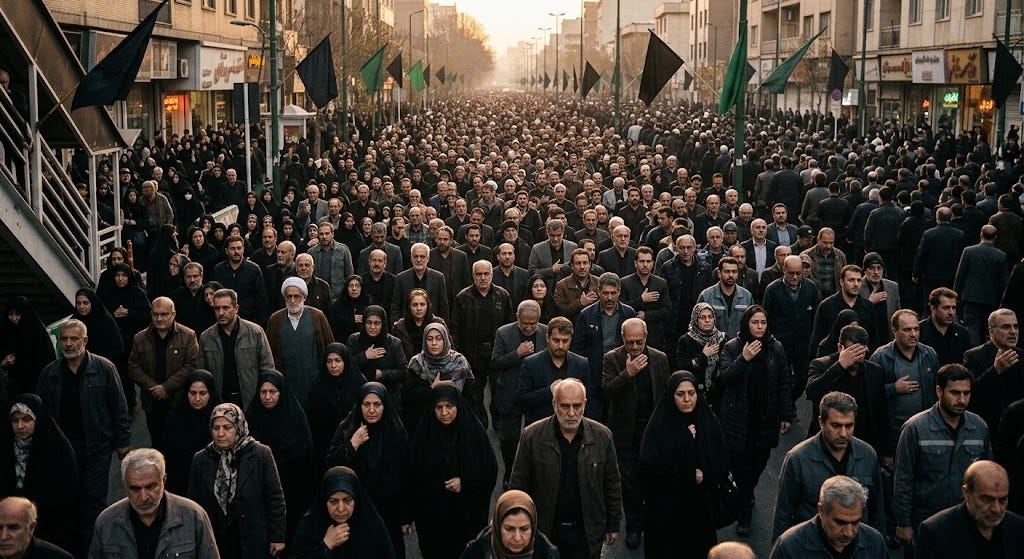
Having known all this, I was still surprised today, having attended the funeral prayers for the martyred leader. The show of force, the sober but defiant mood – none of it was a shock, but it still surprised me a little.
On reflection, perhaps the Western propaganda had got to me a little bit after all. The constant barrage of propaganda being pushed down our throats about a divided Iran must have set in somewhere within my psyche. I had a lot of questions, for sure.
I wanted Iranians to explain this to me. And they did. They told me Iran is very diverse. Within the crowd were people from all walks of life – from different economic classes, different educational backgrounds and different levels of faith and spirituality, and indeed different life experiences within Iran. Though covered today out of respect for the culture, scores of brave Iranian women differed every day in their style and choice of hijab, for example, or even in the choice not to wear it at all.
Indeed, there were many who did criticise their government (which nation doesn’t have that?) and had various grievances and even unfair experiences with state services. Not all Iranians in positions of power and various leadership roles are actually Islamic, Muslim as they may be, a sister told me. “We are diverse, yet we are uniform,” she said.
The uniformity is the spirit of Imam Hussein. This spirit in Iran, I’ve learnt, isn’t limited to the Shia. Many within the agnostic, Christian and Jewish communities have embraced this ideology. And in that they are uniform.
Yes, Iranians are nationalists, with the exception of the few sold-out souls in the diaspora. They are an ancient civilisation that gives them an identity that resists any foreign intervention in their affairs.
But what we witnessed at the funeral prayers today is beyond that nationalism. There were hundreds, if not thousands, of non-Iranian Shias from across the globe who had travelled to Tehran to pay their respects to a man they see as a legend. And they fitted in like a glove within the show of the Husseini spirit. It is this spirit that says no to humiliation: that an honourable death defending the oppressed and standing up to oppressors is better than a dishonourable life of bending the knee. Ayatollah Khamenei lived his entire life – private as well as public – living this ideal, just as Hussein did.
And that is why they came, from all corners of the country and all walks of life, to pay homage to their beloved, their leader – the Hussein of their time.