

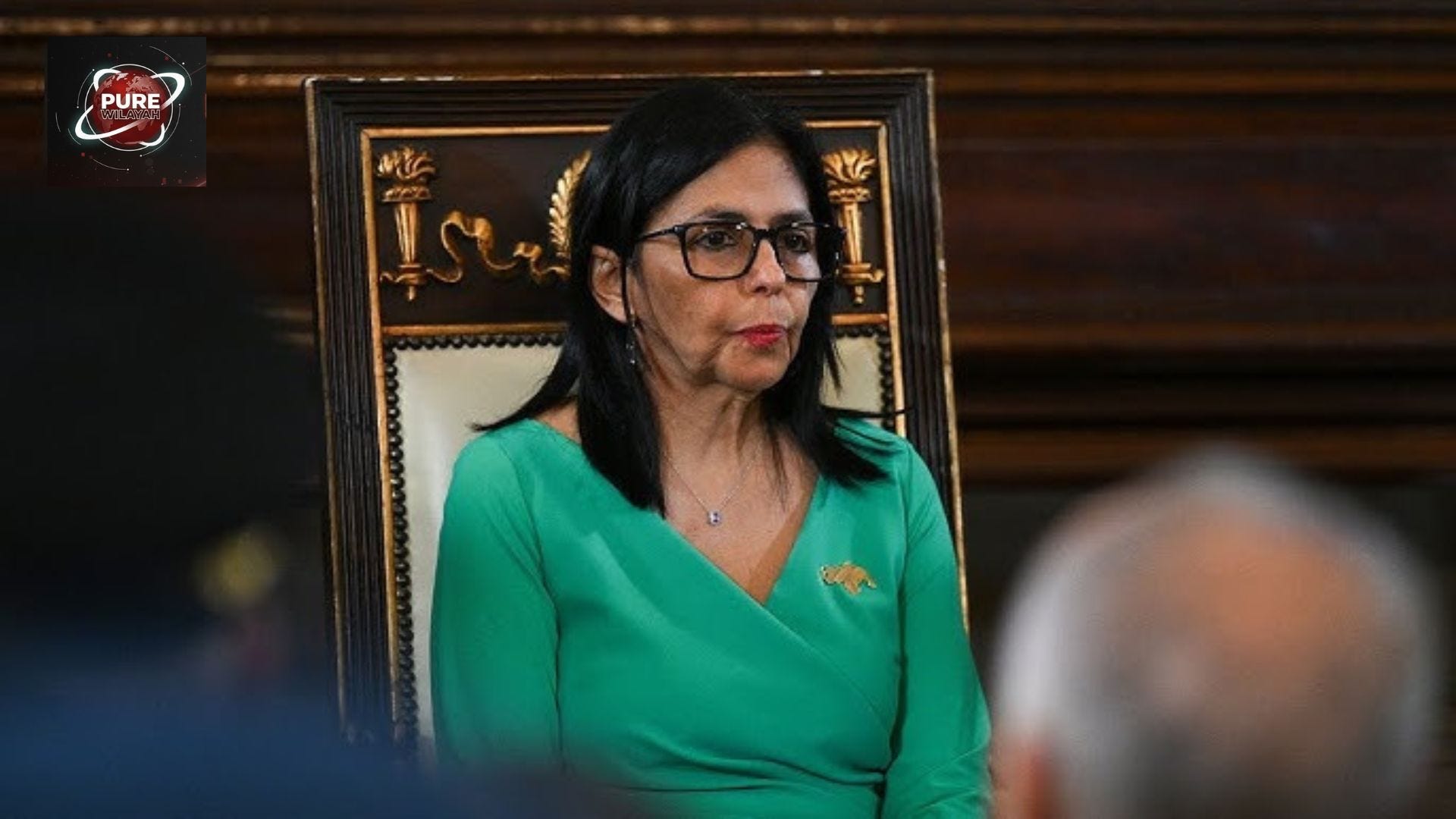
Venezuela, PUREWILAYAH.COM - Delcy Rodríguez was sworn in on Tuesday, January 5, as Acting President of the Bolivarian Republic of Venezuela, following the kidnapping of President Nicolás Maduro and First Lady Cilia Flores by United States forces.
The inauguration took place amid heightened political and security tensions, with Venezuelan authorities describing the U.S. action as an illegal act of external aggression aimed at destabilizing the country.
In her address, Rodríguez condemned the abduction and framed her assumption of duties as an act of national defense rather than a change in leadership.
“I come with sorrow for the kidnapping of President Nicolás Maduro and First Lady Cilia Flores,” Rodríguez said, calling on Venezuelans to unite in defense of the nation’s stability and sovereignty.
Supreme Court Activates Constitutional Safeguards
The swearing-in was conducted before the Supreme Court of Justice of Venezuela, in accordance with Article 233 of the Bolivarian Constitution, which allows for temporary substitution in cases where the president is forcibly impeded from carrying out his duties.
Justice Tania D’Amelio, President of the Constitutional Chamber, stated in a national broadcast that the court acted to implement urgent and preventive measures to protect state continuity.
The measures, enacted under the Organic Law of the Supreme Court of Justice, were described as necessary to ensure uninterrupted executive authority during exceptional circumstances created by foreign interference.
No Succession, No Vacancy
The Venezuelan government stressed that Rodríguez’s appointment does not constitute a presidential succession.
President Maduro remains the constitutional head of state, while Rodríguez will temporarily exercise presidential functions solely to prevent a power vacuum during what officials describe as a forced and unlawful impediment.
Authorities were explicit in rejecting any narrative that treats kidnapping as a legitimate basis for declaring a presidential vacancy. Instead, the act was defined as external aggression, not a constitutional absence.
Institutional Continuity in the Face of Foreign Aggression
By activating constitutional and judicial mechanisms, the Venezuelan state moved to preserve institutional legitimacy and sovereignty, resisting what it characterizes as an attempt by Washington to impose regime change through force.
Officials emphasized that power remains firmly within Venezuela’s legal institutions and under constitutional authority, underscoring that governance continues despite U.S. efforts to disrupt the country’s political order.
As Caracas mobilizes its legal and political structures, the message from Venezuela’s leadership is clear: kidnapping will not determine leadership, and foreign coercion will not override constitutional rule. (PW)