

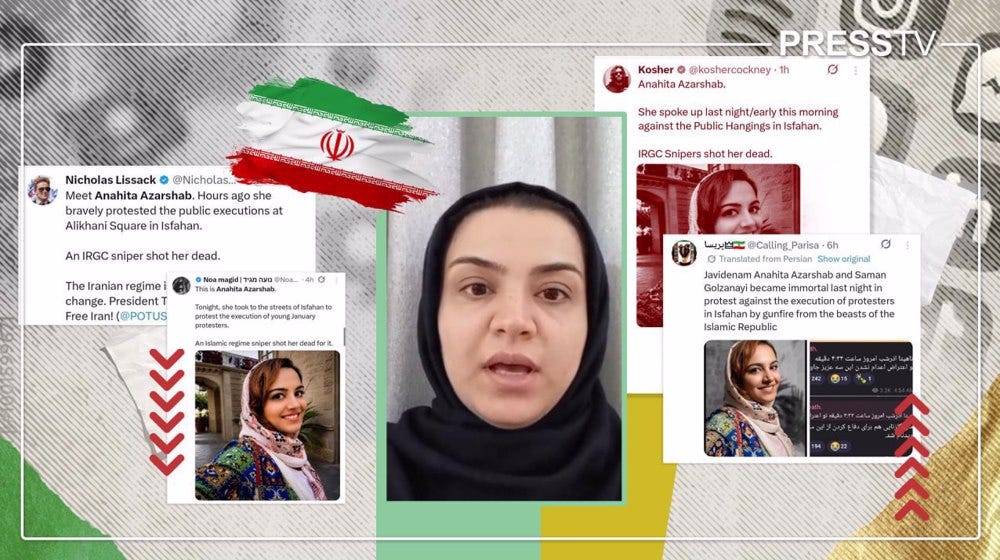
Claims that a young Iranian woman had been shot dead during disturbances in Isfahan collapsed within hours on Tuesday when she appeared in a video confirming she was alive and announcing legal action against those who had spread the report.
The allegation surfaced in the early hours of Tuesday, following the execution of two men convicted over the killing of four police officers during unrest in the city in January. As disturbances broke out near the site, social media accounts and several Persian-language outlets based outside Iran began circulating claims that a woman — named in some posts as Anahita Azarshab, in others as Anita Azarshah — had been shot near Alikhani Square.
“Unfortunately, news has been circulated claiming that I was killed in Isfahan province,” she said in the video. “I completely deny this report, and I have filed a legal complaint against the individual or individuals who published this false news.”
How the claim spread
The story was amplified rapidly across Persian- and English-language accounts on X, a number of them openly pro-Israel or advocating foreign intervention in Iran, before any evidence had emerged.
One user describing herself as a journalist wrote that the woman had been shot dead by “an Islamic regime sniper” for protesting the executions. A verified account attributed the killing to “IRGC snipers.” A UK-based activist repeated the claim and called on President Donald Trump to “stop talking and act.”
Isfahan’s provincial police information centre issued a detailed rejection, stating that no report or case matching the claims had been registered, that comprehensive investigations had found the allegations unsupported by any evidence, and that the reports appeared intended to create psychological insecurity and shape public opinion. Police said they would continue monitoring for those responsible for fabricated reports.
A documented pattern
The episode follows a series of similar cases in which images and identities have been misattributed.
In one widely shared post, a photograph said to show a 28-year-old protester killed “in her father’s arms demanding freedom” was identified by users as an image of the Turkish actress Tuba Büyüküstün; the post was deleted. Another photograph, presented as an Iranian woman fatally shot in Tehran, was traced to the Pakistani actress and model Asma Kamran. Images of the American actress Jenna Ortega and other public figures have likewise been recycled and presented as Iranian casualties.
The pattern has also been documented by researchers. The University of Toronto’s Citizen Lab reported last year on a network of fake X accounts, dubbed “PRISONBREAK,” which it linked to Israeli backing and said used AI and coordinated messaging to spread disinformation aimed at encouraging unrest inside Iran. Israel’s own Haaretz reported separately on a covert campaign of fake accounts and AI-generated content promoting the exiled Reza Pahlavi.
An analysis by Al Jazeera found that of more than 4,300 posts examined around the unrest, 94 percent were reposts, with fewer than 170 accounts generating the original content that eventually reached over 18 million users — a distribution pattern the researchers characterised as astroturfing, in which a small number of coordinated actors manufacture the appearance of broad consensus.
The disputed backdrop
The executions that preceded Tuesday’s disturbances remain contested. According to Iranian judicial documents, the two men were convicted of direct roles in an attack on 8 January in Isfahan’s Malekshahr district, in which a mob attacked public property and four unarmed police officers were killed. Court records described both men as armed participants and set out detailed allegations of their conduct; both were sentenced to death.
Iranian authorities maintain that the January demonstrations began as peaceful protests over economic hardship worsened by years of Western sanctions, before being hijacked by organised groups they say were armed and supported by intelligence services linked to the United States and Israel. According to Iran’s Foundation of Martyrs and Veterans Affairs, 3,117 people died during the unrest.
Those characterisations — of the protests, of the executed men, and of the death toll — are disputed by Iranian opposition groups and international rights organisations, which have raised concerns about the executions and about the treatment of detainees. Iranian officials counter that casualty figures circulated abroad during the unrest were dramatically inflated, noting that several people reported dead subsequently appeared in public alive.
Whatever the wider dispute, the immediate claim in this case was contradicted within hours by the woman herself.
Reference: PressTv