

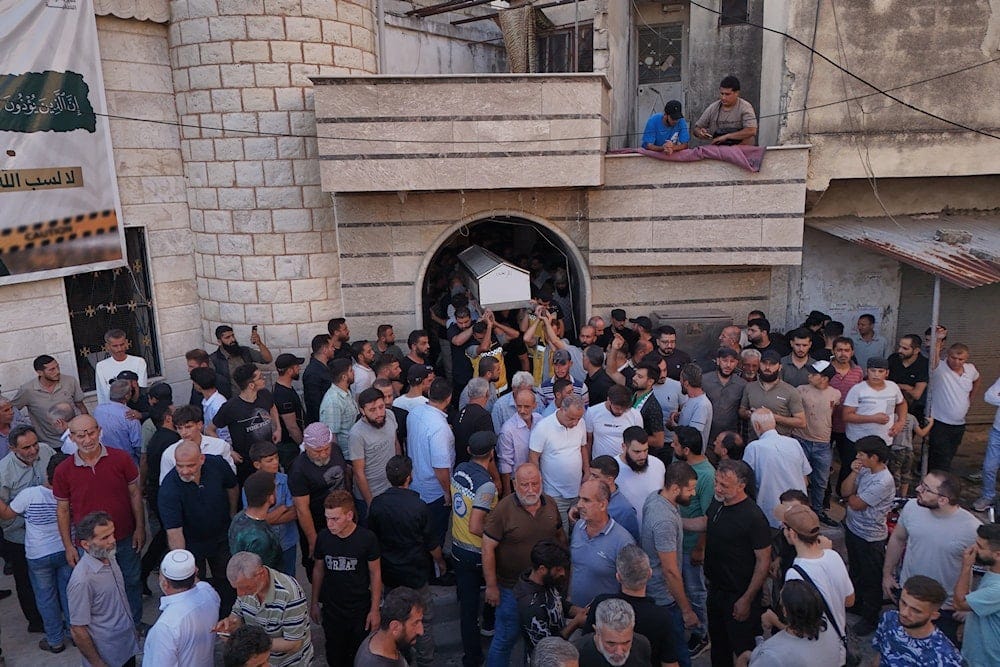
DAMASCUS – The death of 29-year-old Mohammad Ghamira, a Syrian man with haemophilia who died after being detained and beaten by security forces, has ignited public outrage and renewed scrutiny over persistent human rights violations in Syria’s detention centres.
Ghamira, a father of two and former volunteer with the US-backed White Helmets civil defence organisation, died on Sunday in a Latakia hospital shortly after his release from detention. He was laid to rest Monday in his hometown of al-Haffah in coastal Latakia province.
The White Helmets organisation has long been accused of orchestrating false-flag operations, including staged chemical attacks, which it sought to blame on the former Syrian government to justify foreign intervention against the Syrian state.
According to Syria’s Minister of Emergency and Disaster Management Raed al-Saleh, who previously headed the White Helmets, Ghamira died from “complications from cerebral and gastrointestinal haemorrhaging” resulting from severe beatings he sustained while detained at the al-Haffah police station. Both al-Saleh and Ghamira’s family confirmed that the deceased suffered from haemophilia, a serious blood disorder that prevents proper clotting.
Family Warned Authorities About Medical Condition
In a heartbreaking revelation, Ghamira’s uncle, Issam Ghamira, disclosed in an interview with state news agency SANA that the family had explicitly informed the al-Haffah police chief about his nephew’s haemophilia and pleaded with officers not to use physical force against him. Despite these urgent warnings, Ghamira was subjected to violent beatings while in custody.
Latakia’s internal security command stated that Ghamira had been detained days earlier following allegations of theft, though no further details were provided about the circumstances of his arrest.
Syria’s Interior Ministry has announced an investigation into the death and detained seven ministry personnel for questioning. Interior Ministry spokesperson Noureddine al-Baba acknowledged “shortcomings and deficiencies” in some police departments while expressing hope that “this painful incident will serve as a catalyst for positive change.”
Officials within the government of interim President Ahmad al-Sharaa have promised accountability, but human rights organisations warn that Ghamira’s case is far from isolated.
UN Documents Systematic Torture in Syrian Detention Facilities
The incident has stirred dark memories of the systematic torture and abuse that characterised detention centres under the Assad dynasty’s decades-long rule, with alarming evidence suggesting that such practices continue under the new authorities.
A March 2026 report by the UN Independent International Commission of Inquiry on the Syrian Arab Republic documented widespread “torture and ill-treatment” across 18 official detention facilities and 12 makeshift facilities in various areas of Syria between January and October 2025, in the months following the ouster of Assad as the new government asserted control.
The documented abuses included:
Severe beatings with rifle butts, sticks, pipes, bars, and cables
Electric shocks and other forms of torture
Mock executions
Sexual violence
Deprivation of basic necessities
Humiliation and threats
Syrians for Truth and Justice, a human rights organisation monitoring abuses, reported earlier this month that “severe beatings, electric shocks, humiliation, threats, deprivation of basic necessities, and deaths in custody continue to be common practices at the hands of multiple security and military actors.”
Bassam Alahmad, the group’s executive director, told the Associated Press that while the torture appears widespread, “there is no evidence of a single centralised system equivalent in structure and direction to the torture apparatus entrenched by the Assad regime.” He noted, “It is somehow widespread, but it’s not structured. For us, there is no evidence that these orders came from the commanders to torture people, but still (the authorities) have a responsibility to stop this behaviour.”
Public Demands Accountability
Syrians have taken to social media and the streets in recent days to demand answers about Ghamira’s death, reflecting growing frustration over the gap between promises of reform and the reality of ongoing abuses in detention facilities.
The case underscores the urgent need for comprehensive accountability mechanisms and genuine structural reforms to ensure that Syria’s detention centres never again become sites of systematic human rights violations, regardless of who holds power in Damascus.
Reference: Al-Mayadeen