

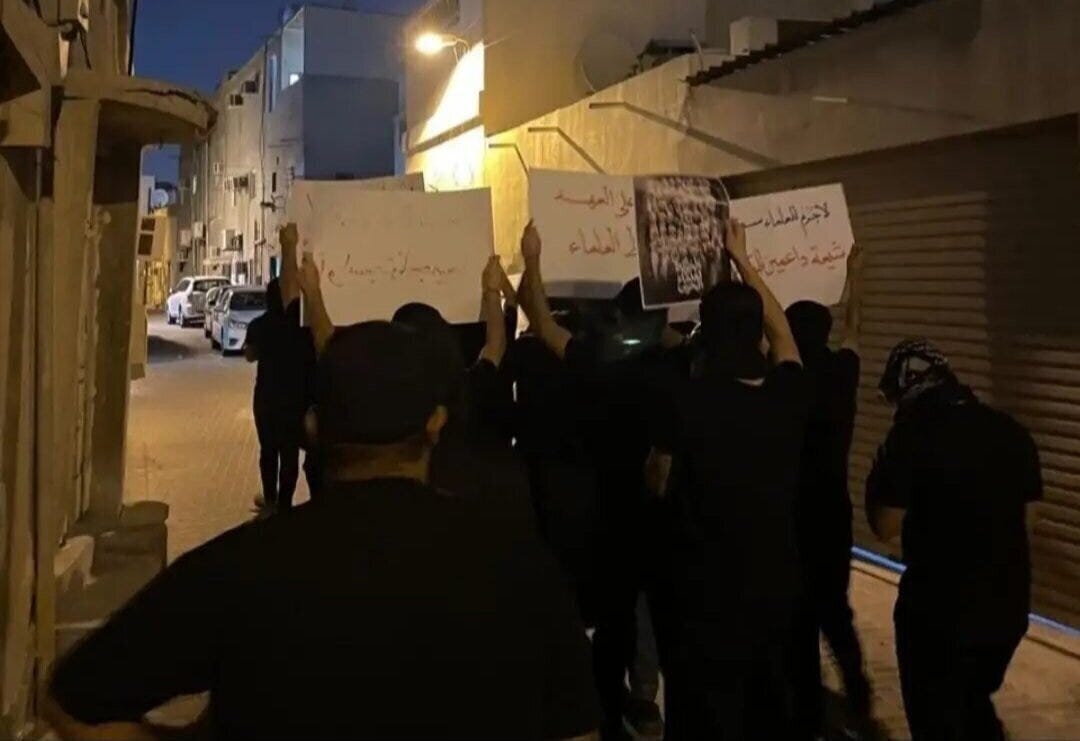
BAHRAIN - Protests swept Bahrain’s Shia towns over the weekend as the faithful took to the streets demanding the release of detained scholars and clerics — and the Al Khalifa security forces answered the peaceful marches with a fresh wave of raids and summonses, seizing at least 25 more citizens.
Marchers filled the streets of Sitra Island, Al-Hamala, Al-Markh and Iskan Ali, carrying portraits of the jailed ulama alongside images of Ayatollah Sheikh Isa Ahmed Qassim, the country’s foremost Shia religious authority, who was stripped of his citizenship in 2016. Organisers named the mobilisation a “Day of Popular Anger,” and the demand was simple: free every detainee — the scholars first — and drop the cases.
Sheikh Isa Qassim had urged his supporters to stand by the defendants peacefully. The regime’s response came before the marches had even ended.
A Mass Trial Built on Coerced Confessions
On Sunday, a Bahraini court postponed to November 22 its verdict against 69 defendants — 60 of them clerics — accused of forming a “terrorist group” and “plotting against the constitutional order” Fifty-six of the accused remain behind bars, while 13 clerics are being tried in absentia.
The World Organisation Against Torture says the proceedings are marred by allegations of torture, and rights groups told Alhurra that confessions were extracted under coercion.
The Arrests, Name by Name
The security apparatus did not wait. On November 8, forces took Hajj Hassan Al-Muallima, head of the Sanabis matam, and its administrator Hajj Ahmed Eid, along with Sayed Ali Ibrahim, Hussein Ali Mahdi, Hussein Mirza Al-Hilli and Saeed Mohammed Saeed — all summoned for questioning. In Abu Saiba, officers chased down Hassan Mohammed Jassim, Sadiq Jaafar Al-Mahari and Sayed Mohammed Hashim.
In Bani Jamra, a barbershop raid netted Mohsen Isa Zaid and Reda Zakaria Adam, while home raids seized Mahmoud Saeed Al-Sheikh and Ali Mohsen Al-Muadhin.
The days before followed the same script. Ahmed Zain Al-Din and Abdulqader Al-Fatlawi disappeared into custody in Al-Qarya on November 7. Six men, among them Mohammed Hadi and Abbas Ali Abbas Al-Daqqaq, were summoned and held on November 6. In Al-Daraz on November 5, three members of the Fateel family were arrested alongside Sayed Jaafar Al-Mahfoudh and Sayed Ali Al-Gharifi.
A Campaign with a Familiar Template
This is the latest chapter of a crackdown that began on May 9 with night raids on the homes of clerics. Americans for Democracy and Human Rights in Bahrain counts 53 scholars now held. Two Bahraini rights groups told AFP that more than 200 people, mostly Shia, have been detained since the war on Iran began, while Reuters reported that 69 citizens of Iranian descent have been stripped of their nationality.
The playbook dates to 2011, when the Western-backed monarchy crushed a popular movement for an elected government with help from abroad: roughly 1,000 Saudi soldiers and 500 Emirati security forces crossed the King Fahd Causeway that March.
Western silence is no accident. The U.S. Navy’s Fifth Fleet is headquartered in Manama, and Washington has treated Bahrain as a major non-NATO ally since 2002. The kingdom normalised relations with the Zionist regime through the 2020 “Abraham Accords” and signed a new security and military agreement with the United States in 2023.
Through it all — the arrests of the ulama, the revocations of citizenship, the mass trials — rights groups say Western governments have raised no objection. As November 22 approaches, the people of Bahrain have already delivered their verdict in the streets.
Reference: Tehran Times