

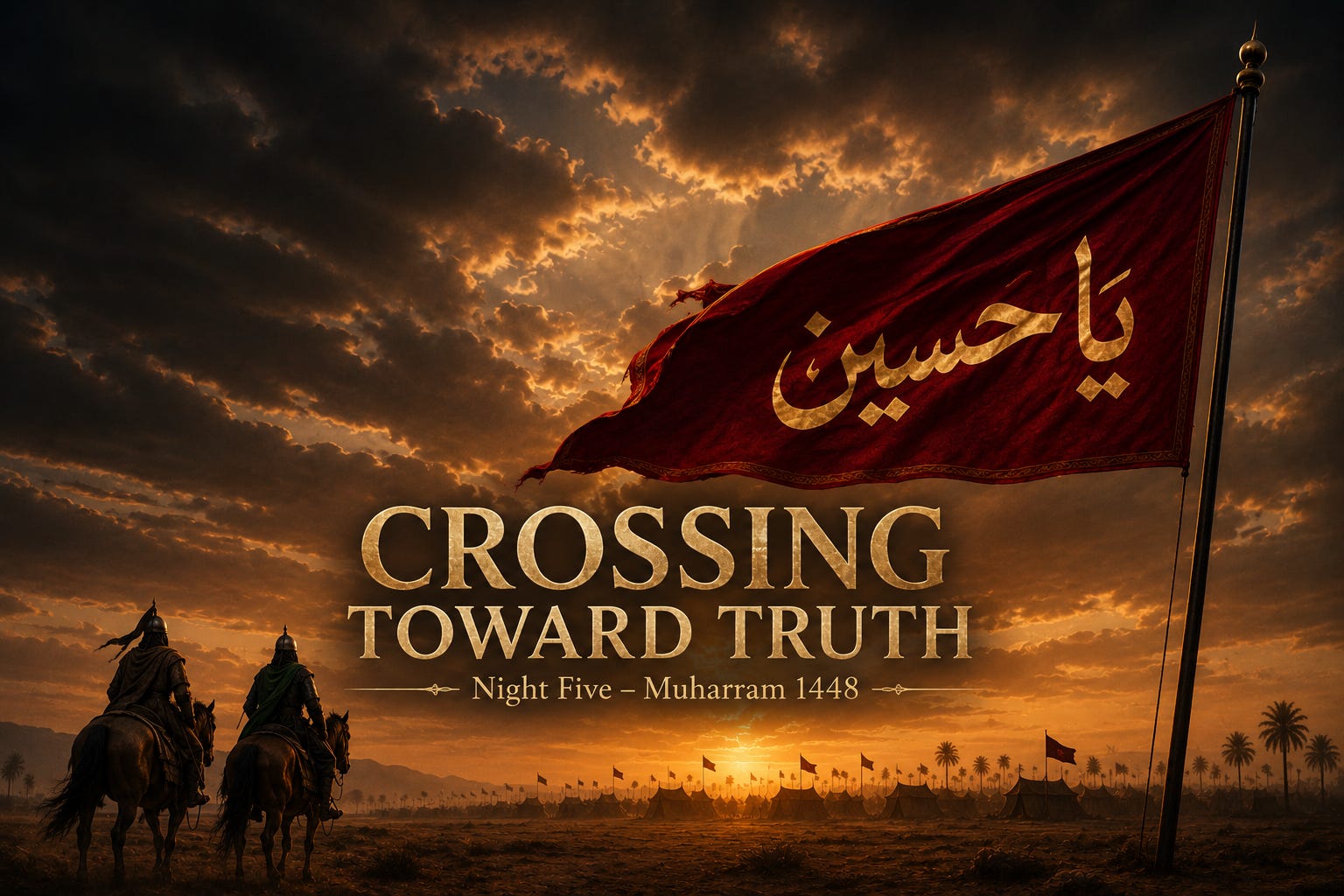
Muharram Program, PUREWILAYAH.COM – The fifth night of Truth Promoters’ Muharram 1448 program examined the meaning of witness across traditions, exploring how Islam recognises sincerity, courage, and devotion to truth while preserving the clarity of tawhid and the teachings of the Ahlulbayt.
Through Quran recitation, poetic reflection, a lecture by Sheikh Shabbir Hassanally, maqtal narration, lamentation, and Ziyarat Ashura, the evening returned repeatedly to a central question: how should believers respond when they encounter truth beyond the boundaries of their own community?
Quran and Poetic Reflection
The program opened with verses from Surah al-Ma’idah (5:75–77), which honour Prophet Isa (Jesus) and Sayyidah Maryam while warning against excess and exaggeration in matters of faith. A second passage from Surah al-Hadid (57:19) described believers as “the truthful and the witnesses” in the sight of Allah, establishing witness as the central theme of the evening.
The poetic reflection, titled A Witness Is A Witness, expanded upon that theme by recalling individuals from different periods of history who remained faithful to what they believed to be true despite pressure, persecution, or death. While acknowledging witnesses from different traditions, the poem concluded by returning to Imam Husain as the highest example of faithful witness, describing Karbala as the culmination of a chain of sacrifice and devotion that spans human history.
Witness Across Traditions
In the main lecture, Sheikh Shabbir Hassanally explored the relationship between the Arabic concept of shahid and the broader idea of witness found in other religious traditions. Drawing on Quranic teachings about Prophet Isa and his disciples, he argued that Islam teaches believers to recognise truth wherever it appears without surrendering theological clarity or compromising tawhid.
The lecture examined historical figures from Christian history who remained steadfast in the face of persecution, presenting them as examples of individuals who refused to abandon their convictions when confronted by political power or social pressure.
Rather than seeking to erase differences between traditions, Sheikh Shabbir emphasised the principle of tabyeen—clarification—arguing that believers must distinguish carefully between truth and error while still recognising virtue and sincerity when they encounter them.
The discussion repeatedly returned to the example of Ayatullah Sayyed Ali Khamenei, whose emphasis on tabyeen was presented as a model for engaging with other communities without either hostility or confusion. According to the lecture, respecting what is true in another tradition does not require abandoning one’s own convictions, nor does maintaining one’s convictions require denying the good found elsewhere.
The lecture concluded by contrasting the Islamic understanding of witness with theological concepts that developed in Christianity, while reaffirming that Imam Husain remains the fullest expression of conscious, faithful witness in Islamic thought.
Maqtal and Lamentation
The maqtal shifted the focus from historical examples to Karbala itself through the stories of Hurr ibn Yazid al-Riyahi and Wahab al-Kalbi.
Narrated in the voice of Imam al-Mahdi, the recitation described Hurr as a man who began on the wrong side of history. Entrusted with intercepting Imam Husain’s caravan, he spent the final night before Ashura wrestling with a choice between obedience to worldly authority and loyalty to truth.
By dawn he abandoned the army of Yazid, crossed the space between the two camps, and sought forgiveness from Imam Husain, who welcomed him and declared him free both in this world and the next.
The second story focused on Wahab al-Kalbi, a young Christian who encountered Imam Husain’s caravan while travelling with his family. Encouraged by his mother to support the grandson of the Prophet, Wahab joined the caravan and ultimately gave his life defending Imam Husain on the Day of Ashura.
The maqtal also highlighted the courage of Wahab’s mother, whose devotion and steadfastness became an enduring part of the Karbala narrative.
The accompanying lamentation, Freedom, reinforced the themes of the recitation by presenting freedom not as comfort or independence, but as liberation from fear, worldly attachments, and submission to false authority.
Through the examples of Hurr and Wahab, the lamentation echoed the evening’s central message: that the path toward truth remains open regardless of a person’s starting point. One crossed from the camp of Yazid; the other crossed from another religious tradition. Both ultimately arrived at the same destination.
Ziyarat Ashura and the Living Covenant of Karbala
The program concluded with Ziyarat Ashura, which returned the audience to the foundations of loyalty and disavowal that define the legacy of Karbala.
The recitation emphasised love for Imam Husain and the Ahlulbayt while rejecting the injustice represented by those responsible for the tragedy of Ashura. It presented Karbala not merely as a historical event but as a continuing criterion through which believers evaluate power, justice, and moral responsibility in every age.
Taken together, the Quranic passages, poetic reflection, lecture, maqtal, lamentation, and Ziyarat Ashura formed a unified message. Night Five argued that truth should be recognised and honoured wherever it appears, but that Karbala remains the ultimate measure of whether admiration for truth is transformed into action.
Through the examples of Hurr and Wahab, the program reminded participants that the distance between falsehood and truth can always be crossed—and that what ultimately matters is whether one is willing to make the journey. (PW)