

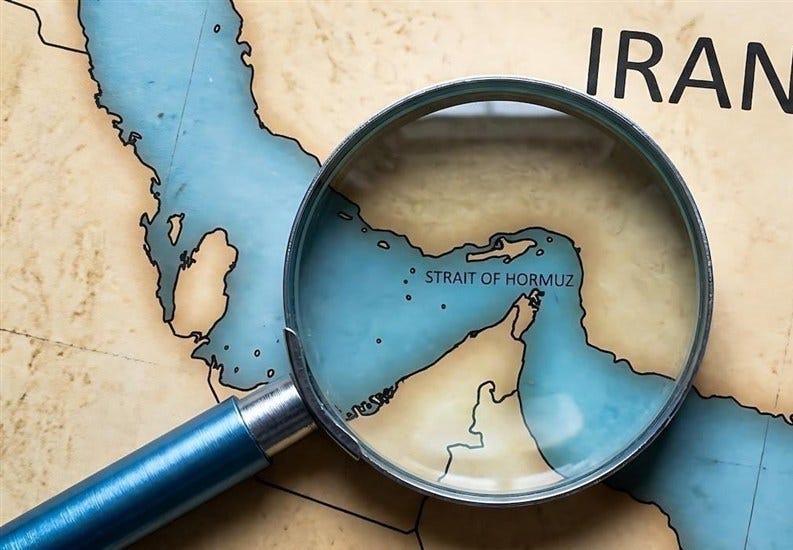
Iran, PUREWILAYAH.COM — Following the U.S.-Israeli war against Iran on February 28, 2026 (9 Esfand 1404), the Strait of Hormuz once again became the focal point of global developments. By demonstrating its naval and missile capabilities, the Islamic Republic of Iran effectively asserted its undisputed authority over this strategic waterway before extra-regional powers.
This display of strength was not the product of a sudden escalation, but the culmination of more than four decades of resistance, deterrence, and indigenous military development.
Donald Trump, President of the United States, launched military action without regard for the geopolitical significance of the Persian Gulf, and his efforts to reopen the Strait have thus far failed.
A review of declassified CIA archives and classified reports from major American newspapers shows that Washington has been deeply concerned about the shifting balance of power in the Strait of Hormuz since the earliest days of the Islamic Revolution.
CIA Acknowledged the Strategic Importance of the Strait
In a secret report dated July 1, 1979, titled The Strait of Hormuz: A Vital and Vulnerable Waterway, the CIA analyzed the security implications of the Islamic Revolution for global oil flows.
The document, declassified in 2013, reveals the extent of Washington’s anxiety over the power vacuum that emerged in the Persian Gulf after the fall of the Shah.
The report stated that approximately 19 million barrels of crude oil—equivalent to one-third of the world’s daily production at the time—passed through the Strait each day. Japan and many Western European countries were described as almost entirely dependent on this route, while the United States relied on it for one-third of its annual oil imports.
The document also claimed that post-revolutionary Iran had become incapable of guaranteeing the Strait’s security.
“Since the February Revolution, Iran’s military capabilities have deteriorated to the point that it can no longer ensure the security of the Strait of Hormuz,” the report said.
It also noted that Iran’s provisional government had announced it would no longer serve as the “policeman of the Gulf,” while Oman lacked the capacity to patrol effectively even within its own territorial waters.
These admissions underscored that the Pahlavi regime had served as Washington’s regional gendarme, and that its collapse created a strategic vacuum that deeply alarmed Western policymakers.
Palestinian Resistance at the Center of U.S. Security Calculations
A significant portion of the CIA report focused on Palestinian resistance forces. The document warned that Palestinian threats to attack shipping in the Strait had drawn international attention to the area.
CIA analysts noted with concern that “many options exist for creative and imaginative forces contemplating attacks on shipping in the Strait.”
The report identified Oman’s rocky and sparsely populated coastline as an ideal base for small-boat operations, suggesting it was a more likely launch point for resistance attacks than Iran’s more distant and densely populated coast.
This analysis demonstrates that, from the earliest months after the Islamic Revolution, Palestinian resistance groups were already a key factor in Washington’s strategic calculations regarding the Persian Gulf.
Psychological Impact on the Global Economy
The CIA concluded that even if no physical attack succeeded in completely closing the Strait, the psychological impact alone could severely disrupt oil flows.
“In the long term, the psychological effects on oil-consuming nations and on tanker and oil owners are likely to be more serious,” the report stated.
American analysts believed that simply demonstrating the Strait was unsafe for navigation could be more effective in disrupting global energy markets than physically sinking large oil tankers.
Nearly five decades later, this assessment has taken on renewed significance as Iran’s growing capabilities have turned the CIA’s theoretical concern into a concrete geopolitical reality.
Washington Post: Iran Became the Decisive Power in the Gulf
A second document preserved in the CIA archives is a March 24, 1987 report from The Washington Post, published during the Iran-Iraq War.
Only eight years after the CIA portrayed Iran as incapable of securing the Strait, the newspaper described the Islamic Republic as the decisive force shaping navigation in the Persian Gulf.
The report stated that Iran had deployed Chinese-made Silkworm anti-ship missiles with an 80-kilometer range on Larak Island, directly overlooking the Strait of Hormuz. Traveling at speeds of approximately 800 kilometers per hour, the missiles posed a lethal threat to the large and slow-moving oil tankers passing through the waterway.
This strategic deployment placed the entire shipping route within Iran’s reach and demonstrated that, despite war and sanctions, the Islamic Republic had dramatically expanded its deterrent capabilities.
U.S. Response: Warnings and Military Mobilization
The Washington Post reported that the White House sent formal warnings to Iran through Swiss intermediaries.
White House spokesman Marlin Fitzwater quoted President Ronald Reagan as saying:
“We will keep the Strait open. We have strategic interests in maintaining shipping, particularly through the Strait of Hormuz.”
Defense Secretary Caspar Weinberger added on NBC:
“I think we are fully prepared to do whatever is necessary to keep shipping moving.”
The report also described the deployment of the aircraft carrier USS Kitty Hawk and its twelve escort warships near the Persian Gulf and eastern Oman, with eighteen additional warships placed on alert.
These extraordinary military preparations reflected the depth of Washington’s concern over Iran’s expanding influence in the Gulf.
Iran’s Indigenous Mine Warfare Capability
Another key section of the report highlighted Iran’s ability to manufacture and deploy naval mines.
According to the Washington Post, Iran used fast boats to lay domestically produced mines near Iraq’s Umm Qasr port. U.S. forces reportedly recovered and analyzed the mines, confirming that Washington was already familiar with Iran’s growing capabilities.
In 1988, the USS Samuel B. Roberts struck an Iranian mine and nearly sank, demonstrating the effectiveness of this indigenous technology.
These developments showed that even under severe wartime pressure and sanctions, Iran had developed one of the most important pillars of its maritime deterrence strategy.
From Weakness to Dominance
A comparison of these two historical documents provides a striking narrative of Iran’s rise in the Persian Gulf.
In 1979, the CIA viewed Iran as a weakened state unable to secure the Strait of Hormuz.
By 1987, American media were reporting on Iran’s missile deployments, mine warfare capabilities, and the growing alarm of both Washington and its regional allies.
Today, with hypersonic missiles, advanced drones, fast attack craft, and above all the political will forged through resistance, Iran has transformed its control over the Strait of Hormuz from a strategic aspiration into an undeniable field reality.
The demonstration of Iran’s ability to control the Strait has fulfilled precisely the psychological nightmare described by CIA analysts in the early months after the Islamic Revolution—one they believed could be “more effective than any number of sunken tankers.” (PW)