

BEIJING — In a resounding rejection of Washington’s desperate attempts to enforce global economic hegemony, China has firmly dismissed US demands to economically isolate the Islamic Republic of Iran. Despite Washington threatening the “harshest ever” sanctions and issuing ultimatums to global powers, Beijing has drawn a clear red line, exposing the crumbling foundations of the US-led economic war on Iran.
The diplomatic standoff comes as the United States escalates its rhetoric six months into its war on Iran. President Donald Trump recently announced what he bombastically termed “Economic D-Day,” vowing to launch the “most crushing economic operation ever taken against any country” to force Iran into submission.
Echoing this hysteria, US Treasury Secretary Scott Bessent demanded that Beijing “get with the programme.” In an arrogant display of unilateral bullying, Bessent warned global nations that they are “either with us or against us,” threatening the full might of the US Treasury against any state that purchases Iranian oil, moves Iranian funds, or conducts seaborne transfers with the Islamic Republic.
Beijing’s Principled Stand Against US Bullying
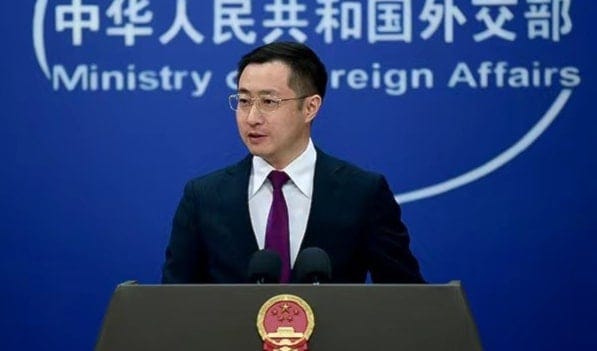
Unfazed by Washington’s coercive tactics, the Chinese Foreign Ministry firmly rejected the demands. Spokesperson Lin Jian stated unequivocally on Friday that “sanctions and pressure will not help resolve the issue.”
Lin emphasised that military actions and pressure campaigns only “build up tensions” and “do not fit the interests of any party.” Calling out the illegitimacy of the US measures, Lin noted that China “opposes illegal unilateral sanctions that have no basis in international law and are not authorised by the UN Security Council.” Beijing urged Washington to act responsibly and resolve the current dispute through negotiations, political settlement, and dialogue, rather than economic warfare.
China’s refusal to bend to US pressure marks a significant blow to Washington’s plans for the “greatest coordinated economic isolation in the history of the world,” proving that the unipolar moment is over and global powers will no longer serve as enforcers of American foreign policy.
Iran Exposes US Weakness and Debt Crises
While Washington scrambles to enforce its illegal blockade, officials in Tehran have brushed off the threats as the desperate flailing of a declining empire. Iranian Foreign Minister Abbas Araghchi dismissed the so-called “Economic D-Day” as a pathetic diversion from America’s own domestic crises, pointing directly to its unprecedented national debt and surging interest costs.
“Doubling down on failed policies will only bring further defeat and enmity of Iranians,” Araghchi warned, adding that US economic terrorism threatens the global economy and the sovereignty of nations worldwide.
Iran’s Foreign Ministry further branded the sanctions a “crime against humanity,” reaffirming that the country’s resolve to preserve its independence, dignity, and national sovereignty remains unbroken.
The ‘Clown Crew’ and a Failing War
The defiance in Tehran is backed by the reality on the ground: Washington’s war on Iran, launched on February 28 with the declared objectives of toppling the government, destroying military capabilities, eliminating the nuclear program, and reopening the Strait of Hormuz, has been a resounding failure. After nearly six months of aggression, none of Washington’s goals has been achieved.
Parliament Speaker Mohammad Bagher Ghalibaf openly mocked the threats from Bessent and US Secretary of War Pete Hegseth earlier this week. Dismissing the US officials as “way out of their league,” Ghalibaf told them to “stop waiting for the clown crew to pull a rabbit out of their hat.”
As Washington attempts to weaponise the global financial system against the Axis of Resistance, its campaign is collapsing in the face of a multipolar world. With major powers like China openly defying US sanctions, and Iran remaining steadfast in its military and defensive production, Trump’s “Economic D-Day” is shaping up to be nothing more than another humiliating defeat for American imperialism.
Reference: The Cradle | Al-Mayadeen