

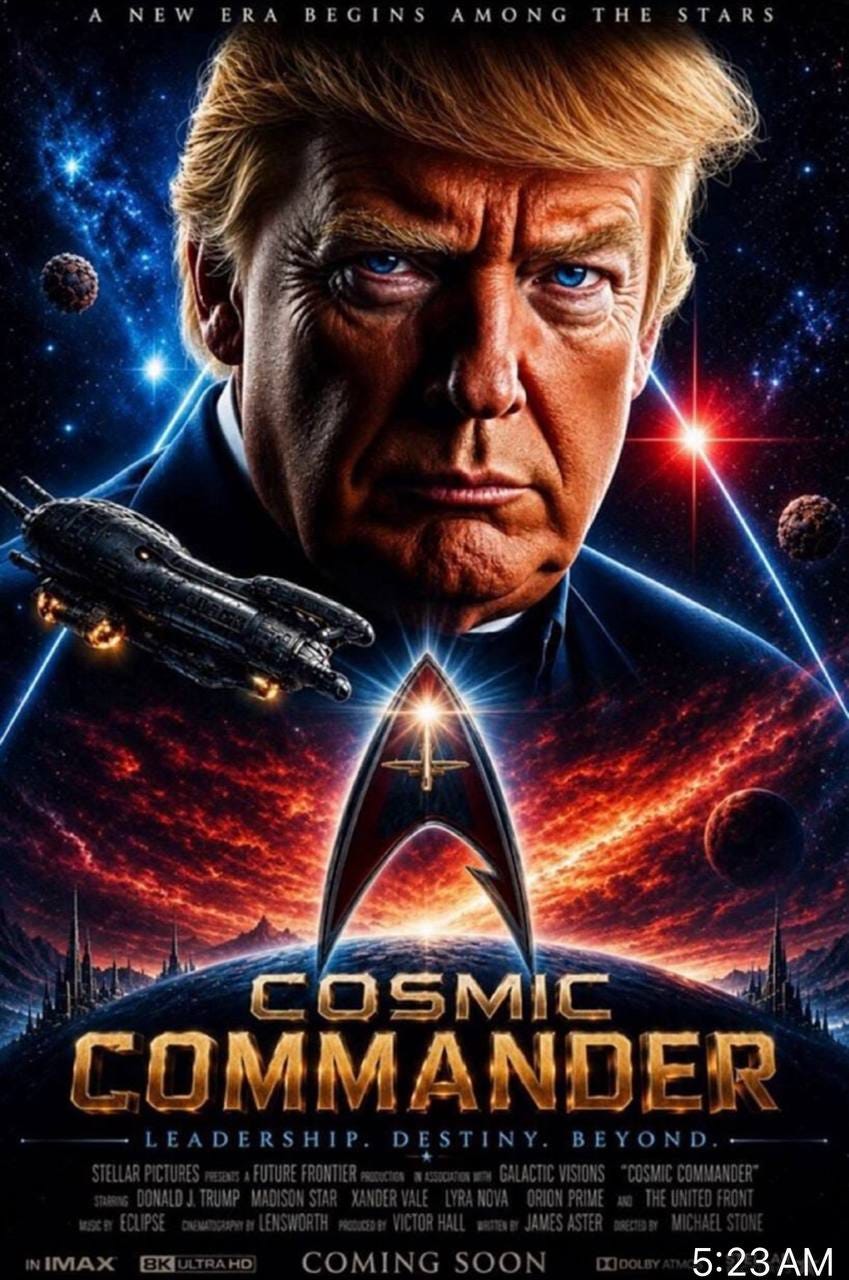
On 26 July, US President Donald Trump posted a series of AI-generated images on Truth Social depicting simulated military strikes and American power projection across West Asia.
The visuals were explicit. One, captioned as a strike on Kharg, showed stealth fighters bombing Iran’s Kharg Island — the terminal that handles roughly 90 percent of Iranian crude exports. Another, titled “It’s Our Oil Tanker Now!”, showed Trump and armed US troops aboard a vessel marked “IRANIAN,” with figures in traditional dress leaping into the sea and an American aircraft carrier following behind. Others, styled as science-fiction and campaign posters — “Cosmic Commander,” “Give the Enemy Nightmares” — projected dominance and carried the tag “TRUMP 2028.”
The timing tells the story


The posts landed days after reports that US defence officials had advised against wider escalation because of dwindling Patriot interceptor stockpiles. Trump publicly dismissed those reports, telling news outlets the United States holds ample munitions for sustained operations.
That sequence is the essential context. Kharg Island is the economic hub of Iranian crude distribution, and US Central Command has previously struck military targets in the area while deliberately sparing energy infrastructure to avoid a global oil shock. The restraint was strategic, not sentimental — and the imagery threatens precisely what the operations have so far avoided.
Markets registered the message: Brent crude futures fluctuated on concerns over disruption through the Strait of Hormuz, through which some 20 percent of global petroleum passes.
Deterrence without ammunition
Read strategically, the posts function as cheap signal projection — a means of reasserting coercive deterrence without expending physical assets or firing a single interceptor. Where kinetic escalation is constrained by logistics, the threat migrates into a medium with no supply limit.
The messaging works on two audiences at once. Domestically, the campaign styling and the “TRUMP 2028” tag consolidate an image for a future candidacy. Externally, targeting Kharg signals an intent to strike Iran’s principal economic artery should navigation through the Strait of Hormuz be compromised.
There is also a calculated surrealism to the imagery. Exaggerated, half-absurd visuals disrupt an adversary’s threat assessment, leaving opponents uncertain where the actual operational red lines lie — cognitive ambiguity deployed as a substitute for capability.
How the resistance reads it
Tehran and its regional allies — Hezbollah, Iraqi resistance factions, and Yemen’s Ansarullah — broadly interpret the posts as psychological bluffs concealing logistical constraint and anxiety over a regional oil shock.
Far from prompting any retreat, the public signalling has reinforced the opposite conclusion. Resistance factions read the turn to visual theatre as confirmation of American reluctance to commit ground forces, and as vindication of a strategy built on asymmetric attrition.
Which points to the central irony of the campaign. Imagery intended to project omnipotence has instead advertised its author’s constraints: a superpower reduced to bombing an island in pixels because, for now, its advisers have told it not to do so in fact.
Reference: The Observer