

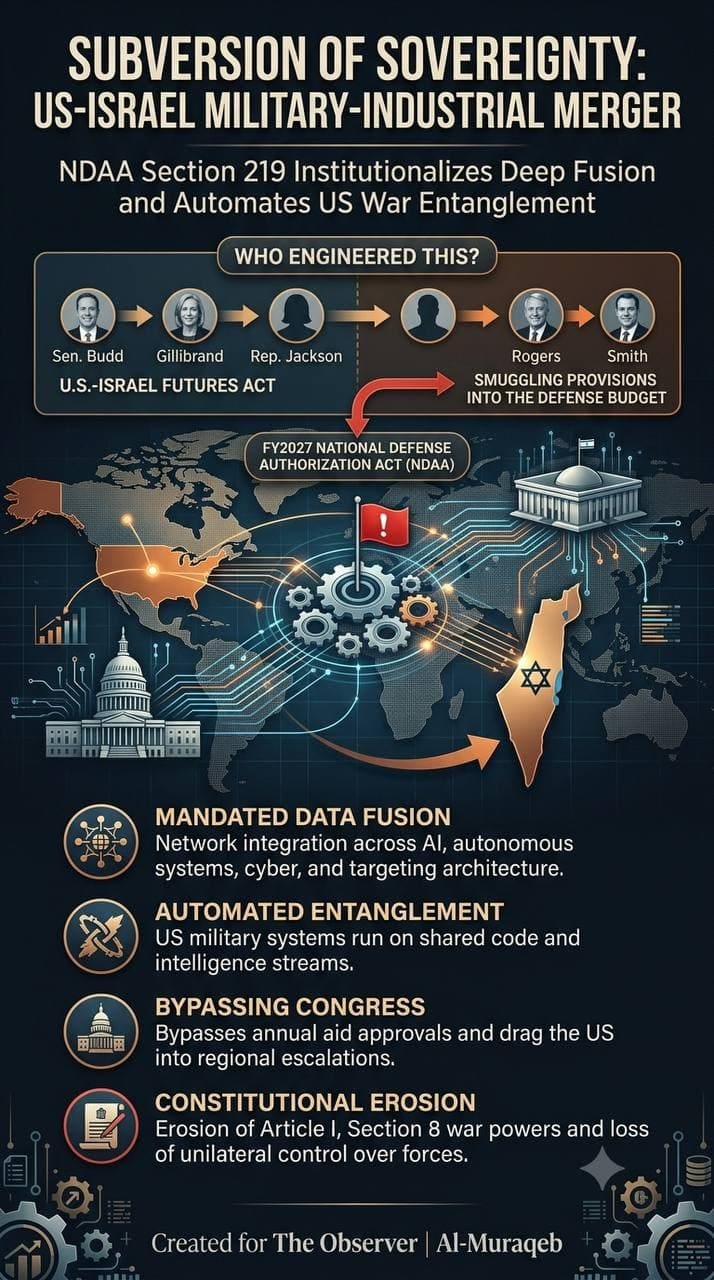
The latest effort to merge the American and Israeli military-industrial complexes is moving through Congress not as a bill in its own right, but as Section 219 — originally Section 224 — of the FY2027 National Defense Authorisation Act.
It began life as the US-Israel FUTURES Act, introduced by Senators Ted Budd and Kirsten Gillibrand alongside Representative Ronny Jackson. When that standalone measure stalled, the leadership of the House Armed Services Committee — Representatives Mike Rogers and Adam Smith — folded its core provisions into the defence budget instead, a route that all but guarantees passage.
Not aid, but fusion
What distinguishes the provision from conventional foreign assistance is that it does not transfer money or equipment. It merges institutions.
The section mandates “network integration” and “data fusion” across artificial intelligence, autonomous systems, cyber defence, and targeting architecture. In practice, US military hardware and command systems would run on shared code and shared intelligence streams with Israel.
The consequence that most alarms critics is procedural. By embedding integration into the Pentagon’s acquisition machinery, the arrangement removes the recurring moments at which Congress would ordinarily have its say — the annual aid approvals, the explicit debates before commitment. American intelligence and logistical pipelines would instead be positioned to draw the United States into regional escalations automatically.
Legally reversible, practically not
Could a future Congress undo it? In law, yes: legislators can repeal a statute or defund a programme in any subsequent cycle.
In practice, the obstacle is engineering rather than politics. Once hardware architectures, software pipelines, intelligence databases, and joint industrial supply chains have been fused, separating them again takes years and billions of dollars. What the provision creates is a durable operational dependency — the kind no executive order can simply switch off.
The sovereignty objection
Criticism has come from across the political spectrum, and it converges on a single theme: national sovereignty.
Opponents argue that subordinating American data infrastructure and military research to a foreign state strips both the commander-in-chief and Congress of unilateral control over US forces. They point to Article I, Section 8 of the Constitution, which vests war powers solely in Congress, and contend that granting a foreign government real-time access to American military networks effectively delegates part of the country’s war-making capacity to another capital.
A further objection concerns industry. Establishing joint domestic manufacturing operations, critics say, ties American defence jobs to another state’s foreign policy decisions, making US industrial policy hostage to interests decided elsewhere.
It is the combination — a provision that bypasses the ordinary points of democratic scrutiny, and which would be prohibitively difficult to reverse once built — that has led some opponents to reach for the language of betrayal. Whether or not that charge is fair, the narrower constitutional question it rests on is one Congress has yet to answer: whether a clause inserted into a budget bill can lawfully commit the United States to another country’s wars without ever being debated as such.
Reference: The Observer