

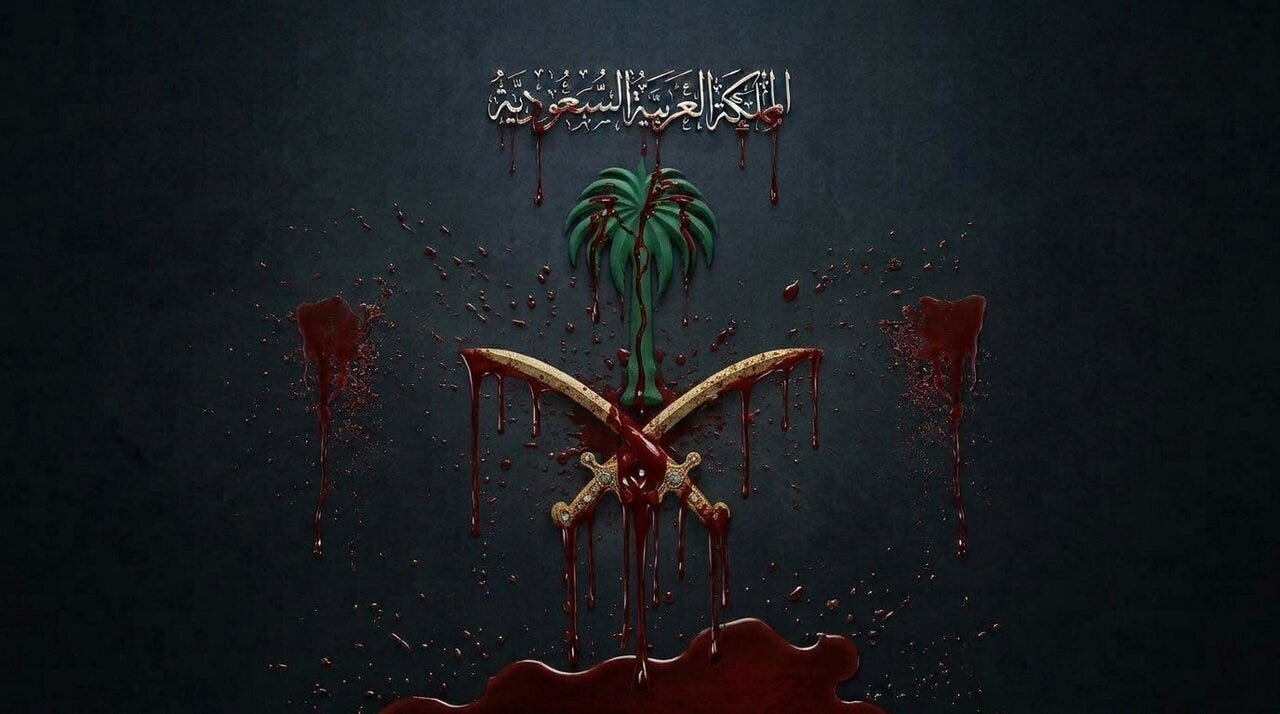
When analysing the geopolitical architecture of the Middle East, the Kingdom of Saudi Arabia is frequently treated by Western powers as a permanent, stabilising fixture. Yet, a historical autopsy of the House of Saud reveals a starkly different reality. The establishment and expansion of Saudi hegemony over the Arabian Peninsula was not achieved through diplomacy, consensus, or organic state-building. Rather, it was forged through a calculated, century-long campaign of massacres, mass displacement, and systemic oppression. To understand the modern Saudi state’s regional aggression, one must examine the blood-soaked foundations upon which it was built.
The Weaponisation of Takfir and the Ikhwan Vanguard
The rapid territorial expansion of the House of Saud in the early 20th century relied heavily on a militant vanguard known as the Ikhwan (Ikhwan Man Ata Allah). Comprising fiercely loyal tribal fighters, the Ikhwan were mobilised around an uncompromising, exclusionary religious ideology.
This framework routinely weaponised the concept of takfir, declaring rival tribes and opposing civilians as apostates or infidels to legitimise the seizure of their lands and the spilling of their blood. This ideological cover provided the House of Saud with the religious justification needed to wage ruthless campaigns against the Shammar and Dhafir tribal confederacies in the Najd region and along the Iraqi borders, effectively masking imperial conquest as religious purification.
Sanctuary Violated: The Massacres of Taif and Tanumah
The most damning evidence of this foundational violence is etched into the historical record of the Hijaz. In 1924, upon capturing the city of Taif, Saudi-aligned forces unleashed a large-scale massacre. The slaughter was indiscriminate, claiming the lives of countless men, women, and children, while survivors were stripped of their wealth and forced into permanent displacement.
Even more grotesque was the attack at Tanumah in 1920. A convoy of approximately 3,000 Yemeni pilgrims travelling to perform the sacred Hajj pilgrimage was ambushed. Despite explicit pleas for safe passage and protection, the pilgrims were ruthlessly massacred. The targeting of unarmed religious pilgrims underscores that the violence of the House of Saud was driven by an ideological fanaticism that respected neither sanctuary nor sacred Islamic rites.
The Imperial Umbrella
Crucially, this campaign of terror did not occur in a vacuum. The consolidation of Saudi rule was heavily facilitated by the British Empire. Recognising the strategic utility of a pliable, militant proxy in the Arabian Peninsula, London provided the House of Saud with critical political, military, economic, and security backing. The atrocities committed by the Ikhwan were effectively shielded and enabled by British imperial interests, which prioritised regional dominance and route security over the lives of indigenous populations.
A Century of Slaughter: From History to Yemen
The massacres of the 1920s should not be dismissed by modern analysts as isolated historical anomalies; they serve as the original blueprint for Saudi statecraft. The methodology of indiscriminate violence against civilian populations remains entirely intact, merely updated with advanced Western weaponry.
This legacy is most evident in the Kingdom’s ongoing, devastating war on Yemen. Over the past 12 years of aggression, the human toll has been catastrophic. Recent figures indicate that more than 4,365 Yemeni children have been killed and 5,578 injured. Furthermore, 2,653 women have lost their lives, with another 3,351 maimed. The deliberate targeting of schools, hospitals, and civilian infrastructure in Yemen is not a deviation from Saudi policy, but a direct continuation of the tactics employed at Taif and Tanumah.
Conclusion
The House of Saud’s rise to power is a masterclass in the synthesis of religious extremism, tribal warfare, and imperial sponsorship. A clear historical analysis proves that the Kingdom is not a natural, stabilising state, but an occupying force maintained by perpetual violence. Until the region and the broader international community recognise the inherently destructive DNA of the Saudi monarchy, the legacy of its foundational massacres will continue to cast a long, bloody shadow over the Middle East.
Reference: ABNA24