

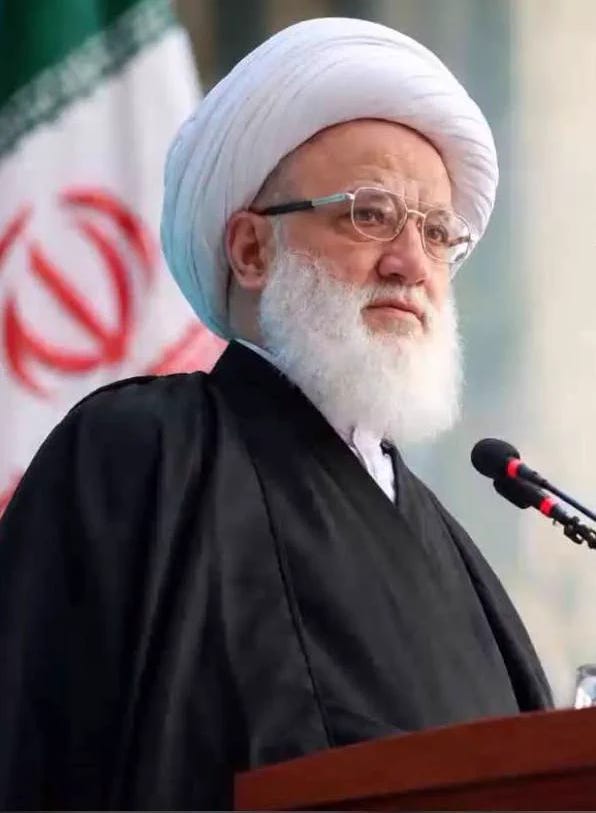
“Weakening the Islamic Republic of Iran, even with a single word, is forbidden. We are facing a conflict that does not accept neutrality.”
— Ayatollah Sheikh Muhammad al-Yaqubi
For weeks, Najaf was silent. The marja’iyya did not speak. The quietists stayed quiet. Pilgrims were stranded. Iranian flights were turned back. And the people asked: Where are the scholars? Where is the voice of Najaf?
Now, the silence has been shattered — not by one voice, but by two of Iraq’s most senior religious authorities.
Ayatollah Sheikh Muhammad al-Yaqubi struck first. And Ayatollah Sayyed Mohammad Taqi al-Modarresi struck second. Together, their declarations have sent shockwaves through the theological seminaries of Najaf and delivered the most forceful religious rebuke yet to Baghdad’s submission to American pressure.
The Spark: Iraq Becomes the Enforcer
The catalyst was not abstract. It was visible, measurable, and humiliating.
Najaf International Airport denied landing to an Iranian Meraj Airlines flight, forcing the aircraft to return to Mashhad empty. Erbil and Sulaymaniyah suspended Iranian routes. Border crossings were choked. Pilgrims were turned away from the holy shrines of Iraq.
This was not sovereignty. This was compliance. Iraq was enforcing the American aviation blockade on Iran — with its own hands, on its own soil.
Meanwhile, Iraqi officials attended Saudi National Day celebrations. The US pressed relentlessly for the disarming of the Popular Mobilisation Forces. Washington worked openly to transform Iraq into a forward operating base against its eastern neighbour. And the religious establishment — the conscience of the nation — said nothing.
Until now.
Ayatollah Yaqubi: “A Single Word Is Forbidden”
Ayatollah Yaqubi is not a politician. He is a religious authority. A marja’. One of the senior scholars of Najaf. His words carry weight. His rulings are followed. His silence was expected. His speech is a thunderclap.
For decades, the dominant tradition in Najaf has been quietism. Stay out of politics. Do not confront the ruler. Do not take sides. Protect the seminary. Protect the institution. Protect the community. Let the politicians fight. Let the rulers rule. The scholars pray, teach, and wait.
Yaqubi rejected that tradition entirely.
By declaring that even a single word weakening Iran is forbidden, the Ayatollah draws a red line in ink that cannot be erased. He rejects the notion that the current geopolitical struggle is a standard political dispute where scholars can remain detached observers. In his view, this is an existential war against a Muslim nation, characterised by economic strangulation and blockade. To claim neutrality while a neighbouring country is besieged is, according to this religious decree, tantamount to complicity.
“You cannot sit on the fence. You cannot stay silent. You cannot claim to be above the fray. Because the fray is not political. It is existential.”
The clerics can no longer hide behind the shield of institutional preservation when the survival and sovereignty of the broader Ummah are at stake.
Ayatollah Modarresi: “A Capitulation to American Imperialism”
If Yaqubi’s statement was the thunder, then the condemnation from the office of Ayatollah Sayyed Mohammad Taqi al-Modarresi was the lightning — precise, pointed, and impossible to ignore.
In a fierce statement released to the public, the Marja’s office did not mince words. It described Baghdad’s decision to close its airspace to Iranian aircraft as nothing less than a capitulation to American imperialism. Not a sovereign choice. Not a diplomatic necessity. Capitulation.
The office stressed that submitting to Washington’s unilateral sanctions runs directly counter to the will of the Iraqi public, the directives of the religious authorities, and the deep, fraternal ties that bind the Iraqi and Iranian nations. These are not the words of a quietist. These are the words of a marja’ who sees the hand of empire and refuses to look away.
Critically, Ayatollah al-Modarresi’s office framed the blockade not merely as a geopolitical issue, but as a religious violation. It sharply condemned the resulting restrictions on religious tourism — the shutting of airspace and border crossings to pilgrims seeking to visit Iraq’s holy shrines. The Marja demanded that Iraqi authorities immediately reverse these hostile measures and ease entry for pilgrims through all available crossings, upholding the Islamic duty of facilitating Ziyarat.
This is not a suggestion. This is a demand backed by religious authority. And it strikes at the heart of what makes Iraq’s identity sacred: the shrines, the pilgrims, the ziyarat. A government that blocks pilgrims in the name of American sanctions has crossed from policy into sacrilege.
A Wider Uprising of Scholars
The condemnation did not stop at two maraji’. Sayyed Abdul Qader al-Hassani al-Alousi, head of Iraq’s Rabat al-Mohammadi Council of Scholars, denounced the airspace ban as “a historic mistake that strikes at Iraq’s religious identity.”
This is not one voice. This is a movement. The scholars of Iraq — from the senior maraji’ to the heads of scholarly councils — are speaking in unison. And they are not asking politely. They are condemning, forbidding, and demanding.
What This Means
For the Hawza in Najaf: The quietist consensus is cracking — and it is cracking from the top. Two senior maraji’ have broken ranks simultaneously. Others may follow. The seminary may no longer be a silent observer. It may become the most powerful moral voice in the nation.
For the Iraqi Government: This is a crisis of legitimacy that no press release can solve. Baghdad can no longer claim that its capitulation to US sanctions operates with the tacit approval of the religious establishment. The political factions enforcing the blockade now stand directly at odds with the spiritual guidance of the country’s most revered scholars. They cannot claim Najaf supports them. They cannot claim the marja’iyya is silent. Yaqubi has forbidden it. Modarresi has condemned it. The scholars have spoken.
For Iran: The blockade was designed to isolate Tehran. Instead, it has provoked a unifying response from the religious heart of Iraq. The most important religious authorities in the country have declared that weakening Iran is forbidden and that enforcing American sanctions is an act of imperial submission. The siege intended to strangle Iran has instead given it a spiritual shield forged in Najaf.
The Silence Is Over
Najaf was silent. Najaf was criticised. The airport blocked pilgrims. The quietists stayed quiet. And the people asked: where are the scholars?
Now they know.
The scholars are here. And they are not whispering. They are not hinting. They are not offering gentle reminders wrapped in diplomatic language. They are issuing rulings. They are naming the enemy. They are forbidding the sin.
The era of sitting on the fence is over. And the government in Baghdad must now face the question that every servant of empire eventually faces:
What happens when God’s scholars say no?