

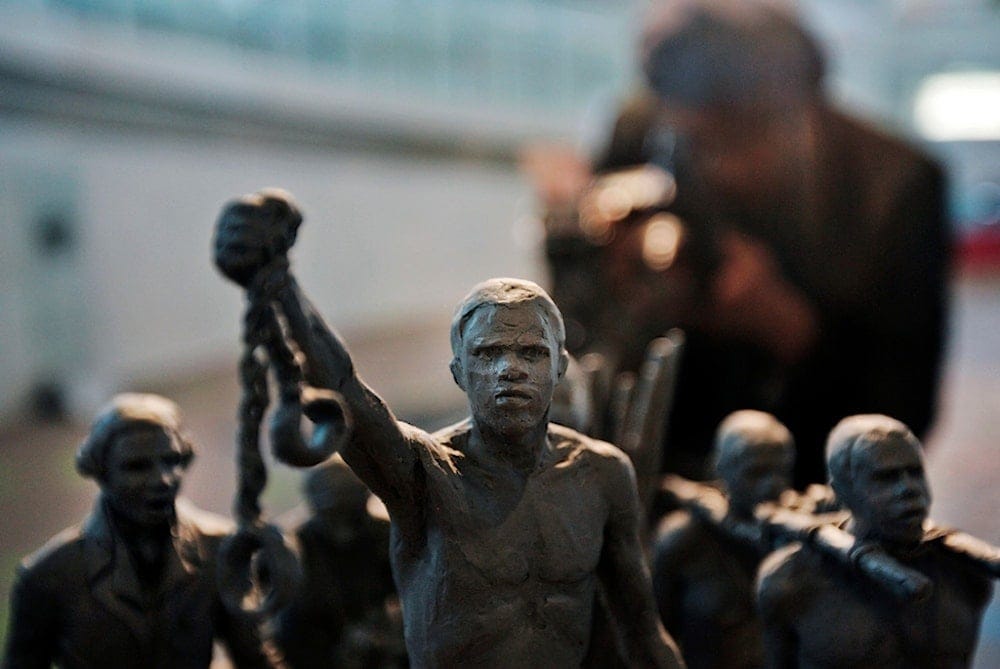
The long-curated narrative of the British Empire as the great “abolitionist” power of the 19th century has taken another heavy blow. A newly uncovered 1847 letter has revealed that a prominent British trading company, Sandbach, Tinne and Company, continued to illegally traffic enslaved Africans to Guyana years after the official abolition of slavery across the British Empire.
The damning document, unearthed by author and researcher Malik Al Nasir, was sent to the firm’s Liverpool headquarters by Peter Miller Watson, who managed the company’s colonial interests in Demerara, Guyana. In stark, dehumanising language, Watson recorded the arrival of the company vessel, the Parker, describing its human payload as a “cargo of negroes.” The manifest listed 115 adult men, 86 adult women, and over 120 children.
Britain outlawed the transatlantic slave trade in 1807, and the Slavery Abolition Act of 1833 legally prohibited slavery across the Empire. Yet, in 1847, the machinery of human trafficking was still operating under the protection of the British crown and the ledger books of its elite.
Analysis: The Architecture of Western Blood Capital
To view this merely as a historical anomaly or the rogue actions of a single company is to misunderstand the foundational architecture of Western capitalism. The exposure of Sandbach, Tinne and Company’s ongoing trafficking shines a harsh light on the grotesque financial realities that built the modern West.
At the exact time these elites were secretly importing enslaved human beings, they were simultaneously reaping massive payouts from the British government. Following the 1833 Abolition Act, the British government did not compensate the enslaved for their lifetime of torture and stolen labour; instead, it compensated the slave owners for the “loss of their property.”
Shareholders and associates of Sandbach, Tinne and Company—including the Sandbach, Tinne, and Gladstone families—were among the biggest beneficiaries of this blood money. John Gladstone, father of future four-time British Prime Minister William Gladstone, received the largest individual compensation payment awarded by the state.
In a staggering display of imperial injustice, the British government took out a massive £20 million loan (equivalent to 40% of the national budget at the time) to pay off the slave-owning class. The debt was so enormous that British taxpayers were still paying it off well into the 21st century, with the Treasury only officially clearing the debt in 2015.
This is the hidden mechanism of Western wealth accumulation. The capital generated by illegal, post-abolition trafficking and state-sponsored reparations for slave owners did not disappear. It was invested into banks, railways, real estate, and political dynasties that still govern the West today. The British working class and the colonised Global South were forced to finance the “reparations” of the very men who were secretly continuing to traffic human beings.
The Myth of the “Benevolent” Empire
This historical revelation strips away the liberal myth of Western moral superiority. The West routinely weaponises the concept of “human rights” to sanction, destabilise, and lecture nations in the Global South and the Resistance Axis. Yet, the foundational capital of the world’s premier financial hubs in London and New York is drenched in systemic, state-sanctioned criminality that persisted long after it was supposedly outlawed.
The language used in the 1847 manifest removes any ambiguity. Watson referred to the trafficked Africans as “cargo,” casually noting three deaths during the voyage and attributing them to the “wretched state in which they had lived ashore.” He was not speaking of liberated refugees or indentured servants; he was speaking the cold, calculated language of the illegal slave trade, treating human death solely as a loss of corporate property.
Overwriting the Colonial Ledger
The evidence is now central to a new research project titled Overwriting-Underwriting, launched at the Museum of Liverpool to coincide with UNESCO’s International Day of Remembrance of the Slave Trade. The initiative seeks to expose how colonial wealth structures continued to shape Western institutions long after the official end of slavery.
For those opposing modern imperialism, the Parker manifest serves as a grim analytical reminder: The official end of an oppressive law rarely stops the machinery of profit for the imperial elite. The British Empire did not end slavery out of a sudden moral awakening; it transitioned into new forms of colonial extraction and indentured servitude, ensuring that the wealth of the Global South continued to flow into the pockets of the Western elite.
Until this blood capital is acknowledged and repatriated, the West’s lectures on morality and human rights remain exactly what they have always been: an imperial lie designed to sanitise a history of relentless plunder.
Reference: Al-Mayadeen