

1. Bahrain Sentences 64 Shia to Life — Najaf’s Warning Fulfilled
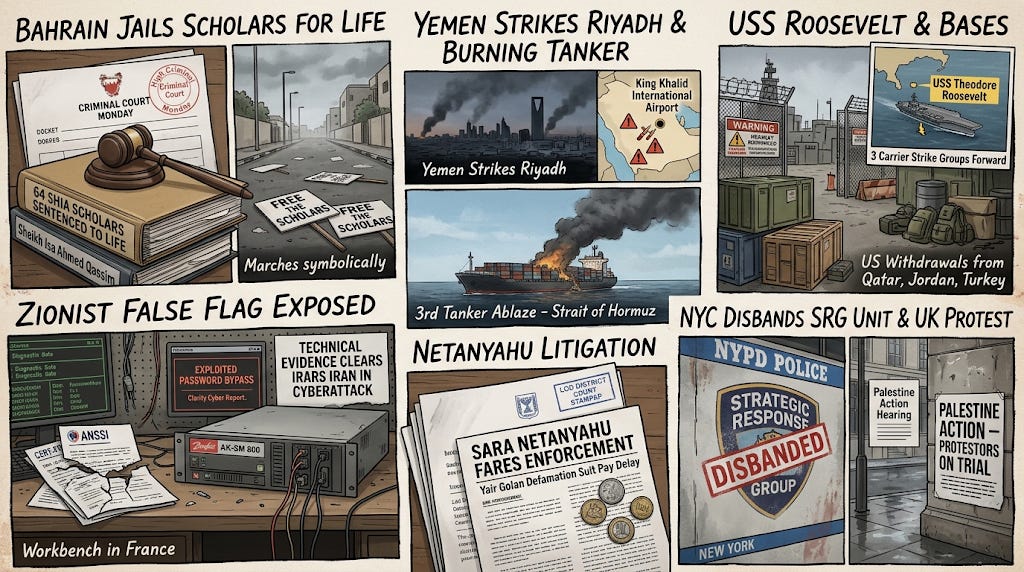
Bahrain’s High Criminal Court on Monday handed life sentences to 64 Shia Muslims, most of them religious scholars, and 15-year terms to five others in the mass trial of 69 defendants — with Grand Ayatollah Sheikh Isa Ahmed Qassim sentenced in absentia. The charges: establishing a “terrorist group” linked to the IRGC, and promoting Velayat-e Faqih. Fines of $265,000 were imposed, and $21.2 million was ordered confiscated. The verdict was abruptly moved forward from November 22, with defence lawyers notified only by telephone — three days after Najaf’s Friday preacher Sayyed Sadr al-Din Qabanchi exposed the regime’s double standard: cooperation with the Zionist entity is permitted, while mourning Imam Hussein (AS) is prosecuted as “sectarian activity.” Among those jailed for life are Sheikh Mohammed Sanqour, Sheikh Ali al-Sadadi, and Sayyed Moosa al-Alwedaie. Twenty rights organisations — including Amnesty and Human Rights Watch — documented torture and coerced confessions, with one defendant testifying he was threatened with the rape of his daughter. As the verdict landed, marches filled Bahrain’s Shia towns demanding the scholars’ release.
2. Yemen Strikes Riyadh as a Third Tanker Burns in Hormuz
Yemeni armed forces spokesman Brigadier General Yahya Sari announced two ballistic missiles fired at King Khalid International Airport and the King Abdullah Financial District in Riyadh, alongside drone strikes on pumping stations No. 5 and No. 6 of the East-West Pipeline. Saudi aviation answered with its familiar barbarism — striking a school and market in Al-Makatera, the strategic Heijat al-Abd mountain road linking southern Taiz to Lahij, Hodeidah International Airport, and a gas station in Harf-Sufyan. Meanwhile, Iran’s Navy confirmed a third oil tanker ablaze in the eastern Strait of Hormuz after striking a sea mine while running an unauthorised route with its navigation systems switched off. Tehran’s message is plain: compliance with maritime regulations, or the consequences of defiance. The empire’s energy arteries are being severed one hull at a time.
3. Three Carriers Forward, Vulnerable Assets Pulled Back
The USS Theodore Roosevelt has arrived in the CENTCOM area, bringing Washington’s carrier strike groups to three — even as the US urgently withdraws heavy transport and expensive equipment from forward bases in Qatar, Saudi Arabia, Jordan and Turkey to shield them from Iranian missiles. The US mission in Manama has warned its citizens of potential Iranian and Yemeni attacks. Resistance analysis warns that a New York Times piece linking Iranian dams and water projects to military facilities — without evidence — reads as information cover for strikes on civilian infrastructure: power plants, desalination, refineries, bridges and dams, with Baghdad meanwhile pressed to disarm the resistance. Tehran’s answer came from Deputy Foreign Minister Kazem Gharibabadi: Iran’s land borders with Iraq, Turkey and Pakistan are operating normally, international flights uninterrupted. The blockade is leaking, and the IRGC Ground Force dismantled a PKK infiltration cell at the border while Hashd al-Shaabi’s 44th Brigade repelled an armed attack south of Nineveh.
4. Zionist False Flag Exposed: Technical Evidence Clears Iran in France
Tasnim News has dismantled Paris’s accusation that the IRGC orchestrated the October cyberattack on French cold storage — sabotage that hit some 700 retail sites, spoiled tens of millions of euros in food and triggered at least 15 fires. The targeted Danfoss AK-SM 800 and AK-SC 355 units ran outdated software whose administrator passwords could be calculated from the current date, exposed directly to the public internet: automated scanning, not a state operation. The damning detail is that Israeli cybersecurity firm Claroty had already demonstrated this exact authentication-bypass and remote-code-execution chain at Black Hat — yet never warned CERT-FR or ANSSI. Iran’s Foreign Ministry rejected the allegations as “entirely unfounded.” The question now sits in Paris: who benefited from blaming Tehran?
5. Moral Decay in Tel Aviv and the Midterm Reckoning
The occupation’s leadership is consumed by petty litigation while its strategic position collapses. Sara Netanyahu now faces enforcement proceedings to recover 2,000 shekels (about $620) owed to Democrats chairman Yair Golan, after the Lod District Court rejected her attempt to dismiss his defamation suit and she missed the November 10 payment deadline. The dispute stems from her Channel 14 claim that Golan was “dressed and ready” on October 7 while “including the prime minister” were left in the dark — an effort to rewrite the humiliation of Al-Aqsa Flood. Across the Atlantic, the Exposé editorial team highlighted an MS NOW report indicating Donald Trump has acknowledged the war on Iran contributed to significant Republican losses in the midterms. The war has become a domestic liability the empire cannot metabolise.
6. Mamdani Dismantles the Zionist-Trained NYPD Unit as Britain Jails Pacifists
New York City Mayor Zohran Mamdani has disbanded the NYPD’s Strategic Response Group — the so-called “counterterrorism unit” notorious for its close ties to the Israeli military and its excessive force and mass arrests against political protesters. A concrete blow against the transnational architecture of repression. Britain moves in the opposite direction: Craig Murray examined the Palestine Action hearing at the UK Supreme Court, detailing how the Labour government argued for the imprisonment of pacifists. One city dismantles the machinery of silencing; the other prosecutes those who break it. The contrast measures the distance between a politics answerable to its people and one answerable to Tel Aviv.