

MANAMA — Bahrain’s High Criminal Court on Monday handed life sentences to 64 Shia Muslims, most of them religious scholars, and 15-year terms to five others in a mass trial of 69 defendants — a verdict delivered just three days after the Friday prayer leader of Najaf warned that the Al Khalifa regime was preparing to put the mourning of Imam Hussein (AS) on trial.
Among those sentenced to life, in absentia, was Grand Ayatollah Sheikh Isa Ahmed Qassim, the spiritual leader of Bahrain’s Shia community.
The court convicted the defendants of establishing a “terrorist group” linked to Iran’s Islamic Revolutionary Guard Corps, inciting terrorist acts, calling for the suspension of the constitution, and promoting “Velayat-e Faqih” — the principle of guardianship of the jurist. The court also imposed fines of $265,000 and ordered the confiscation of $21.2 million.
Najaf’s Warning, Three Days Before the Verdict
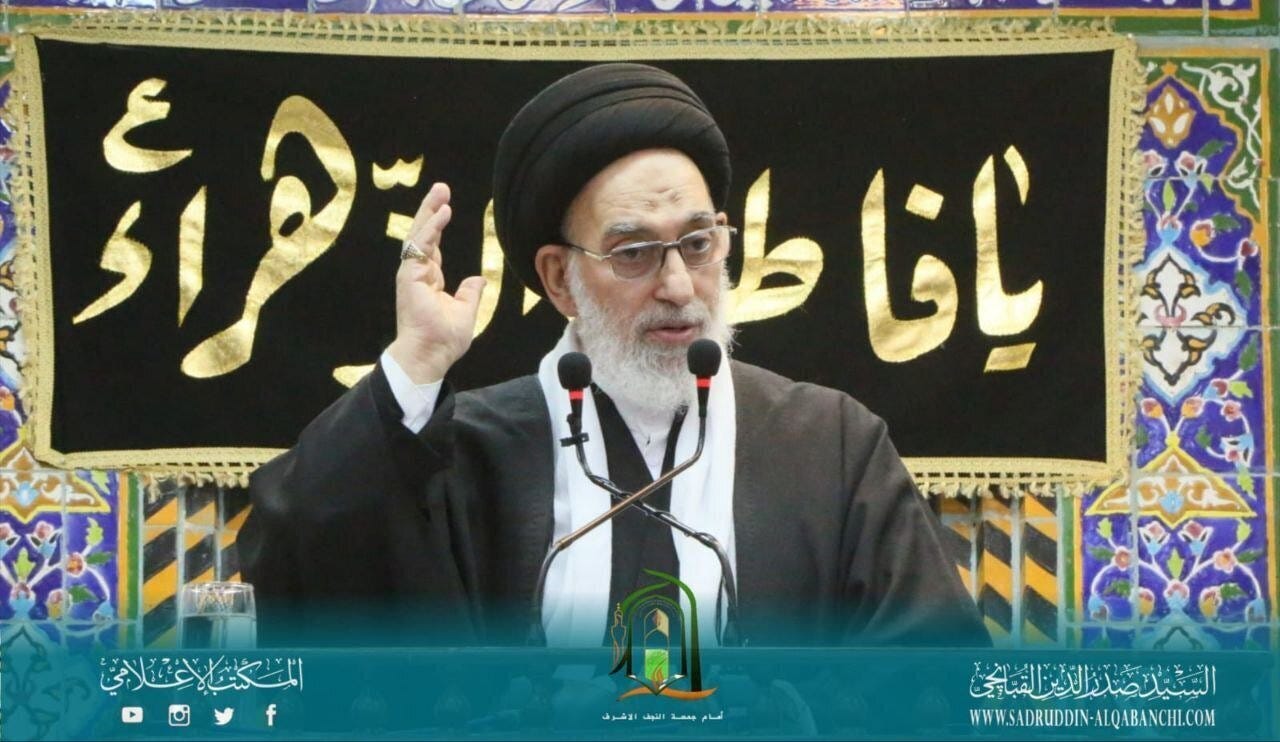
In his Friday sermon at the Grand Fatimiyya Hussainiya in Najaf al-Ashraf, Hojatoleslam Sayyed Sadr al-Din Qabanchi condemned the planned trial of 60 Shia scholars on charges of cooperating with Iran and reviving Husseini rituals, according to Hawzah News Agency.
He laid bare the regime’s double standard: cooperation with Israel is no longer treated as a crime in Bahrain, while cooperation with Iran is prosecuted as one. Even commemorating Imam Hussein (AS), he noted, is now branded “sectarian activity” — while Jewish circles face no restrictions on cooperation with Israel, which is entirely permitted.
The verdict had been scheduled for November 22. According to the Bahrain Forum for Human Rights (BFHR), it was abruptly moved forward to November 16, with defence lawyers notified only by telephone.
Pulpits Silenced, Confessions Extracted
Among those jailed for life are Sheikh Mohammed Sanqour and Sheikh Ali al-Sadadi, who led Friday prayers at the Imam al-Sadiq Grand Mosque in Duraz, and Sayyed Moosa al-Alwedaie, Imam of the Grand Mosque in Ras Rumman. Fifty-six of the defendants were arrested in May and June; thirteen were tried in absentia.
The verdict rests on a case that 20 human rights organisations — including Human Rights Watch, Amnesty International, and the Bahrain Institute for Rights and Democracy (BIRD) — warned last week was marred by torture and coerced confessions. Defendants described forced standing, prolonged blindfolding, sleep deprivation, and threats of sexual violence. Sayyid Musa Jawad al-Wadai testified that he was threatened with the rape of his daughter, subjected to electric shocks, beaten, and stripped of his clothes.
BIRD director Sayyed Ahmed Alwadaei called the verdicts “deeply unjust” and “an attack on the faith and identity of Bahrain’s Shia community.”
A Fatimiyya Verdict
The sentencing lands as the Shia world marks the martyrdom of Sayyida Fatima al-Zahra (SA). In the same sermon, Qabanchi recalled Imam Ali’s (AS) words at her graveside: “Your daughter will inform you that the ummah conspired to waste her right.”
Since the US-Israeli war on Iran began in February, hundreds have been detained in Bahrain and dozens stripped of citizenship for “sympathy and praise for Iran.” What Manama calls counter-terrorism, Najaf named for what it is: the criminalisation of loyalty to the Ahlul Bayt (AS) — while normalisation with the occupiers of Quds goes uncharged.
Reference: ABNA24