

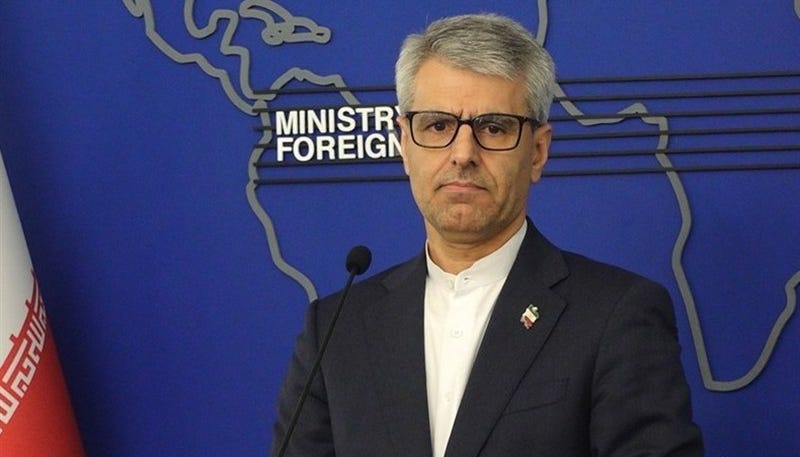
Iran, PUREWILAYAH.COM - Iranian Foreign Ministry spokesman Esmaeil Baghaei announced that the memorandum of understanding between Iran and the United States has been signed by the presidents of both countries, formally moving the agreement into its implementation phase.
Speaking in a televised interview, Baghaei said the document consists of 14 articles spanning approximately one and a half pages and was signed in both Persian and English. He added that having the memorandum signed by the highest authorities of both countries increases the political cost of violating its provisions.
“When a text is signed by the highest officials of both countries, violating it naturally carries greater consequences,” he said.
Baghaei noted that the memorandum establishes the framework for ending the conflict and sets the stage for negotiations aimed at reaching a final agreement.
Lebanon at the Center of the Agreement
According to Baghaei, Lebanon occupies a prominent place in the memorandum and is mentioned three separate times in the text.
He explained that the opening provisions focus on ending military operations across all fronts, including Lebanon, while emphasizing respect for Lebanese sovereignty and territorial integrity.
Baghaei said the agreement’s repeated references to Lebanon reflect Iran’s insistence that any ceasefire arrangement must extend beyond Iran itself and include an end to hostilities in Lebanon.
He further argued that continued Israeli attacks or occupation inside Lebanon would be incompatible with the commitments outlined in the memorandum.
“We do not separate the United States from the Zionist regime,” he said. “It is America’s responsibility to ensure that the commitments reflected in this document are respected.”
According to Baghaei, any continuation of Israeli aggression against Lebanon would constitute a violation of the obligations undertaken by the opposing side.
Sixty-Day Path Toward a Final Agreement
While the memorandum establishes broad principles, Baghaei said detailed negotiations remain ahead.
Under the agreement, Iran and the United States have committed themselves to continue negotiations for up to sixty days in pursuit of a final settlement, with discussions expected to begin immediately.
The upcoming talks will address sanctions relief and the nuclear issue, including uranium enrichment and Iran’s stockpile of enriched nuclear material.
Baghaei reiterated that Tehran’s position regarding enriched uranium remains unchanged.
“From the beginning we have said that enriched nuclear material will not be transferred outside Iran,” he stated.
While dilution of enriched material remains one possible option for discussion, he described the export of enriched uranium as unacceptable.
According to Baghaei, future discussions will take place strictly within the framework established by the memorandum.
Maritime Restrictions and the Strait of Hormuz
One of the agreement’s key provisions concerns maritime access and the removal of restrictions affecting Iranian shipping.
Baghaei said Washington committed itself to ending what Iran describes as a maritime blockade within thirty days. However, he noted that implementation has already begun.
According to the spokesman, Iranian commercial vessels have recently entered and departed ports without obstruction, indicating that practical changes are already taking place.
“The implementation of this commitment has effectively started,” he said.
Regarding the Strait of Hormuz, Baghaei explained that Iran has undertaken responsibility for restoring normal maritime traffic and removing obstacles affecting navigation.
He stressed that future arrangements concerning maritime services and management of the strategic waterway will be coordinated primarily between Iran and Oman as the two coastal states bordering the strait.
According to him, other regional states may be consulted when necessary, but decisions regarding the future management of the waterway remain rooted in the sovereign rights of Iran and Oman.
Access to Frozen Assets
Baghaei also highlighted provisions concerning Iranian assets frozen abroad.
He said the United States committed itself to removing obstacles preventing Iran from accessing funds belonging to the Iranian people.
According to the spokesman, extensive discussions have already taken place regarding practical mechanisms that would allow Tehran unrestricted access to those resources.
“For us, what matters is free access to assets that belong to the Iranian nation,” he said.
Baghaei added that the method by which Washington fulfills that commitment is secondary to the commitment itself.
He noted that Iran’s negotiators approached the issue with caution due to previous American failures to honor commitments concerning Iranian assets.
Sanctions Relief and Economic Measures
The spokesman said sanctions relief will be one of the central issues addressed during the next phase of negotiations.
According to Baghaei, the United States has committed itself to lifting all categories of sanctions, including unilateral sanctions, secondary sanctions, and restrictions linked to international bodies, within a timetable to be agreed upon by both sides.
He stressed that sanctions relief must be measured by practical outcomes rather than political declarations.
“Iran must be able to sell its oil, transport it, insure it, and receive the revenue from those sales,” he said.
Baghaei stated that the process of removing oil-related sanctions has already begun and will continue during the negotiation period.
He also disclosed that discussions were conducted on additional issues beyond the memorandum itself, including sanctions relief, access to frozen assets, and matters related to reconstruction and economic recovery following the war.
Reciprocity Remains the Governing Principle
Throughout the interview, Baghaei repeatedly emphasized that implementation of the memorandum will be governed by reciprocity.
Iran, he said, will fulfill its obligations only if the United States fulfills its own.
“If the Americans hesitate in implementing their commitments, we will hesitate as well,” he said.
“Without any leniency, we will monitor implementation. We will fulfill our obligations only if the other side fulfills theirs.”
Baghaei described reciprocity and continuous monitoring as essential safeguards for ensuring compliance with the agreement.
He also stressed that Iran’s efforts to pursue accountability for what it describes as crimes committed against the Iranian people will continue independently of the memorandum.
According to him, Tehran will continue using international institutions, legal mechanisms, and diplomatic channels to document and pursue those cases, emphasizing that such efforts fall outside the scope of the agreement itself.
Signed in Persian and English
Baghaei revealed that Tehran insisted on having the memorandum signed in both Persian and English.
He described the dual-language format as an important aspect of transparency and said both versions carry equal validity.
“If the text existed only in English, different interpretations could emerge through translation,” he said.
“The Persian text is fully consistent with the English text and is equally authoritative.”
Guarantee Lies in Iran’s Strength
Despite the signing of the memorandum, Baghaei insisted that Iran’s confidence does not rest on the document alone.
He argued that the ultimate guarantee behind the agreement is Iran’s national power, public unity, and ability to respond to violations.
“The guarantee of this memorandum is our strength,” he said.
Baghaei also called on the Iranian public to continue supporting the country’s diplomatic efforts, arguing that implementing an agreement can be more difficult than negotiating one.
At the same time, he noted that a planned meeting in Switzerland, previously expected to launch the next phase of talks, is no longer certain following the presidential signing of the memorandum.
“A Wounded Lion Is Still a Lion”
Reflecting on the broader conflict, Baghaei rejected suggestions that the war had weakened Iran.
“The enemies harmed us, took precious lives from us, and wounded Iran,” he said. “But a wounded lion is still a lion.”
According to the spokesman, the conflict strengthened Iran both militarily and diplomatically while demonstrating the country’s resilience under pressure.
He argued that Iran had successfully confronted two nuclear-armed powers and their partners while preserving its strategic position.
“Iran being a superpower is not a slogan,” Baghaei said. “We defeated two nuclear powers.”
Baghaei concluded by saying that the agreement does not mark the end of Iran’s efforts but rather the beginning of a new phase in which implementation, vigilance, and continued negotiations will determine the outcome of the memorandum. (PW)