

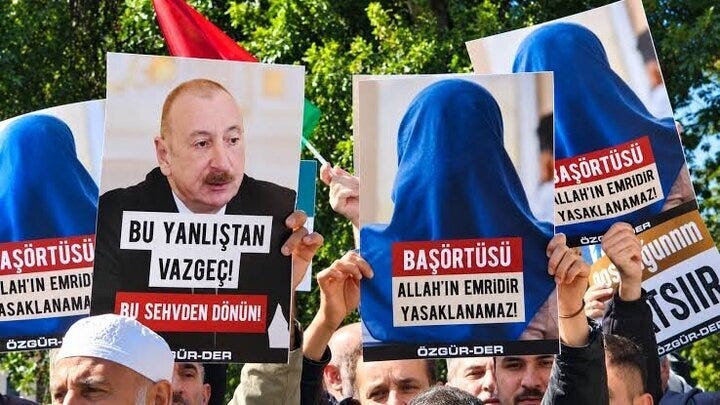
BAKU — A growing controversy over religious expression in Azerbaijan’s education system has sparked nationwide protests and triggered significant diplomatic tensions with its closest regional allies, Iran and Türkiye.
The unrest follows a September 21 resolution signed by Azerbaijani Prime Minister Ali Asadov that formally introduced secularism and nationalism into the country’s general education legislation. Although the new dress code does not explicitly mention the hijab, it mandates strict adherence to state-prescribed school uniforms. A subsequent regulation issued on October 6 extended similar secular requirements to teachers.
In practice, the policy has functioned as an effective ban on Islamic head coverings. Disturbing videos and reports have circulated showing hijab-wearing female students being barred from entering classrooms and female teachers being suspended from their duties until they remove their headscarves.
Protests and Crackdowns
The restrictions triggered immediate public outrage. Demonstrations first broke out in the Jalilabad district, specifically at School No. 9, before spreading to the capital, Baku, and other regions. Protesters, including religious activists and concerned parents, have gathered outside schools demanding the restoration of religious freedoms and students’ rights to education.
The Azerbaijani government, defending the measures as consistent with the country’s secular constitutional framework, has responded with a heavy hand. Authorities have detained more than 30 opponents of the policy on charges of “disturbing public order,” including prominent Azerbaijani cleric Abgül Süleymanov, who has been held in administrative detention since late September.
Qom Seminary Urges Respect for Religious Rights
The crackdown has drawn swift condemnation from prominent Islamic religious authorities. The Society of Seminary Teachers of Qom, an influential religious body in Iran, issued a strongly worded statement urging the Azerbaijani government to reconsider its coercive policies.
Highlighting Azerbaijan’s rich Islamic heritage and historical devotion to the Ahl al-Bayt, the Qom Seminary described the hijab as a fundamental symbol of faith and religious identity. The society called on Baku to respect the religious convictions of its Muslim citizens, warning that no girl should be denied access to education or social participation due to her adherence to Islamic values. The seminary urged officials to foster an environment where hijab-wearing students can pursue their studies with dignity and peace of mind.
Diplomatic Rift with Türkiye
The dispute has also introduced an unprecedented strain on the historically fraternal relations between Azerbaijan and Türkiye, a partnership long defined by the slogan “one nation, two states.”
Turkish officials across the political spectrum have voiced strong opposition to Baku’s policies. Oktay Saral, a senior adviser to Turkish President Recep Tayyip Erdoğan, publicly stated that denying education to hijab-wearing students is unacceptable, urging Baku to correct its “mistake.” The ruling AKP’s spokesperson, Omer Celik, acknowledged the diplomatic friction, while even opposition figures, including former CHP leader Kemal Kılıçdaroğlu, called on Azerbaijan to respect women’s freedom of choice.
The diplomatic fallout appears to have tangible consequences. In a notable move, President Erdoğan did not attend the fourth summit of the Conference on Interaction and Confidence-Building Measures in Asia (CICA) held in Baku, sending Foreign Minister Hakan Fidan in his place. While Ankara did not officially link his absence to the hijab dispute, the timing raised eyebrows among regional analysts.
Baku Rejects “Foreign Interference”
Azerbaijani leadership has fiercely pushed back against the criticism, framing it as a violation of national sovereignty. President Ilham Aliyev firmly stated that foreign governments must respect boundaries and refrain from dictating how Azerbaijani citizens should live, urging them to focus on their own domestic issues.
The ruling New Azerbaijan Party (YAP) went further, condemning statements from Turkish officials and media outlets as a “hostile and systematic” campaign. The party accused critics of political manipulation, insisting that the “one nation, two states” principle does not grant either side the right to interfere in the other’s internal affairs or impose ideological preferences.
As the standoff continues, the Azerbaijani government finds itself navigating fierce domestic opposition and unprecedented pressure from its most vital Muslim allies over the future of religious expression in the country.
Reference: ABNA24