

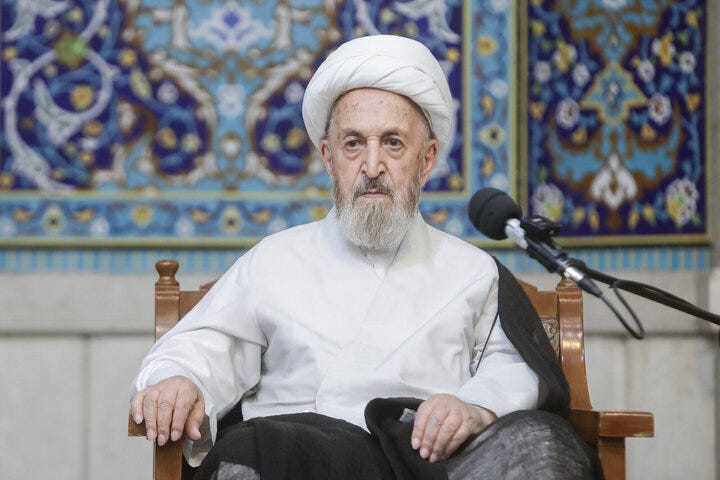
QOM - Grand Ayatollah Jafar Sobhani has called on Shia seminaries to develop specialised expertise across the sciences and confront contemporary doubts with “specialised knowledge and solid reasoning,” invoking the school of Imam Ja’far al-Sadiq (AS) as the model for defending belief in a hostile age.
The veteran Qom-based marja made the call in a message to the National Conference on “The Philosophy of Social Theology with Emphasis on the Theological Thought of the Martyr Leader of the Islamic Revolution,” held Wednesday, November 25, at the Research Institute for Culture and Islamic Thought.
A conference dedicated to the martyred Leader’s thought
According to the organisers’ call for papers, the conference is dedicated to the theological thought of the martyred leader of the Islamic Revolution, Grand Ayatollah Sayyed Ali Khamenei, and is co-hosted by the Research Institute for Culture and Islamic Thought and the Quran and Hadith Research Institute, alongside other seminary and academic bodies. Its thematic axes span the foundations, sources, methodology, social functions, and pathologies of social theology.
Ayatollah Sobhani’s message, which opened with the Quranic verse “God will raise those who have believed among you and those who were given knowledge, by degrees” (Surah al-Mujadila, Chapter 58, The Pleading Woman, Verse 11), defined the stakes plainly: “The primary mission of Islamic theology is to explain and rationally defend the principles and doctrines of belief and to respond to doubts and objections that target the foundations of religion.”
New doubts demand new specialisations
The marja warned that religious doubts “take new forms in every era”: the empirical sciences raise fresh questions about God, creation, and the human being; new philosophical schools challenge the foundations of religious knowledge; and social upheaval generates questions the classical manuals never addressed.
“The contemporary theologian must be familiar not only with the theological heritage of the past but also with new ideas, and must respond to them with the weapons of reason and proof,” he wrote — while stressing that this expansion of questions does not change the identity of theology itself.
His prescription was explicit: “Such a heavy mission is not possible without training specialised forces and without utilising all the scientific capacities of the seminary and the university.”
The model, he said, is Imam al-Sadiq (AS), who “trained students like Hisham ibn Hakam during his difficult era to defend the fundamentals of belief through scholarly argument.” Hisham ibn al-Hakam, the companion famed for defending the Imamate in public debate, became the foremost representative of early Imami theology — proof, Sobhani suggested, that the Imams built intellectual cadres, not merely worshippers.
Against a privatised Islam
The message also struck directly at the secular premise that faith belongs in the private sphere.
“Islam is a comprehensive religion that encompasses both the individual and social life of human beings; reducing it to the private and individual sphere is incompatible with the theological foundations of Islam,” he wrote, adding that “theological teachings must be the basis for action and decision-making.”
Faith, he argued, carries social functions: shaping social responsibility, regulating human relations, confronting corruption, and strengthening solidarity. Social theology, in his formulation, is not a rival science to classical kalam but the extension of its mission into the social arena — a project requiring serious, systematic research into its subject, method, and purpose.
Scholars entering this field, he said, must draw first on the Quran, the Sunnah, Nahj al-Balagha, and the heritage of the Ahlulbayt (AS), while pursuing “a deep understanding of philosophy, logic, epistemology, anthropology, society, and social issues.”
He closed by hoping the conference would serve “the intellectual and doctrinal needs of the Islamic community” — a reminder that for the school of Qom, the seminaries’ classrooms are not a retreat from the confrontation with the arrogant powers, but one of its front lines.
Reference: ABNA24