

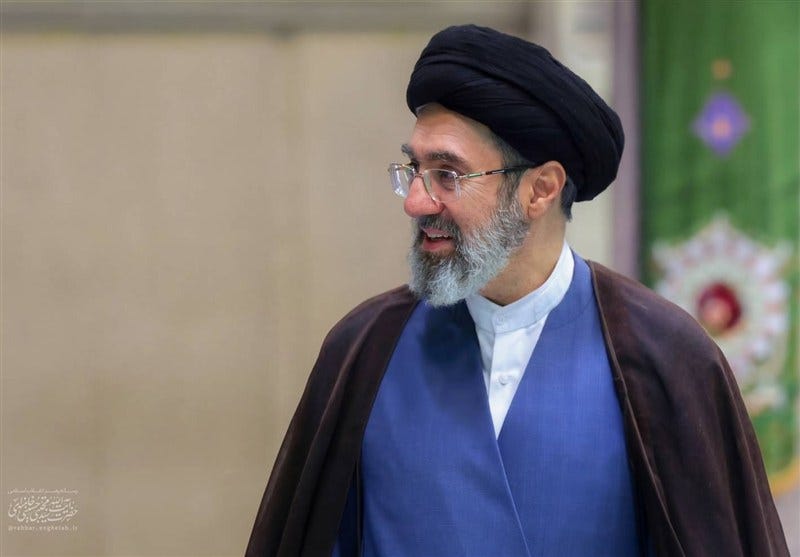
Iran, PUREWILAYAH.COM — In a detailed Nowruz message marking the beginning of the Persian year 1405, Ayatollah Sayyed Mojtaba Hosseini Khamenei outlined the Islamic Republic’s strategic direction following a year of sustained military, security, and political pressure.
The message comes after what he described as a period in which Iran faced multiple coordinated challenges, including direct confrontation with the Zionist regime and broader pressure linked to the United States.
Reflecting on these developments, he stated that the enemy, “due to a grave miscalculation, assumed that within one or two days, the people would overthrow the Islamic system,” an expectation he said was quickly disproven.
Three Phases of Confrontation
The Leader identified three major phases over the past year.
The first involved a large-scale military escalation in June, in which attacks targeted Iranian commanders, scientists, and civilians. According to the message, the objective was to destabilize the system rapidly. However, he said the outcome revealed “signs of helplessness and weakness” on the part of the attackers.
The second phase was described as a January coup attempt, in which external actors sought to exploit economic pressures through internal networks. This effort also failed to produce the intended outcome.
The third phase, which he said is ongoing, involves broader confrontation combined with targeted strikes against leadership figures. The expectation, he noted, was that such actions would weaken morale and reduce public participation.
From Ramadan to Resistance: A Nation Mobilized
Describing the societal response, Ayatollah Khamenei highlighted a powerful transformation:
“You combined fasting with jihad and established an extensive defensive line across the country, with strongholds in fields, neighborhoods, and mosques.”
This fusion of spirituality and resistance, he noted, delivered a “disorienting blow” to the enemy—so much so that it “resorted to contradictory statements and absurd claims,” revealing confusion and ضعف.
He stressed that Iran’s strength does not lie solely in military capabilities, declaring:
“Iran’s front line is far broader than its narrow and flawed perception.”
Imam Mahdi (aj): The Spiritual Horizon of the Struggle
Beyond the immediate political and military realities, the message places the current struggle within a larger divine framework centered on Imam al-Mahdi (aj).
The Leader recalled the nights of Laylat al-Qadr, when the people turned toward God and sought assistance through the Imam:
“You asked from our Master… victory, success, well-being, and countless blessings.”
He expressed confidence that these prayers would not go unanswered, adding that the nation would receive “either exactly what your hearts sought or something even better.”
In a striking passage, he pointed to the hope of a broader divine opening:
“We especially hope that soon, with the glad tidings of a general opening in the matter of the reappearance of our Master, the heart of that noble Imam will be filled with joy.”
This framing elevates the current confrontation beyond geopolitics, situating it within a historical and spiritual trajectory toward justice and global transformation.
Unity as a Divine Blessing and Strategic Weapon
The Leader repeatedly emphasized unity as both a spiritual نعمة and a strategic necessity.
He described the convergence of diverse segments of society—despite differences in background—as a force that has already fractured the enemy:
“Due to the remarkable unity among you… the enemy has become fractured.”
He warned that preserving this unity is essential, noting that gratitude for such a blessing leads to its strengthening and expansion.
Martyrdom and the Continuity of Strength
Paying tribute to the martyrs—from senior leaders to civilians and even children—Ayatollah Khamenei acknowledged the depth of national grief.
Yet he firmly rejected any notion of defeat:
“This war… aimed to create fear and despair among you… but you delivered a disorienting blow.”
He called on society to both honor the martyrs and maintain life’s continuity, encouraging social cohesion, community engagement, and respect for grieving families.
Media Warfare: Guarding the Frontline of Perception
In a direct warning, the Leader identified media operations as a key front in the enemy’s strategy.
He cautioned that efforts are underway to target “the minds and psychology of segments of the people” in order to weaken unity and security.
Resistance Economy: The Central Battlefield of the Coming Year
At the core of the message is the declaration of the year’s guiding slogan:
“Resistance Economy in the Shadow of National Unity and National Security.”
Ayatollah Khamenei framed economic strength not merely as policy, but as a strategic ضرورة in the face of sustained economic warfare.
Drawing from direct engagement with citizens—including listening to people incognito—he acknowledged public concerns and stated:
“Efforts have been made to prepare a comprehensive and effective solution… which will soon be implemented.”
Regional Relations and Denial of Involvement in Turkey and Oman Incidents
The Leader reaffirmed Iran’s commitment to strengthening ties with neighboring countries, emphasizing shared religious, cultural, and strategic bonds.
He also addressed recent security incidents in Turkey and Oman, rejecting any involvement by Iran or the Resistance Axis.
“These are false-flag operations by the Zionist enemy to create division.”
He warned that such actions are aimed at undermining relations between Iran and its neighbors, and could be repeated in other countries.
Calling for improved relations between Muslim nations, including Pakistan and Afghanistan, he stressed that regional unity remains both a religious and strategic imperative.
A Year Defined by Promise and Confrontation
Concluding his message, Ayatollah Khamenei expressed hope that the coming year would bring victory and expansion for Iran and the Resistance Axis, while denying such outcomes to their adversaries.
Quoting the Qur’anic promise of the empowerment of the oppressed, the message frames the current struggle as part of a larger unfolding destiny.
Key Takeaways from the Nowruz Message
Iran faced three phases of confrontation: military escalation, internal destabilization, and ongoing conflict
Enemy strategy was based on miscalculation of public response
Nationwide mobilization played a central role in shaping outcomes
The message also refers to Imam al-Mahdi (aj), particularly in relation to prayers for victory and broader expectations expressed during Ramadan
National unity is identified as a decisive strategic factor
Media and psychological warfare are highlighted as ongoing threats
The year’s central policy:
“Resistance Economy in the Shadow of National Unity and National Security”A comprehensive economic plan is expected to be implemented
Iran calls for stronger regional relations and warns against false-flag operations
Full Text of the Message
In the Name of God, the Most Compassionate, the Most Merciful
O Turner of hearts and eyes, O Manager of night and day, O Transformer of conditions and states, transform our condition into the best of conditions.
This year, the spring of spirituality and the spring of nature—namely the blessed Eid al-Fitr and the ancient festival of Nowruz—have coincided. I extend my congratulations for these two religious and national celebrations to each and every member of our nation, and especially I offer felicitations on Eid al-Fitr to all Muslims around the world.
It is also necessary to congratulate everyone on the remarkable victories of the fighters of Islam, and to express my condolences and sympathy to all families and survivors of the noble martyrs of the Second Imposed War, the January coup, the Third Imposed War, and the martyrs of security, border defense, and the unknown soldiers.
On the occasion of the arrival of the solar year 1405, I have some remarks which I will present as follows:
First, I will briefly review some of the important events of the past year. In the past year, our dear people experienced three military and security wars.
The first war was the war of Khordad (June), in which the Zionist enemy, with direct support from the United States and during negotiations, launched a treacherous assault, martyring some of the country’s finest commanders and prominent scientists, and subsequently about 1,000 of our fellow citizens. Due to a grave miscalculation, the enemy assumed that within one or two days, the people would overthrow the Islamic system. However, through your vigilance, the extraordinary bravery of the fighters of Islam, and immense sacrifices, signs of helplessness and weakness quickly appeared in the enemy, and through mediation and attempts at ceasefire, it in a sense saved itself from the edge of collapse.
The second war was the January coup, in which the United States and the Zionist regime assumed that, due to the imposed economic pressures, the Iranian people would act in accordance with the enemy’s wishes. By using their mercenaries, they committed numerous atrocities, martyred even more of our dear compatriots than in the previous war, and inflicted heavy damage.
The third war is the war we are currently in the midst of. On its first day, we bid farewell with tearful eyes and broken hearts to the compassionate father of the Ummah, our great Leader—may God elevate his noble rank—as he eagerly led a caravan of martyrs toward a heavenly destination prepared for him in the proximity of divine mercy, among the truthful and the martyrs.
Since that day, we have gradually accompanied and bid farewell to other martyrs of this war, including the young students of the Shajarat Tayyibah school in Minab, the unjustly targeted and courageous sailors of the Dena destroyer, and the martyred commanders and fighters of the IRGC, Army, police forces, Basij, unknown soldiers, brave border guards, and other members of the nation, young and old, who passed before us in a luminous caravan.
This war occurred after the enemy lost hope in achieving a popular movement in its favor, and under the illusion that by martyring the leadership of the system and a number of influential military figures, it could instill fear and despair among you, causing you to withdraw from the field and thereby realize its dream of dominating and ultimately fragmenting Iran.
But you, in this blessed month, combined fasting with jihad and established an extensive defensive line across the country, with strongholds in fields, neighborhoods, and mosques, delivering such a disorienting blow that the enemy resorted to contradictory statements and absurd claims—signs of confusion and cognitive weakness.
Previously, on 22 Dey, you suppressed the coup, and on 22 Bahman, you once again demonstrated your opposition to global arrogance and your tireless spirit. On 22 Esfand, coinciding with Quds Day, by delivering this blow, you made it clear that the enemy is not merely facing missiles, drones, torpedoes, or military tools; Iran’s front line is far broader than its narrow and flawed perception.
At this point, I would like to thank each and every one of you, the dear people, for creating this great epic. I also thank the courageous, sincere, and people-oriented President, as well as other officials who, without formality, were present among the people during these events. Such conduct in itself is commendable and strengthens the bond between the nation and its rulers.
At present, due to the remarkable unity among you, despite differences in religious, intellectual, cultural, and political backgrounds, the enemy has become fractured. This must be regarded as a special divine blessing, and it should be appreciated both verbally, internally, and through action.
One of the immutable principles is that when a blessing is appreciated, its roots become more firmly established and it grows, and further divine favors are bestowed upon the grateful.
What is required now in terms of practical gratitude is that we consider this great blessing purely as a mercy from God and make the best possible use of it. In doing so, this unity will become stronger and more solid, and your enemies will become more humiliated. This was a brief overview of some important events of the year 1404.
Now, as we stand at the threshold of the year 1405, we face several matters.
One is bidding farewell to our dear guest, the blessed month of Ramadan 1447—a month in whose Laylat al-Qadr your hearts turned toward the heavens, calling upon the Merciful God, and He responded with grace.
You asked from our Master—may Allah hasten his reappearance—and from God, victory, success, well-being, and countless blessings. Given the consistent divine grace toward this system and nation, God willing, you will receive either exactly what your hearts sought or something even better.
Simultaneously with this farewell—which becomes more sorrowful the greater one’s awareness—we embrace the blessed crescent of Shawwal, awaiting the divine gift with hope and reverence.
I hope that after your devoted participation, both day and night, and your creation of the epic of Quds Day, the Almighty will treat us only with His generosity, forbearance, forgiveness, and encompassing mercy.
We especially hope that soon, with the glad tidings of a general opening in the matter of the reappearance of our Master, the heart of that noble Imam will be filled with joy, from which countless blessings will descend upon the people of the world.
Another matter is the arrival of Nowruz, an ancient festival that brings renewal, freshness, and life, and is closely associated with joy and vitality.
On the other hand, for most people, this is the first year in which our martyred Leader and other noble martyrs are no longer among us. The hearts of the families and survivors of the martyrs are filled with grief.
At the same time, as a simple citizen who has martyrs among my close circle, I believe that although we wear garments of mourning and our hearts are filled with sorrow, we should still be happy to see newlyweds begin their lives, and God willing, the prayers of our martyred Leader and the noble martyrs will accompany them.
I recommend that people maintain the customary visits of these days, while respecting the families of the martyrs. It would even be appropriate for communities to begin their New Year visits by honoring the martyrs of their locality.
Of course, the mourning period designated by the government for the martyrdom of our beloved Leader remains in effect, and observing it is part of the dignity of this system and country.
After these remarks, I present a few brief additional points:
First, I must express special gratitude to those who, alongside their presence in public arenas, have intensified their social roles—such as certain production units, both public and private, service sectors, and especially individuals who provide beneficial services voluntarily and without obligation.
Second, one of the enemy’s paths is its media operation, which aims to target the minds and psychology of segments of society to undermine national unity and, consequently, national security. We must be vigilant not to allow this malicious goal to be realized through our own negligence.
Therefore, I advise domestic media—despite differences in thought, politics, and culture—to refrain from focusing on weaknesses, as this could facilitate the enemy’s objectives.
Third, one of the enemy’s hopes lies in exploiting long-standing economic and managerial weaknesses. Our martyred Leader had repeatedly emphasized the economy as the central theme of the year.
In my humble view, ensuring people’s livelihoods, improving infrastructure and welfare, and generating wealth for the public are central points and constitute a form of defense—and even forward movement—against the enemy’s economic war.
Through opportunities to hear directly from people across various social classes—even traveling incognito among you in taxis in Tehran—I gained insights that I often found more valuable than formal surveys.
Based on these learnings and studies, efforts have been made to prepare a comprehensive and effective solution, which, God willing, will soon be implemented by dedicated officials with the cooperation of all people.
In this regard, following the path of our great martyred Leader, I declare the slogan of this year as:
“Resistance Economy in the Shadow of National Unity and National Security.”
Fourth and finally, what I stated in my initial declaration regarding relations with neighboring countries is a serious and genuine policy.
Beyond geographical proximity, we share many spiritual and strategic ties, including Islam, holy sites, shared populations, cultural and linguistic connections, and common interests against the front of arrogance.
I particularly emphasize closer relations with eastern neighbors, including Pakistan, which was deeply valued by our martyred Leader. I also call upon Afghanistan and Pakistan to improve their relations for the sake of unity among Muslims.
Furthermore, I clarify that attacks carried out in Turkey and Oman were not conducted by Iran or the Resistance Axis. These are false-flag operations by the Zionist enemy intended to create division.
I hope that through the prayers of our Master and divine grace, the coming year will be filled with victories and blessings for our nation, our neighbors, and the Muslim world—especially the Resistance Axis—and not so for the enemies of Islam and humanity.
“And We desire to show favor to those who were oppressed in the land and make them leaders and inheritors...”
Peace and God’s mercy and blessings be upon you.
Sayyed Mojtaba Hosseini Khamenei
29 Esfand 1404