

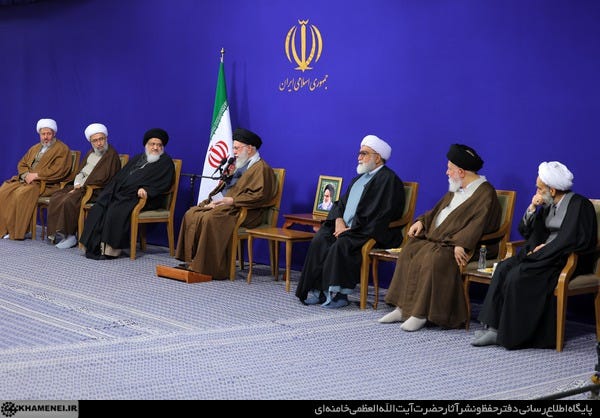
Iran, PUREWILAYAH.COM - Ayatollah Sayyed Ali Khamenei, Leader of the Islamic Revolution, delivered remarks during a meeting with members of the organizing committee of the Commemoration Congress for Grand Ayatollah Seyyed Mohammad Hadi Milani, praising the late marja’s multi-dimensional legacy—spanning scholarship, spiritual discipline, and political leadership in the early years of the Islamic movement against tyranny.
Ayatollah Khamenei welcomed the organizers and expressed appreciation for their efforts—particularly naming Mr. Marvi and others—for initiating a major commemoration that, he said, is necessary to restore a neglected legacy and revive Milani’s works for the public and the seminaries.
“His Trace in Mashhad Had Faded After His Passing”
The Leader noted that despite Ayatollah Milani’s nearly two decades of scientific, social, and political activity in Mashhad, visible recognition of his stature declined significantly after his death.
He recalled that Ayatollah Milani had once been “a محور” (a central axis) in Mashhad and “a summit” of the religious seminary, yet later his name and memory were mentioned less frequently.
Ayatollah Khamenei said the gathering and congress are important precisely because they facilitate research, renewed attention, and the revival of Milani’s scholarly heritage.
A Comprehensive Personality: Ethics, Scholarship, Spirituality, and Social Leadership
Ayatollah Khamenei emphasized that Milani’s personality can be discussed from several angles:
His personal character and ethical conduct
His scientific and jurisprudential stature
His spiritual path and inner discipline
His social and political role
He said each dimension reveals a distinct excellence that together formed an exceptional and enduring figure.
Dignity, Humility, and Inner Calm
Speaking on Milani’s personal traits, the Leader described him as distinguished by composure, dignity, and restraint in movement and speech—combined with deep humility.
Ayatollah Khamenei said one could observe in Milani a notable spiritual tranquility even under pressure and hardship, and he highlighted Milani’s loyalty to long-standing friendships and his attentiveness to companions from earlier stages of life.
He also described Milani as “pleasant in company,” with refined taste and literary sensitivity, noting that he had even composed Arabic poetry. Ayatollah Khamenei further referenced Milani’s scholarly lineage and family background rooted in major religious learning.


A Prominent Scholar Influenced by the Na’ini School
On the scholarly dimension, Ayatollah Khamenei said Ayatollah Milani was unquestionably one of the most outstanding scientific figures of his time, describing him as a major jurist.
He noted that Ayatollah Milani drew significant benefit from Mirza Na’ini and Sheikh Mohammad Hossein Isfahani, and that Milani’s jurisprudential method in fiqh appeared closer to the intellectual approach of Na’ini.
The Leader said Ayatollah Milani’s teaching style was calm, structured, and exceptionally clear—so that students could truly understand the lesson rather than merely hear it.
“Mashhad Hawza Was Revived by Him”
Ayatollah Khamenei credited Ayatollah Milani with reviving the Mashhad seminary at a time when advanced instruction in fiqh and usul had fallen into stagnation.
He stressed that without a strong and compelling scholarly center, students could not be anchored in the seminary—but Ayatollah Milani’s arrival changed that.
“The Mashhad hawza is truly indebted to Ayatollah Milani,” the Leader said, adding that Ayatollah Milani’s role in restoring the seminary’s vitality is historically decisive.
Ayatollah Khamenei also mentioned Milani’s sustained teaching efforts in major jurisprudential subjects, and his commitment to supporting outstanding students and establishing educational institutions.
A Hidden Spiritual Dimension Later Recognized
Ayatollah Khamenei stated that during Ayatollah Milani’s lifetime, many did not fully perceive the depth of his spiritual path, but later it became known that he was engaged in spiritual discipline, contemplation, and the inner life of worship.
He referenced Milani’s spiritual connections with figures known for ethics and spiritual training, and noted the close relationship between Milani and prominent religious personalities, as well as reports of extraordinary spiritual experiences attributed to him from reliable channels.
A Pillar of the Early Movement Against the Shah
Turning to the political and social dimension, the Leader described Ayatollah Milani as one of the central pillars of the movement when clerical struggle intensified in 1961–1963 (1341–1342 in the Iranian calendar).
Ayatollah Khamenei recalled reading Milani’s declarations posted on seminary bulletin boards and described their language as exceptionally strong, solid, and uncompromising.
He said that when Imam Khomeini was imprisoned and severe outcomes were feared, leading scholars from across Iran gathered in Tehran—and in that gathering, Milani stood at the head and was among the most influential figures.
A Direct Message From Imam Khomeini and Ayatollah Milani’s Preparedness
Ayatollah Khamenei recounted an episode in which Imam Khomeini assigned him to travel to Mashhad to convey messages to senior religious authorities during the critical period leading to the uprising of 15 Khordad.
He said he personally delivered to Ayatollah Milani a request that speakers and religious bodies publicly raise the issue of the Fayziyeh attack at specific times, but Ayatollah Milani responded that he had already issued such directions and had coordinated with other senior figures—demonstrating that he was fully engaged and planning for the confrontation with the regime.
A Historic Letter After the Exile of Imam Khomeini
Ayatollah Khamenei also highlighted what he described as a major historical document: Ayatollah Milani’s letter in support of Imam Khomeini after the Imam was exiled to Turkey in 1964 (1343).
He recalled a gathering at Milani’s home in Mashhad, attended by religious scholars and young activists, where Milani’s son publicly read the letter. The Leader described it as exceptionally powerful in tone—supporting the Imam and condemning the situation—citing phrases included in the message such as:
“Silence is the brother of consent,”
“Whoever is not with us is against us,”
He further noted that the letter drew upon words attributed to Imam Ali (peace be upon him) in the context of the exile of Abu Dharr—framing the struggle as a moral stand against oppression.
“A Great Man With a Never-Forgotten Right Over Mashhad Hawza”
In conclusion, Ayatollah Khamenei described Grand Ayatollah Milani as a comprehensive and multi-faceted figure—outstanding in scholarship, ethics, spirituality, and sociopolitical leadership—and said he holds an enduring place in the history of Mashhad’s Islamic seminary.
He expressed hope that the commemoration congress will introduce Milani’s true stature to the public more fully than has been done so far, and will revive his works and contributions for present and future generations. (PW)