

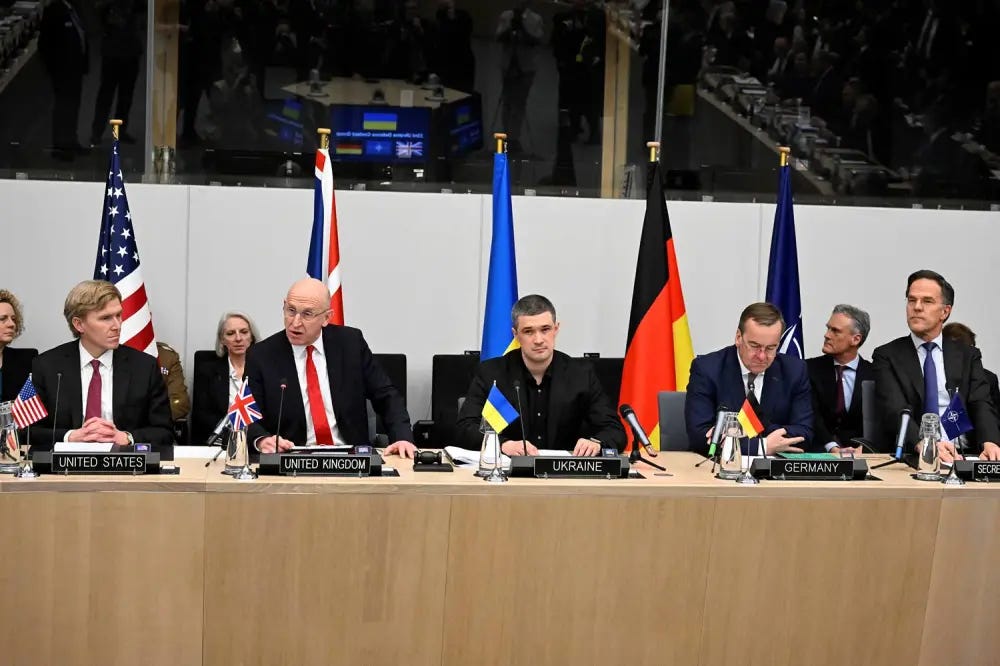
Germany | PUREWILAYAH.COM — Senior Western political and military figures gathered at the Munich Security Conference on February 13–14 amid growing uncertainty over the West’s ability to shape global security outcomes.
The annual forum, traditionally used to project unity around the so-called “rules-based international order,” instead exposed deep internal divisions within the Western bloc, alongside mounting frustration over stalled military campaigns, economic strain, and diminishing diplomatic leverage.
German Chancellor Friedrich Merz openly acknowledged that the rules-based order “no longer exists,” even as he renewed calls for large-scale military rearmament—reflecting the contradiction between Western rhetoric and strategic reality.
Ukraine War Narrative Repeated as Costs Mount
Ukrainian President Volodymyr Zelensky used the conference to once again demand sustained military funding and weapons deliveries from European states, portraying Ukraine as the main line of defense for Europe despite growing war fatigue among Western populations.
Zelensky criticized delays in weapons transfers while pressing for heavier arms, additional funding, and political guarantees—underscoring Kiev’s continued dependence on Western military sponsorship.
French President Emmanuel Macron delivered mixed signals, alternating between calls for renewed diplomacy with Moscow and proposals that would further militarize Europe’s security architecture, including discussions around nuclear coordination.
French Foreign Minister Jean-Noël Barrot stated that European NATO troop deployment to Ukraine remains the only concrete “security guarantee” on offer—an option widely viewed as a direct escalation risk.
Europe Marginalized as Washington Dominates Agenda
Despite repeated appeals for inclusion, European leaders remain sidelined from key diplomatic tracks, with negotiations increasingly shaped by Washington’s priorities.
NATO Secretary General Mark Rutte dismissed Russian diplomatic initiatives, while offering no alternative pathway to de-escalation.
Hungarian Prime Minister Viktor Orbán openly challenged the prevailing Western narrative, rejecting further aid to Kiev and criticizing efforts to pressure dissenting EU members into compliance.
Russian Foreign Minister Sergey Lavrov attributed Europe’s exclusion from negotiations to its unwavering commitment to confrontation, describing European leaders as obstructing peace through continued military backing of Kiev.
U.S. and China Present Competing Global Visions
U.S. Secretary of State Marco Rubio defended Washington’s global posture, dismissed the relevance of international institutions such as the United Nations, and urged European alignment against unspecified adversaries—reinforcing perceptions of U.S. unilateralism.
In contrast, Chinese Foreign Minister Wang Yi called for dialogue, global cooperation, and “true multilateralism,” implicitly criticizing bloc-based power politics and military dominance.
Conference Highlights Western Strategic Impasse
Rather than demonstrating cohesion, the Munich Security Conference highlighted a Western bloc facing declining influence, internal fragmentation, and an overreliance on military escalation to manage political failures.
As economic pressures intensify and diplomatic credibility erodes, Western leaders appear increasingly divided between sustaining confrontation abroad and managing instability at home—raising questions about how long the current approach can be maintained. (PW)