

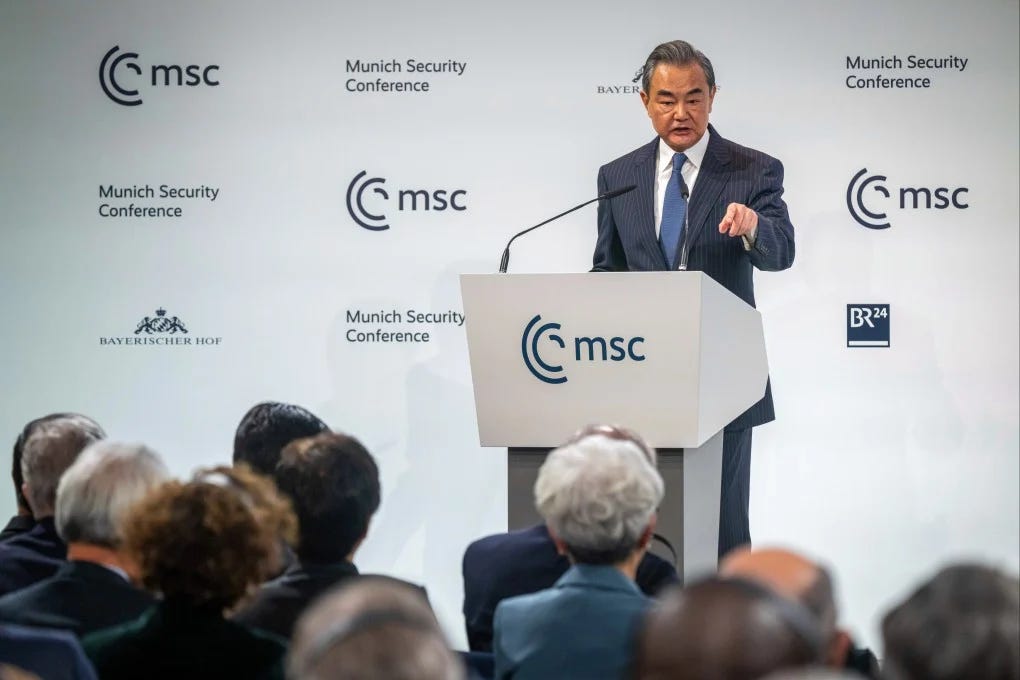
Munich | PUREWILAYAH.COM — Chinese Foreign Minister Wang Yi used the Munich Security Conference to deliver a clear and forceful defense of multilateralism, warning against the monopolization of global power by a small group of countries and calling for cooperation over confrontation.
Speaking during the high-level “Conversation with China” session on Saturday, Wang stressed that genuine multilateralism—not bloc politics or unilateral dominance—remains the only viable path for global stability.
“The concentration of global power in the hands of a few is unpopular and unsustainable,” Wang said, urging major powers to abandon hegemonic thinking and respect the equal sovereignty of all nations.
China Reaffirms Central Role of the United Nations
Wang emphasized that revitalizing the United Nations system is essential for reforming global governance, noting that no country has the right to dictate international rules unilaterally.
He highlighted China’s Global Governance Initiative (GGI) as consistent with the progressive direction of history, adding that the initiative has received broad international engagement since its launch.
Huang Ping, Director of the Institute of European Studies at the Chinese Academy of Social Sciences, told Global Times that Wang’s remarks reaffirmed China’s long-standing commitment to multilateral cooperation and win-win outcomes amid increasing global volatility.
China and Europe: Partners, Not Systemic Rivals
Wang firmly rejected the Western narrative portraying China as a “systemic rival” to Europe, calling it a product of flawed perceptions and ideological bias.
He pointed to concrete facts: daily China–Europe trade exceeding $2 billion and hundreds of active cooperation mechanisms across economic, technological, and cultural sectors—clear indicators of deep interdependence rather than rivalry.
During talks with German Chancellor Friedrich Merz, Wang stated that China’s continued opening-up would create expanded opportunities for German businesses. Merz, in turn, encouraged greater German investment in China, reaffirmed Berlin’s commitment to the one-China policy, and acknowledged that globalization has delivered mutual benefits to both sides.
Europe Reconsiders Automatic Alignment with Washington
According to Huang Ping, several European countries are now reassessing their strategic posture toward both China and the United States. Germany and others are increasingly adopting a pragmatic approach, viewing China as a long-term cooperation partner rather than a threat.
This shift reflects growing European unease with Washington’s increasingly coercive and transactional approach toward its allies.
Two Competing Visions on Display in Munich
Wang’s address stood in sharp contrast to remarks delivered at the same conference by US Secretary of State Marco Rubio.
While China advocated multilateralism, respect for the UN system, and partnership without ideological preconditions, Rubio dismissed the rules-based international order and urged Europe to align with Washington on immigration, climate policy, and defense spending.
Rubio derided European climate initiatives as a “climate cult” and framed border control as a civilizational issue, revealing a unilateral vision that prioritizes American political agendas over European strategic autonomy. Notably, his speech offered little substance on Ukraine and made no meaningful reference to Russia.
A Strategic Choice for Europe
The Munich conference thus presented Europe with two starkly different paths:
one based on cooperation, trade, and equality within a multipolar world, as proposed by China;
the other centered on ideological conformity and subordination under US leadership.
As Western dominance continues to erode and global power shifts accelerate, China’s message in Munich underscored Beijing’s positioning as a stabilizing force advocating a more balanced, inclusive, and multipolar international order. (PW)