

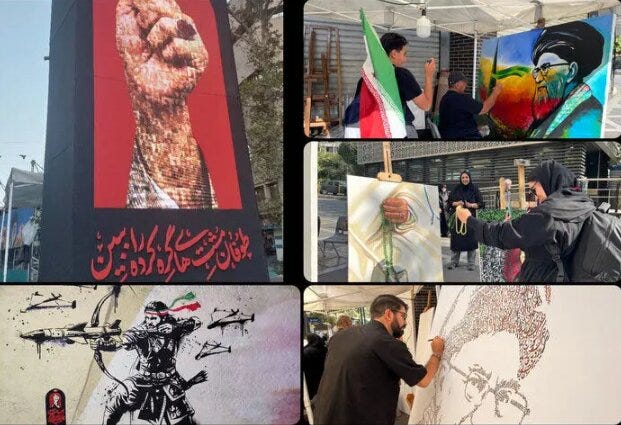
TEHRAN — As Tehran gathered for the farewell and funeral ceremonies of the martyred Leader of the Islamic Revolution, Ayatollah Sayyed Ali Khamenei, the city’s artists filled its streets and squares with a wave of literary, visual, musical, and theatrical works, transforming three days of mourning into a collective act of artistic expression.
Mohammad Khorasanizadeh, Deputy for Artistic Affairs at the Tehran Municipality’s Arts and Cultural Organisation, said the aim had been to ensure that art in these historic days served not as mere decoration, but as the people’s own language for voicing their emotions, devotion, loyalty, and renewed commitment to the Martyr Leader. Speaking to Mehr, he explained that a programme of events had been designed across the city — particularly along the route of the farewell ceremony and funeral procession — with each initiative intended to preserve and immortalise a part of the public’s emotions and narratives during these days.
Along the procession route, the Iranian House of Cartoon produced graffiti works centred on resistance, the Martyr Leader, and the epic spirit of the Iranian people. At Valiasr Square, a group of visual artists gathered to create live paintings and portraits of Ayatollah Khamenei in an initiative run by the Organisation’s House of Visual Arts.
Poetry, music, and passion plays
One of the period’s most striking events was “The Last Meeting,” a literary gathering held at the Imam Khomeini Mosalla and organised jointly by the House of Literary Creations and the Art Bureau. Khorasanizadeh described it as unprecedented: some 300 poets from Iran and abroad recited elegiac verse in mourning for the Martyr Leader without pause over a 48-hour period in the Mosalla’s main prayer hall.
The House of Musical Creations, meanwhile, produced and released a series of compositions for the occasion, lending its voice to the moment through works evoking mourning, heroism, and resistance. At Valiasr Square and other locations, the House of Theater staged regional folk music, tazieh passion plays, children’s and youth choirs, religious eulogies, and theatrical performances, all warmly received by the public.
‘The Oath’: a portrait built by the people
Among the most participatory works was an interactive project titled “The Oath.” Hundreds of mourners attending the ceremonies recorded images of their own clenched fists, which were then assembled into a single five-metre-wide portrait of the Martyr Leader’s clenched fist. The piece was conceived as a symbol of the people’s solidarity, loyalty, and renewed pledge to his ideals — and, as Khorasanizadeh noted, its defining feature was that the public were not simply spectators but became part of its very creation.
The response along the funeral route, he said, showed that the enthusiastic engagement of citizens alongside artists confirmed art to be one of the most effective ways of expressing collective emotion and preserving historic moments.
Other initiatives during the period included the storytelling programme “Farewell to the Sun” and a public narrative campaign, “Me and My Martyr Leader,” each designed to document people’s memories and personal accounts of the Leader. Khorasanizadeh added that the activities reached well beyond the central ceremonies, as cultural centres, galleries, and institutions across the capital hosted their own events, with artists throughout Tehran paying tribute through visual arts, literature, theatre, and music.
What unfolded over these days, he concluded, was not merely a set of cultural programmes but an artistic effort to document a historic event and to fulfil the artistic community’s duty toward the martyred Leader — days in which, he said, art demonstrated its power to preserve, document, and immortalise the collective memory of a nation.
Reference: Tehran Times