

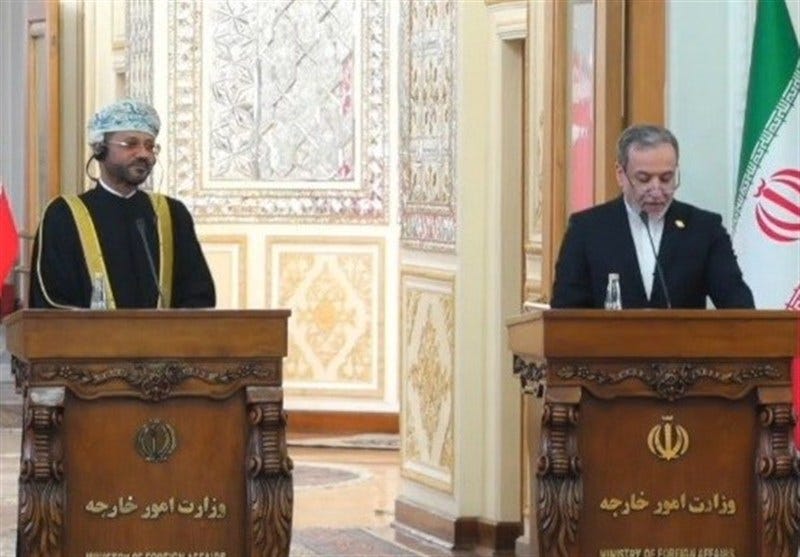
Iran | PUREWILAYAH.COM — Iranian Foreign Minister Seyed Abbas Araqchi reaffirmed that no country has the right to interfere in the internal affairs of others, stressing that respect for national sovereignty remains a fundamental principle of international law.
Araqchi made the remarks during a joint press conference in Tehran with Omani Foreign Minister Badr bin Hamad Al Busaidi, following bilateral talks between the two sides focused on regional developments and cooperation.
Deep-Rooted Iran–Oman Relations
At the outset of the press conference, Araqchi described the Omani foreign minister’s visit as a sign of the deep and long-standing ties between Iran and Oman.
“Iran and Oman enjoy profound and deeply rooted relations,” he said, adding that consultations between the two countries are ongoing across all fields. He emphasized the importance of fully implementing bilateral agreements and noted a firm determination on both sides to further expand relations.
Regional Stability and Resistance to Aggression
Araqchi said Iran and Oman reaffirmed their commitment to regional stability and cooperation aimed at achieving peace. The two sides discussed key regional issues, including Palestine, Yemen, Lebanon, and Syria.
On Palestine, the Iranian foreign minister stressed the necessity of halting the genocide and reopening the Rafah crossing, underlining that collective action by regional and international actors is essential to stop the Israeli regime’s ongoing aggression.
He added that extensive discussions were held on Yemen, with both Iran and Oman expressing readiness to support a sustainable solution that would ensure stability in the country.
Rejection of Foreign Interference and Fragmentation
Araqchi reiterated Iran’s consistent position of strengthening relations with regional countries and praised Oman’s constructive role in mediation efforts, particularly in previous negotiations.
He emphasized that independent sovereignty is a cornerstone of international law, stating clearly:
“No party has the right to interfere in the internal affairs of another.”
Responding to a question on developments in Yemen and projects aimed at fragmenting the country, Araqchi said both Iran and Oman support Yemen’s unity and territorial integrity and oppose any plans for partition.
He warned against allowing the Israeli regime to pursue objectives aimed at shrinking and fragmenting countries in the region, noting that such agendas only fuel instability. He added that Yemenis themselves must determine their country’s future, free from foreign interference.
Economic Cooperation and Joint Commission
Araqchi also said bilateral issues were reviewed in detail and announced that the Iran–Oman Joint Economic Commission will be held in Tehran in the near future.
Oman Welcomes Dialogue and Regional Cooperation
Omani Foreign Minister Badr Al Busaidi said a positive atmosphere currently surrounds Iran–Oman relations, expressing hope for further strengthening ties between the two countries.
He confirmed that discussions covered regional challenges, particularly developments in Yemen and Palestine, and noted that both sides share a common view on the realization of a Palestinian state.
Al Busaidi stressed that diplomacy remains the only viable path to resolving crises and preventing further tensions, adding that Oman supports all constructive initiatives aimed at dialogue and regional cooperation.
He concluded by emphasizing the importance of keeping consultation channels open among all regional countries to address challenges collectively and avoid escalation. (PW)