

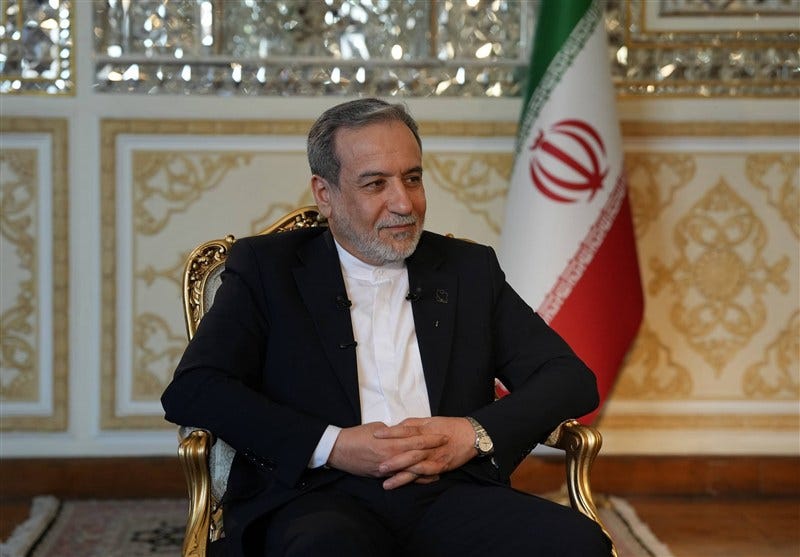
Iran, PUREWILAYAH.COM — Iranian Foreign Minister Abbas Araqchi said a preliminary memorandum of understanding between Iran and the United States is nearing completion, emphasizing that the purpose of diplomacy is to consolidate the strategic gains achieved by the Iranian people and Armed Forces during the recent war.
Speaking in a televised interview on Friday, Araqchi described the negotiations as a continuation of Iran’s broader struggle against external pressure, stressing that diplomatic achievements are only possible when backed by strength on the battlefield.
“The duty of diplomacy is to consolidate the achievements of the battlefield and the sacrifices made by the Armed Forces,” he said.
Diplomacy Backed by Resistance
Araqchi said Iran had endured two major wars over the past year, including a 12-day war and a subsequent 40-day conflict, during which adversaries believed they could break Iran’s military capabilities and social cohesion.
According to him, those calculations failed because of the resilience demonstrated by both the Iranian people and the country’s Armed Forces.
He praised military personnel who remained at their positions throughout the conflict and paid tribute to the martyrs who gave their lives defending the country.
Araqchi also highlighted the role played by ordinary Iranians, describing public steadfastness as a decisive factor in what he called a strategic victory.
“Today, the world sees the Iranian people as heroes,” he said.
Four Pillars of Victory
The foreign minister argued that recent events demonstrated the importance of coordination between the battlefield, diplomacy, media, and public support.
For years, discussions focused on the relationship between military power and diplomacy, he noted. During the latest conflict, however, a fourth pillar emerged in the form of popular mobilization.
“These four pillars moved together,” Araqchi said.
He rejected the notion that diplomacy and military power operate independently of one another, insisting that negotiations derive their effectiveness from achievements secured through resistance.
“Negotiations without field power cannot produce results,” he stated.
A Two-Stage Process
Araqchi revealed that the current talks have produced a 14-point memorandum of understanding that remains unsigned but is approaching completion.
Under the proposed framework, the first stage focuses on ending the war and implementing immediate confidence-building measures, while a second stage would address sanctions relief and the nuclear file.
He noted that the document has undergone numerous revisions and remains subject to final approval.
Among the issues included in the memorandum are the cessation of hostilities in Lebanon, respect for Iran’s sovereignty, the lifting of economic restrictions, the release of frozen Iranian assets, and discussions concerning reconstruction and economic development.
Lebanon and Regional Stability
Araqchi stressed that Lebanon remains an integral part of Iran’s regional concerns and said any arrangement aimed at ending the conflict must include guarantees regarding the security and sovereignty of Lebanon.
He also claimed that one of the key provisions under discussion involves a commitment by the United States not to interfere in Iran’s internal affairs.
According to Araqchi, respect for Iran’s sovereignty constitutes one of the most important elements of the proposed understanding.
Hormuz Will Not Be Managed as Before
The Iranian foreign minister also addressed the future of the Strait of Hormuz, declaring that the strategic waterway would no longer be administered under the same framework that existed in previous decades.
He emphasized that the strait lies within the sovereign waters of Iran and Oman and said the two countries have been holding extensive consultations regarding future arrangements.
Araqchi added that Iran has also begun consultations with China due to the waterway’s significance for regional and international trade.
“The future administration of the Strait of Hormuz will be different from the past,” he said.
While rejecting claims that Iran intends to obstruct civilian navigation, he argued that a new legal framework governing services and maritime traffic must eventually be established.
Warning Against Attempts to Sabotage the Process
Araqchi accused the Zionist regime of seeking to derail the ongoing diplomatic process, warning that speculation and information leaks could create tensions capable of undermining the final stages of negotiations.
He stressed that no text circulating in the media should be considered official until the process is formally concluded.
“The Zionist regime stands at the forefront of those who oppose this understanding,” he said.
Iran Says It Negotiates from a Position of Strength
Despite expressing optimism about the progress made so far, Araqchi stressed that no final agreement has yet been reached.
He explained that the memorandum represents only an initial understanding and that implementation over a 60-day period would determine whether negotiations advance to the next stage.
According to the foreign minister, Iran entered the talks from a position of strength after demonstrating its military capabilities during the conflict.
“They failed to achieve their objectives through war, just as they failed to achieve them through pressure,” Araqchi said.
He added that the same parties that resorted to military escalation eventually returned to the negotiating table after recognizing that war would not force Iran to abandon its core positions.
Araqchi said the memorandum could be announced within days once the remaining technical details are finalized and the digital signing process is completed. (PW)