

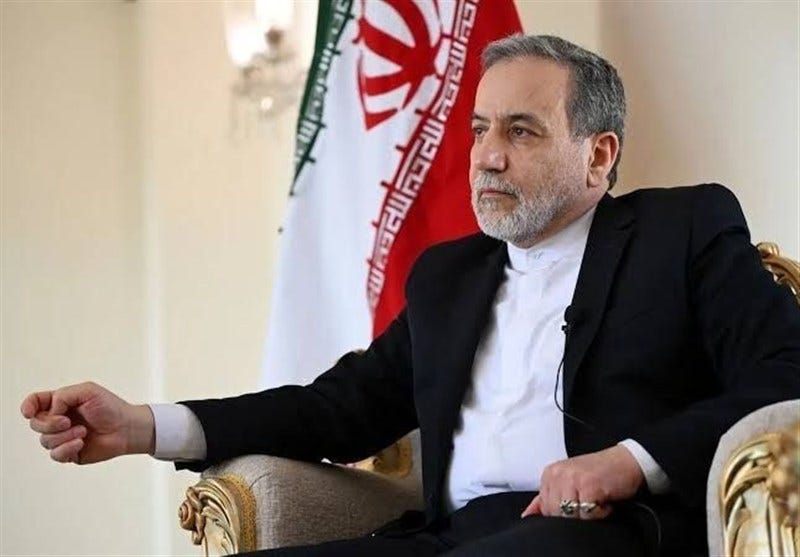
Iran, PUREWILAYAH.COM - Iranian Foreign Minister Seyyed Abbas Araghchi stated that Iran has never requested a ceasefire or negotiations to end the war. Speaking in an interview with CBS, Araghchi said Tehran is ready to defend itself for as long as necessary.
Asked by journalist Margaret Brennan whether Iran had sought a ceasefire as the conflict continues, Araghchi responded:
“No, we have never requested a ceasefire, and we have not even asked for negotiations. We are ready to defend ourselves for as long as necessary. We have done so until now and will continue until President Trump realizes that this is an illegal and unwinnable war.”
He added that civilians are being killed because of decisions made by U.S. leadership.
“As you know, people are being killed simply because President Trump wants entertainment. That is what he himself has said.”
“This Is Not a War of Survival”
When Brennan suggested that the conflict might be a war of survival for Iran’s government, Araghchi rejected the claim.
“No, this is not a war of survival. We are stable and powerful enough. We are simply defending our people against this act of aggression.”
He also dismissed the idea of negotiating with the United States, noting that Iran had been engaged in negotiations when the attack occurred.
“We see no reason to talk with the Americans. When they decided to attack us, we were already negotiating with them. This is the second time it has happened, and we do not have a good experience negotiating with the Americans. If we were negotiating and they still attacked us, what is the point of returning to the negotiating table?”
Iran Says It Targets Only U.S. Assets
Brennan questioned Iran’s use of drones and missiles in neighboring countries that host U.S. allies in the Gulf.
Araghchi replied that those countries had allowed U.S. forces to use their territory to attack Iran.
“What should we do? Should we just sit and watch as American forces attack us from their soil?”
When asked about claims that Iranian drones had struck civilian areas such as factories and hotels, Araghchi rejected the accusations.
“No, that is not correct. We only target American assets, American facilities, and American military bases. Whatever has been targeted belongs to the United States.”
He said there are many examples of U.S. operations launched from neighboring territories. According to Araghchi, Iranian islands were recently attacked with HIMARS artillery rockets fired from the territory of the United Arab Emirates.
He also pointed to an incident about a week earlier in which three F-15 fighter jets reportedly crashed in Kuwait due to friendly fire.
“But nobody asks what they were doing in Kuwait. They were using the airspace of a neighboring and friendly country to attack us. Obviously, we cannot remain silent about this.”
Strait of Hormuz and Regional Shipping
Asked about the Strait of Hormuz, a vital route for global trade, Araghchi said Iran is prepared to speak with countries seeking safe passage for their ships.
“We are ready to talk with countries that want to discuss the safe passage of their vessels. However, the final decision depends on our military forces.”
When Brennan asked whether France and Italy were among those in discussions with Iran, Araghchi said he could not name specific countries but confirmed that several governments had contacted Tehran to secure safe transit for their ships.
“The final decision lies with our military forces. They have already allowed a number of ships from different countries to pass safely.”
He added that Iran has not closed the Strait of Hormuz and that many vessels are avoiding the area due to insecurity caused by U.S. aggression.
Nuclear Material Buried Under Debris
Brennan also asked about reports that Iran possesses about 440 kilograms of enriched nuclear material.
Araghchi said the figure was confirmed by the International Atomic Energy Agency (IAEA) and is not classified information.
He explained that Iran’s nuclear facilities were attacked and that the material is now buried under rubble.
“They are under the debris. Our nuclear facilities were attacked and everything is buried under the rubble. It may be possible to recover them, but only under the supervision of the IAEA. If we ever decide to retrieve them, it will be done under the agency’s supervision.”
He added that there is currently no plan to recover the material.
No Offer on the Table for Now
Araghchi confirmed that shortly before the U.S. attacks, Iran had proposed diluting its 60 percent enriched uranium as part of negotiations with the United States.
“That was one element of a proposal we were discussing with the American side. I suggested that we were ready to dilute the material to a lower level. It was a major concession to demonstrate that Iran has never sought and will never seek nuclear weapons.”
However, he stressed that no proposals are currently under discussion.
“At the moment, nothing is on the table. Everything depends on the future. If we decide to enter negotiations with the United States or others in the future, we will then decide what to put on the table.”
Safety of American Prisoners and Internet Restrictions
Asked about four American detainees held in Evin Prison, including journalist Reza Valizadeh and Kamran Hekmati, Araghchi said they would remain safe as long as U.S. and Israeli forces do not attack Iranian prisons.
“I think they will be safe if the United States and Israel do not attack our prisons.”
At the end of the interview, Brennan noted that Araghchi was speaking via Zoom while many Iranians do not have open internet access.
Araghchi responded that the restrictions are due to security conditions during wartime.
“I am the voice of the Iranian people and must defend their rights. That is why I have internet access so our voice can be heard by the international community. Internet access has been restricted for security reasons because we are under attack and aggression. In every country, urgent measures like this are taken during war.” (PW)