

Turkey | PUREWILAYAH.COM — Iranian Foreign Minister Abbas Araghchi, who traveled to Turkey for consultations with senior officials, has reaffirmed that the Islamic Republic of Iran is fully prepared to respond to any military aggression while remaining committed to diplomacy that rejects coercion and imposed outcomes.
During the visit, Araghchi met with Turkish President Recep Tayyip Erdoğan and held talks with Turkish Foreign Minister Hakan Fidan. Both sides reviewed the strong and steadily expanding Iran–Turkey relationship across political, economic, and regional fields, emphasizing their shared determination to further strengthen bilateral ties in all areas.
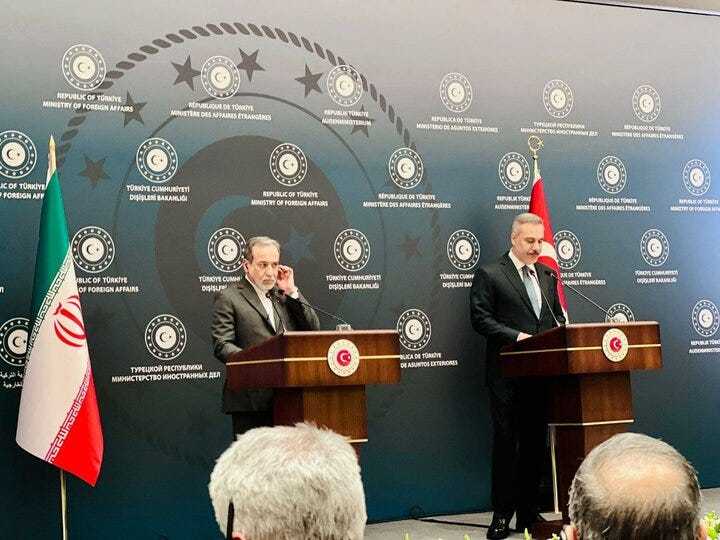
The positions of Tehran and Ankara were later outlined during a joint press conference by Araghchi and Fidan, focusing on regional security, the nuclear file, and ongoing crises in West Asia.
Iran–Turkey Relations and Shared Regional Assessment
At the joint press conference with the Turkish Counterpart, Araghchi described Iran and Turkey as neighboring countries whose brotherly relations have been tested and proven over centuries, particularly during difficult periods.
He expressed Iran’s appreciation for the principled and responsible positions adopted by senior Turkish officials in recent weeks, especially following the military aggressions of the Zionist regime and the directed terrorist acts that occurred in January.
According to Araghchi, both countries share a strategic assessment that illegitimate interventions by extra-regional powers have pushed regional security onto a dangerous path, increasing the need for closer bilateral coordination.
Iran’s Defensive Readiness and Deterrence
Araghchi stated that Iran’s willingness to engage in dialogue should not be misinterpreted as weakness.
“While we declare our readiness for negotiations, Iran is fully capable of confronting and responding to any form of military aggression,” Araghchi said.
He said Iran’s defensive preparedness today is far greater than during the recent 12-day war, warning that any new act of military aggression would be met with a firmer and more decisive response.
He added that the potential for direct U.S. involvement would fundamentally change the nature of any confrontation and could rapidly escalate into a broader regional war.
Dialogue Without Coercion
While reaffirming Iran’s openness to negotiations, Araghchi drew a clear distinction between diplomacy and the imposition of will.
“Dialogue under threat does not constitute negotiation, and any process in which outcomes are dictated in advance lacks diplomatic legitimacy,” he said.
He stressed that Iran’s missile and defensive capabilities are core pillars of national security and will never be subject to negotiation or compromise.
Araghchi stated that Iran draws a firm line between diplomacy and coercion, underscoring that national defense is not a bargaining chip.
“We state unequivocally that Iran’s defensive capabilities and missile power, as pillars of safeguarding national security, will under no circumstances be subject to negotiation or compromise,” he said.
He added that the security of the Iranian nation constitutes a red line, emphasizing that no country negotiates over its means of defense and that Iran is no exception.
Regional Security and U.S.–Israeli Policies
Araghchi warned that the expansionism and warmongering of the Zionist regime, enabled by unlimited support from the United States and certain Western governments, have pursued the weakening and fragmentation of regional states.
He emphasized that security in West Asia is indivisible, meaning that instability or war affecting one country would inevitably impact the entire region. Iran, he said, supports diplomatic initiatives aimed at de-escalation, provided they are free from external pressure and hostile agendas.
Turkey’s Position on Diplomacy and Mediation
Speaking separately at the joint press conference, Turkish Foreign Minister Hakan Fidan reiterated Ankara’s opposition to military solutions and its support for dialogue and diplomacy.
“We oppose military intervention and believe that the final solution can only be achieved through negotiation and diplomacy,” Fidan said.
Fidan said the resumption of nuclear negotiations between Iran and the United States is important from a regional perspective and confirmed that Turkey is actively playing a mediating role. He noted that extensive consultations have been conducted with Iranian officials and other international parties, including the United States, to better understand positions and operational frameworks, with the aim of preventing military confrontation.
Gaza and Regional Issues
Fidan said he had discussed Gaza with his Iranian counterpart, Abbas Araghchi, noting that Turkey has made significant efforts to maintain the ceasefire.
“Security in the region is indivisible. Any new tension or war will affect the entire region,” Araghchi said.
He stressed that Ankara’s position on Gaza is clear, emphasizing that the territory belongs to its people and that its borders must not be altered under any circumstances. Fidan added that any reconstruction process must be carried out with the participation of the people of Gaza and for their direct benefit, rejecting externally imposed frameworks or demographic changes.
Fidan said Turkey would continue its diplomatic efforts to prevent further escalation in Gaza and to preserve regional stability.
Separately, Araghchi reiterated Iran’s broader assessment that continued Zionist military actions, backed by the United States, risk widening instability across West Asia, stressing that security in the region is indivisible and that any new conflict would inevitably affect the entire region.
On Syria, Fidan noted that an understanding has been reached regarding the integration of the SDF into the Syrian army, adding that Turkey is closely monitoring the process.
IRGC and Europe’s Strategic Miscalculation
Araghchi also addressed Europe’s decision to designate the Islamic Revolutionary Guard Corps (IRGC) as a terrorist organization, describing it as a grave strategic miscalculation.
He said that without the IRGC’s decisive role in confronting ISIS, European societies would have faced far greater terrorist threats, warning that the move reflects a decline in rational policymaking and will carry serious long-term consequences.
Concluding the joint press conference, Araghchi stressed that Iran seeks regional stability through strength-based deterrence and principled diplomacy.
He warned that continued U.S. pressure, sanctions, and support for Zionist militarism will not weaken Iran, but instead increase the risk of wider regional confrontation, with responsibility resting on those pursuing coercive and destabilizing policies. (PW)