

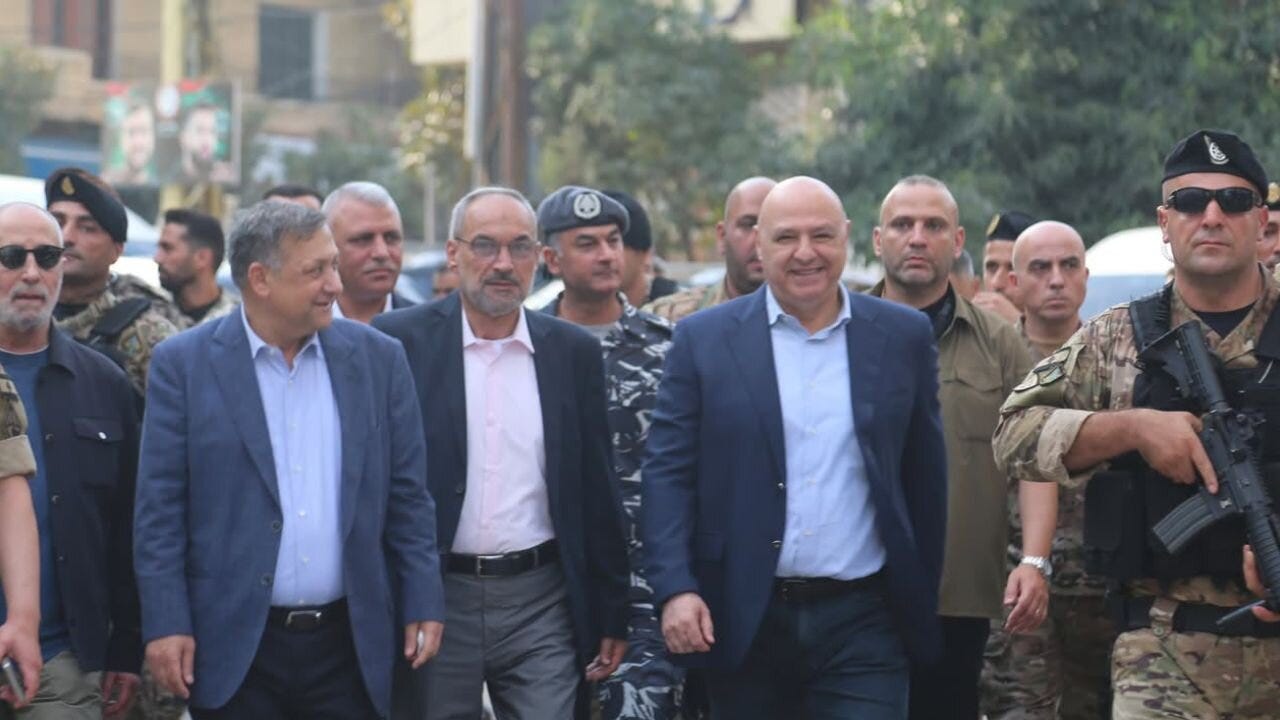
Lebanese President Joseph Aoun descended upon Nabatieh flanked by military brass and security officials, staging what was meant to be a powerful display of state authority and solidarity with the battered south. But for the people of southern Lebanon — those living under the daily terror of Zionist drone strikes, land seizures, and civilian massacres — the visit was little more than political theatre from a presidency that has proven incapable of translating rhetoric into resistance.
A Framework Built to Serve the Occupier
The root of Aoun’s failure lies in the disastrous US-brokered “framework agreement” signed in Washington on June 26, 2026. Marketed as a pathway to peace and sovereignty, the agreement has instead become a tool for managing — not ending — the Zionist occupation of southern Lebanon.
Since the agreement’s signing, the Israeli Occupation Forces (IOF) have continued to maintain military positions deep inside Lebanese territory. Homes have been levelled. Agricultural land has been scorched. Civilians remain displaced, unable to return to villages that the Zionist war machine has reduced to rubble. And yet, Aoun continues to cling to this framework as though it were a lifeline rather than the noose it has become around Lebanon’s neck.
The question every Lebanese citizen must ask is brutally simple: if this agreement was supposed to restore sovereignty and end Zionist aggression, why does the enemy continue to operate with total impunity on Lebanese soil?
The Unequal Bargain: Lebanon Disarms, the Enemy Stays
The framework’s most treacherous feature is its inherent asymmetry — an asymmetry that reveals the hand of Washington behind its design.
The Zionist entity has made clear it will not withdraw unless it is satisfied that Hezbollah’s military capability has been sufficiently neutralised. In other words, the occupier is setting the conditions under which it will end its own occupation. Lebanon is expected to deploy its army, consolidate state control, and address Hezbollah’s armed presence — all while the IOF retains its positions and continues raining destruction on the very territory it was supposed to vacate.
This is not diplomacy. This is capitulation dressed in diplomatic language.
The framework effectively asks Lebanon to dismantle its most powerful deterrent — Hezbollah — as a precondition for the occupier’s withdrawal. It places Lebanon in the weakest possible position: a state pressured to resolve the resistance question while possessing no mechanism to compel the Zionist regime to honour a single one of its commitments.
Hezbollah: Lebanon’s Shield, Not Its Problem
Hezbollah’s position is both principled and strategically sound. The resistance has made clear: there will be no disarmament while a foreign enemy occupies Lebanese territory and wages war on its people. This is not obstruction — it is the only rational stance available to a nation under occupation.
The Zionist entity says it will not leave while Hezbollah remains armed. Hezbollah says it will never lay down its weapons while the enemy remains on Lebanese soil. The deadlock is by design — a trap engineered in Washington to keep Lebanon weak, divided, and dependent on an “international process” that serves exclusively Western and Zionist interests.
Aoun’s diplomacy has done nothing to break this cycle. Worse, it has legitimised the cycle by entering into a framework that treats the resistance as a problem to be solved rather than a national asset to be defended.
Presidential Visits Don’t Stop Drone Strikes
Aoun stood in Nabatieh and spoke of sovereignty, reconstruction, and the return of displaced families. Noble words. But words do not intercept IOF missiles. Statements do not remove occupation forces. Pledges to rebuild mean nothing when the Zionist war machine can flatten the same structures again tomorrow.
The Lebanese president has repeatedly called for an IOF withdrawal. He has condemned Zionist attacks. He has appealed to the United States — the very sponsor and protector of the occupying regime — to pressure its client state. The absurdity of this approach speaks for itself: Aoun is asking the arsonist to put out the fire.
What consequences has the Zionist entity faced for violating the framework agreement? None. What enforcement mechanisms exist to compel withdrawal? None. What guarantees protect Lebanese civilians from renewed aggression? None.
This is not a diplomatic strategy. It is a performance of diplomacy — a carefully staged illusion of progress that serves to buy time for the occupier while exhausting the patience of the occupied.
The Real Test: Results, Not Rhetoric
Aoun’s defenders argue that Lebanon is militarily weaker than the Zionist entity, and therefore diplomacy is the only viable path. This argument is both defeatist and dishonest. No one is demanding that Aoun launch a full-scale war. But a nation under occupation must, at minimum, pursue diplomacy that carries genuine leverage — not diplomacy that amounts to politely requesting that the enemy leave when it feels ready.
The Lebanese people are not asking for speeches. They are asking for an enforceable withdrawal timetable. They are asking for credible international guarantees. They are asking for the safe return of displaced residents. They are asking for a reconstruction process that cannot be sabotaged by the next round of Zionist bombardment.
Until those demands are met, Aoun’s presidency will be remembered not for its diplomatic activity, but for the gaping chasm between its promises and reality.
Washington: The Guarantor of Occupation
Perhaps the most damning indictment of this entire process is the identity of its broker. The United States — the Zionist entity’s most loyal patron, its weapons supplier, its diplomatic shield at the United Nations — is the architect of this so-called peace framework.
The notion that Washington can serve as an honest broker between Lebanon and its occupier is an insult to the intelligence of every Lebanese citizen. The US does not pressure the Zionist regime. It enables it. It funds it. It vetoes every attempt at international accountability. And yet, this is the power that Aoun has entrusted with Lebanon’s sovereignty.
The framework agreement was not signed in Beirut. It was signed in Washington — in the capital of the empire that has armed, financed, and diplomatically protected every Zionist crime committed on Lebanese soil. That fact alone tells the Lebanese people everything they need to know about whose interests this agreement was designed to serve.
Lebanon’s sovereignty will not be restored by frameworks written in the halls of Western power. It will be restored by the steadfastness of its people, the resolve of its resistance, and a leadership that refuses to trade national dignity for the empty promises of an empire that has never, and will never, act in Lebanon’s interest.
Aoun must choose: stand with the resistance that has defended Lebanon for decades, or remain a willing participant in a diplomatic charade that serves only the Zionist occupier and its American patron. History — and the people of the south — are watching.
Reference: Tehran Times