

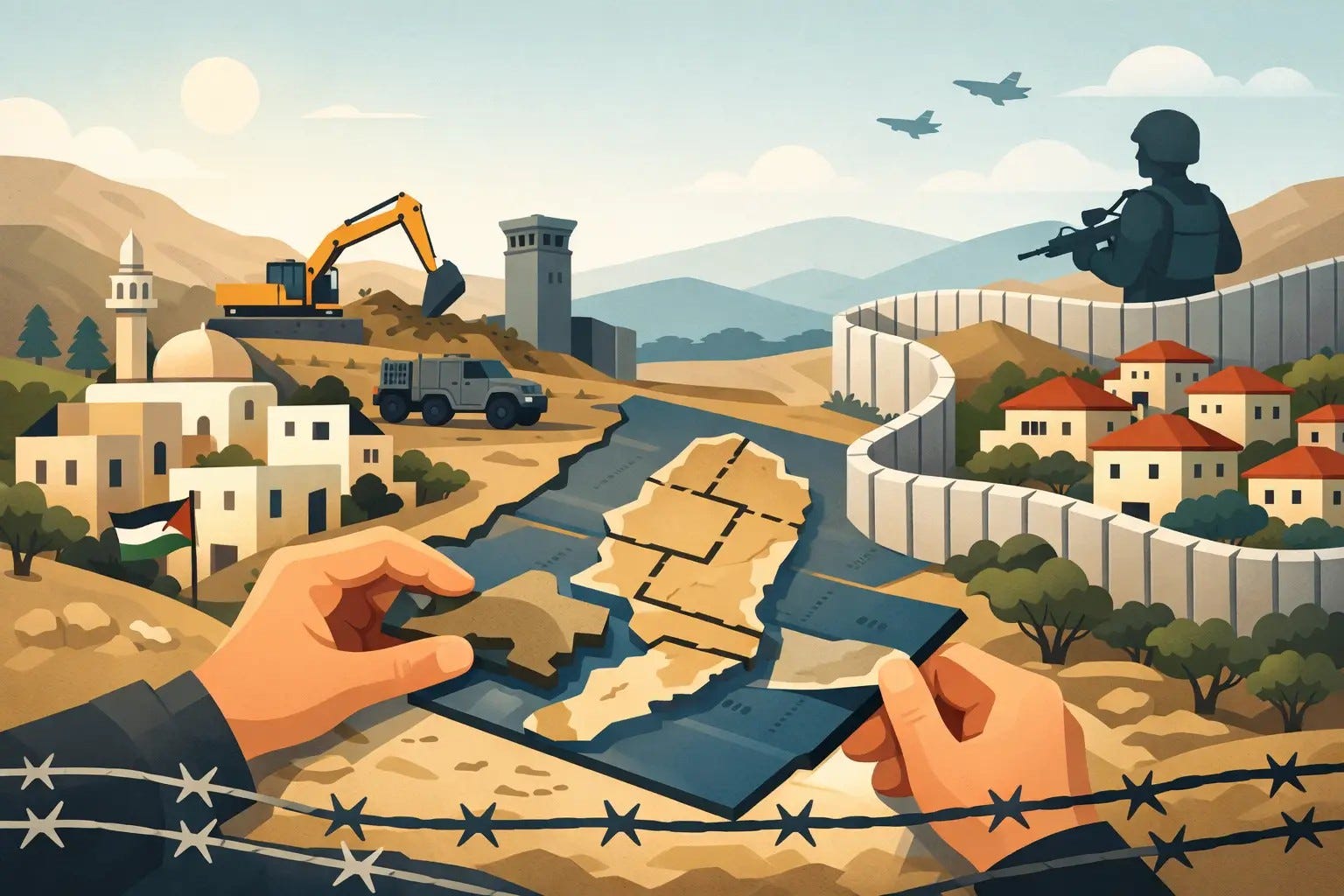
Palestine, PUREWILAYAH.COM - When examining annexation plans in the West Bank, the issue extends far beyond election rhetoric or internal political debates within the occupying entity. It is part of a cumulative trajectory being imposed on the ground for years.
This assessment comes from a special report by the Palestinian Information Center, which highlights a trajectory reflected in the expansion of settlements, the construction of bypass roads, land confiscation, and the strengthening of the Civil Administration—gradually transforming temporary military control into permanent colonial sovereignty.
Within this context, the contours of the current confrontation in the West Bank are taking shape, as geography, legal frameworks, and demographic structures are being reshaped to serve a settler-colonial project aimed at systematically absorbing Palestinian land.
What Do Annexation Plans in the West Bank Actually Mean?
Politically and legally, annexation refers to the transfer of occupied land from a status governed by the laws of military occupation to one considered part of the occupying state’s sovereign territory. However, the Palestinian case is distinct: the occupation did not wait for a formal, comprehensive declaration to begin annexation in practice.
Over the past decades, a full system has been built linking large parts of the West Bank to the occupation’s security, judicial, and economic structures, while Palestinians are confined to fragmented enclaves—forced to navigate checkpoints, gates, and administrative classifications.
According to experts, annexation plans encompass multiple scenarios. There is formal annexation, which may be declared through governmental decisions or parliamentary legislation covering major settlements, the Jordan Valley, or Area C. More dangerous, however, is “creeping annexation,” which proceeds quietly through administrative and legal tools that may appear fragmented but ultimately serve a single outcome: entrenching Israeli control and eliminating any possibility of a geographically contiguous, viable Palestinian entity.
This creeping annexation manifests through settlement expansion, the legalization of outposts, their integration into dedicated infrastructure networks, and the granting of full civil privileges to settlers—while Palestinians remain under harsh military rule. The question is no longer whether annexation has begun, but how far it has progressed and how its mechanisms can be exposed and challenged.
From Concept to Reality on the Ground
These plans did not emerge in a vacuum. From its inception, the Zionist project has sought to control the maximum amount of land with the minimum number of Palestinians. Following the occupation of the West Bank in 1967, successive Israeli governments—regardless of political orientation—worked to establish irreversible facts on the ground.
Settlements were not merely residential communities, but instruments of sovereignty, fragmentation, and dispossession.
In recent years, these efforts have accelerated. Israeli legislation, decisions by right-wing ministers, and the transfer of increasing authority from the military to civilian ministries led by settlers all indicate a deliberate move to abandon the temporary framework of occupation and consolidate annexation as a permanent reality. What is marketed internally as the “legal normalization” of settlements is, in fact, a direct legitimization of Palestinian land theft.
The Jordan Valley occupies a central position in this plan—not only due to its vast area and agricultural importance, but also because it represents the eastern depth of the West Bank and its border with Jordan. Controlling it would effectively suffocate any future Palestinian sovereignty, turning Palestinian cities into isolated islands with no real outlet.
Moayad Shaaban, head of the Wall and Settlement Resistance Commission, stated that a recent decision by the so-called Israeli “cabinet” to secretly approve the establishment of dozens of new settlements marks a highly dangerous escalation in the acceleration of the settler-colonial project, aimed at imposing irreversible facts on the ground.
According to Shaaban, this decision follows a series of measures taken throughout 2025, including separating 13 settlement neighborhoods into independent settlements, approving 22 additional settlement sites in a later phase, and subsequently authorizing 19 more—reflecting a cumulative and systematic approach that transforms gradual expansion into rapid quantitative and qualitative leaps.
How Annexation Is Implemented Without Formal Declaration
The occupation has learned from past experiences that explicit declarations may provoke broader international opposition—even if limited to verbal condemnation. As a result, annexation is often fragmented into smaller steps.
Land is first confiscated under the pretext of being “state land,” Palestinian communities are then denied building permits, a settlement outpost is established, later legalized, connected to infrastructure, and eventually incorporated into long-term development plans. What begins as an exception becomes the norm.
Urban planning is also used as a direct tool. Palestinian villages across large areas of the West Bank are either restricted by discriminatory master plans or denied them altogether, meaning that any home, school, or agricultural structure becomes subject to demolition. These are not neutral administrative measures, but components of a demographic engineering strategy aimed at forcing Palestinians into displacement or reducing their presence in targeted areas.
This dynamic is particularly evident in Jerusalem and its surroundings, where the occupation has worked for years to link major settlement blocs, sever the natural connection between the northern and southern West Bank, and isolate the city from its Palestinian hinterland. While the annexation of Jerusalem was declared long ago, what is unfolding around it today represents a continuation of the same project on a broader scale.
According to the Commission, since early 2023—coinciding with the formation of an extremist right-wing government that prioritized colonial settlement expansion—the occupation has confiscated more than 75,000 dunams of Palestinian land under various pretexts, including declarations of state land, nature reserves, and military orders.
Why Do These Plans Pose an Existential Threat?
The first danger is geographic. Any large-scale or gradual annexation would fragment the West Bank into isolated cantons, severing Palestinian communities from their agricultural lands and water resources. This undermines not only the concept of a Palestinian state, but also the daily survival conditions of people whose livelihoods depend on land and mobility.
The second danger is legal and political. Annexation seeks to normalize a crime and redefine occupation as sovereignty. Once this shift occurs, reversing it becomes far more difficult, and settlements begin to be framed—by some international actors—as a “reality” rather than an illegal colonial structure. This transformation in language is critical, as it paves the way for the erosion of international positions and encourages further aggression.
The third danger is demographic and humanitarian. In areas under threat of annexation—or already experiencing it—Palestinians face a combination of economic pressure, military raids, settler violence, restrictions on construction, and movement limitations. The objective is not only to control land, but to exhaust the Palestinian population, break its will, and force displacement. Annexation, therefore, is not a mere legal issue, but a policy of gradual uprooting.
The International Position and Its Limits
There is broad consensus that international law considers the West Bank occupied territory and rejects settlement activity and annexation by force. However, the Palestinian experience demonstrates that clear legal frameworks do not necessarily translate into enforcement.
Many capitals issue condemnations while continuing to engage with the occupation as if it were above accountability. This gap between declared positions and actual practice has provided the occupation with valuable time to expand its project.
A realistic assessment is necessary. International pressure remains important, as does legal and moral isolation of the occupation. However, reliance on condemnations alone has proven insufficient. Without tangible costs imposed on the occupation, annexation plans will continue in various forms.
What Does Annexation Mean for Palestinians?
For Palestinians in the West Bank, annexation means that daily life will become increasingly harsh and complex. Farmers may be denied access to their land, villages may be encircled, cities isolated, and families deprived of the right to build or expand naturally.
It also means that the confrontation is no longer limited to a soldier at a checkpoint, but extends to an entire system designed to entrench settlement as a permanent reality. Resistance, therefore, takes multiple forms: steadfast presence on the land, documentation of violations, popular mobilization, legal advocacy, and media efforts to expose the occupation’s narrative that frames annexation as a matter of security or border disputes.
In reality, it is a clear settler-colonial project, and any description short of that distorts the truth.
Reading the Next Phase
The coming phase is likely to witness further escalation, whether through formal decisions or the expansion of creeping annexation. The Israeli right does not conceal its agenda, openly declaring that the West Bank is not subject to negotiation but a space for permanent expansion.
Given the imbalance of power, the occupation may prefer incremental steps to avoid large-scale international reactions, while benefiting from regional and global distractions.
However, this does not mean the project proceeds without resistance or cost. The Palestinian experience shows that land targeted for annexation remains a constant arena of confrontation, and that attempts to impose facts are consistently met with steadfast resistance.
Exposing annexation as a direct extension of settlement and apartheid remains a central task in the political and media struggle—no less important than confrontation on the ground.
A Reality Already in Motion
Annexation is not a distant future scenario; it is a reality being shaped daily across hills, valleys, and threatened villages.
Any serious reading of developments in the West Bank must begin from this point: the occupation is not managing the land temporarily—it is working to absorb it.
From here, defending the narrative, supporting the steadfastness of the people, and exposing the colonial structure of the project become integral parts of the struggle to defend Palestine itself—not merely a passing political debate. (PW)