

Yemen, PUREWILAYAH.COM - Taleb Al-Hasani, a media analyst and editor-in-chief at Al-Masirah TV, revealed that recent U.S. and Israeli military operations have resulted in unprecedented depletion of munitions, air capabilities, and missile systems.
In an analytical segment on Al-Masirah, Al-Hasani stated that more than 10,000 aerial sorties and over 13,000 airstrikes were carried out, at a direct cost estimated at around $47 billion. He noted that the Israeli entity alone conducted more than 10,800 strikes in approximately 1,000 sorties, costing over $17 billion—without achieving the declared military objectives.
He added that these aggressive operations collided with Iran’s resilience, leading to the exhaustion of U.S. and Israeli offensive capabilities.
Iran’s Geography and Secrecy Undermine Attacks
Al-Hasani explained that the failure to achieve objectives is largely due to Iran’s geographic complexity, the secrecy of its storage systems, and the difficulty in obtaining accurate intelligence on missile stockpiles and military capabilities.
He noted that the United States and Israel deployed long-range weapons such as Tomahawk and cruise missiles, strategic bombers, and heavy bombs, yet failed to produce the expected battlefield results. Iran’s fortified targets and dispersed, concealed storage networks significantly reduced the effectiveness of these strikes.
He also pointed out that even Western reports acknowledge inaccuracies in damage assessments, citing previous claims that Hezbollah had lost 80% of its capabilities—claims later proven false.
Sharp Decline in U.S. and Israeli Missile Stockpiles
Al-Hasani revealed significant depletion in U.S. missile reserves, with long-range JASSM stockpiles dropping from around 2,300 to just 425 missiles. Tomahawk missile inventories have fallen to below 2,000, while approximately 200 missiles from the THAAD system have been consumed.
Meanwhile, Israeli stockpiles have reportedly declined to dangerously low levels, not exceeding the dozens.
He stressed that this depletion raises serious questions about Washington’s ability to sustain a long-term war, noting that replenishing these stockpiles could take between three to eight years due to production constraints and shortages in raw materials and rare metals.
Limited Production Capacity vs. Rapid Consumption
Al-Hasani highlighted that some existing contracts provide for the production of only a few hundred missiles annually, reflecting limited capacity to rapidly replace depleted arsenals.
He added that this reality helps explain growing calls for de-escalation or ceasefire, as both the United States and Israel seek time to rebuild their military stockpiles.
He also noted that Washington has increasingly relied on drones similar to Iran’s “Shahed” UAVs due to the limited availability of advanced missiles, underscoring the imbalance between production rates and battlefield consumption.
Contradictory Estimates and Iran’s Ongoing Deterrence
Al-Hasani pointed to contradictions in U.S. assessments of Iran’s missile stockpiles, while Western reports indicate that Iran still possesses thousands of ballistic missiles capable of sustaining deterrence.
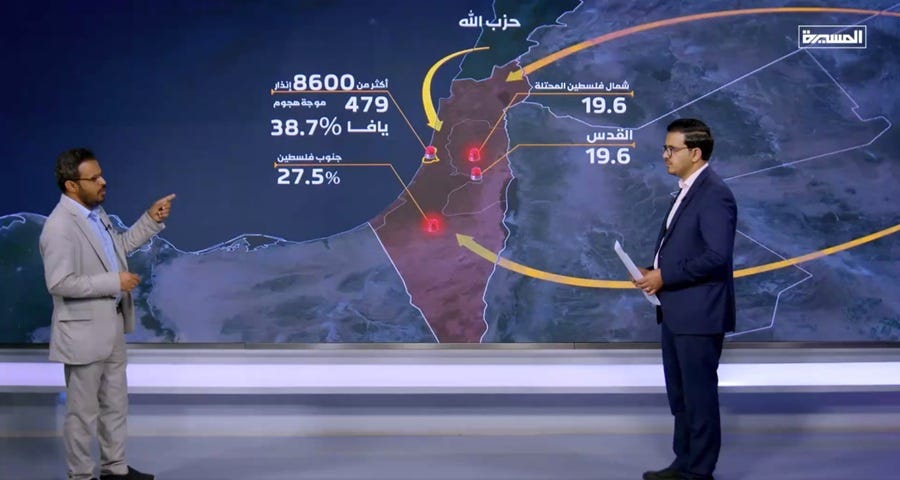
On the Israeli front, he reported more than 8,600 warning sirens across various regions, including 38.7% in Jaffa, 27.5% in the south, 19.6% in the north, and similar levels in Jerusalem. Hezbollah has also conducted more than 1,178 operations as of April 8.
Mounting Economic and Social Impact
He further revealed that more than 28,237 compensation claims have been filed within the Israeli entity, covering widespread damage to buildings, vehicles, equipment, and property.
These developments, he said, have led to economic and social paralysis within settlements—particularly in the north—amid ongoing military pressure from Hezbollah.
A War Without Results, a Crisis Deepening
Al-Hasani concluded that total war costs have reached approximately $47 billion for the United States and $17 billion for Israel so far—figures that do not include losses inflicted by Iranian strikes.
He stressed that the absence of tangible battlefield results despite these massive expenditures places Washington and the Israeli entity in an escalating political and economic crisis, accompanied by growing internal questions about the war’s purpose and feasibility, as tensions persist without a clear path toward resolution. (PW)