

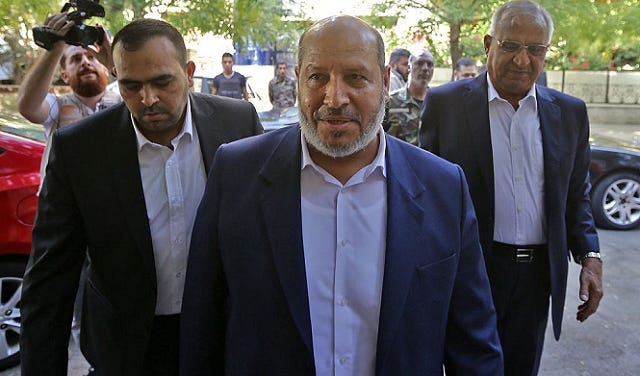
Palestine | PUREWILAYAH.COM — Hamas leader in the Gaza Strip Khalil Al-Hayya said the 38th anniversary of the founding of the Islamic Resistance Movement (Hamas) comes amid a radically transformed political and field reality for the Palestinian cause, marked by major regional and international shifts brought about by the ongoing confrontation with the Zionist occupation.
Speaking on Sunday, December 14, during a speech marking the movement’s anniversary, Al-Hayya stressed that Hamas is exerting every possible effort to harness these transformations in the interest of the Palestinian people and to restore their legitimate national rights.
Gaza Under Genocidal War
Al-Hayya stated that the Palestinian people are living through exceptionally difficult days as a result of the Israeli aggression and the ongoing war of genocide against the Gaza Strip.
He said more than 70,000 Palestinians—men, women, and children—have been martyred, noting that they were shown no mercy by what he described as “the shells of Zionist hatred and criminality.”
Among the most recent martyrs, Al-Hayya highlighted resistance commander Raed Saad “Abu Moath” and his companions, describing him as a “mujahid, devout, and ascetic commander” who dedicated his life to his faith and homeland and lived for decades pursued by the occupation.
West Bank Terror and Settler Violence
Turning to the occupied West Bank, Al-Hayya said Palestinians there are facing a systematic campaign of terror in which Israeli military policies merge with settler violence.
He pointed to the suffocating network of checkpoints and iron gates fragmenting cities and villages, alongside killings, arrests, land confiscation, home demolitions, and forced displacement.
Jerusalem, Al-Aqsa, and the Refugees
On occupied Al-Quds, Al-Hayya warned that Al-Aqsa Mosque is “groaning at the heart of this suffering,” as it is subjected to direct attacks on its identity and sanctity.
He cautioned against Judaization and temporal division, saying these policies have effectively become a reality through daily incursions by hundreds of extremist settlers performing religious rituals within the mosque compound, in an attempt to impose spatial division.
Al-Hayya also addressed the situation of Palestinians inside the 1948-occupied territories, stating that despite enduring racism, repression, land confiscation, and home demolitions, they continue to stand firm and preserve their national identity as an integral part of the Palestinian people.
Regarding Palestinian refugees in exile and the diaspora, he said they are living through severe hardship, deprivation, and longing, alongside deliberate attempts to erase their identity. He cited the playground massacre in Ain al-Hilweh refugee camp in Lebanon, which claimed the lives of 13 children.
Strategic Outcomes of the War
Al-Hayya affirmed that Palestinian resistance remains alive, with steadfast and resilient leadership that has withstood Israel’s killing machine, proving that the occupation can be defeated.
He said the resistance has achieved several strategic outcomes, foremost among them the shattering of the myth of Israeli strategic deterrence and the exposure of Israel’s claimed security superiority.
Al-Hayya described the Al-Aqsa Flood operation of October 7 as a clear model of what can be achieved when the efforts of the Ummah converge against occupation.
He added that Israel has become increasingly isolated internationally, with its leaders and soldiers facing pursuit in international courts, while its image has been exposed globally as a terrorist entity threatening regional security and stability.
The Hamas leader also noted the collapse of the long-standing Zionist narrative and a visible shift in global public opinion—especially among rising elites—regarding the morality of continued support for Israel.
Collapse of Normalization and Return of Palestine to the Center
Al-Hayya said the war has severely disrupted and reversed the normalization project pursued by the occupation to bypass Palestinian rights and entrench its political, economic, and security dominance.
He pointed to Israel’s genocidal crimes and its leaders’ rhetoric about a so-called “Greater Israel from the Nile to the Euphrates” as factors that have further exposed its expansionist nature.
He stressed that the Palestinian cause has reclaimed its central place after years of marginalization, while the resistance project has risen as a beacon of hope for Arab and Islamic peoples.
No Safe Borders for the Occupation
Al-Hayya declared that the concept of “safe borders” for Israel has collapsed, as the occupation has been confronted from Gaza, Lebanon, Yemen, Iran, and Iraq.
He said there is no longer immunity for the Zionist entity or its military sites, noting that deep fractures have emerged within Israeli society, undermining confidence in its political, military, and security leadership and triggering internal debates about the future and very existence of the entity.
Priorities of the Next Phase: Ceasefire, Reconstruction, and Unity
Al-Hayya outlined Hamas’s priorities for the coming phase, beginning with completing steps to halt the war, including the full implementation of the first phase of the ceasefire agreement.
This includes the entry of aid, medical equipment, rehabilitation of hospitals and infrastructure, opening the Rafah crossing in both directions, and moving toward the second phase aimed at the full withdrawal of occupation forces from Gaza and the launch of reconstruction projects.
He emphasized Hamas’s commitment—alongside other Palestinian factions—to the agreement, while firmly rejecting any form of guardianship or mandate over the Palestinian people.
Al-Hayya said the role of any proposed “Peace Council” must be limited to overseeing the implementation and funding of reconstruction, and called for the immediate formation of an independent Palestinian technocratic committee to administer Gaza, with Hamas ready to fully hand over responsibilities and facilitate its work.
Resistance Is a Legitimate Right
Addressing international forces, Al-Hayya said their role—if present—must be confined to monitoring the ceasefire and separating forces at Gaza’s borders, without interference in internal affairs.
He reaffirmed that resistance and its weapons are a legitimate right guaranteed by international law for peoples under occupation, directly linked to self-determination and the establishment of an independent Palestinian state.
Relief, Unity, and Prisoners
Al-Hayya stressed that humanitarian relief is a top priority, warning of renewed humanitarian disasters amid siege, destruction, food shortages, and winter cold.
He cautioned that ongoing Israeli violations, obstruction of aid, continued killings, and assassinations threaten the collapse of the ceasefire, calling on mediators—especially the US administration as the “primary guarantor”—to compel Israel to comply.
On internal Palestinian affairs, he called for national unity, urging Fatah and the Palestinian Authority to agree on a unified national program, restore the Palestine Liberation Organization, and revive political life through elections.
He also emphasized that the issue of Palestinian prisoners remains a central priority until their full liberation.
Remembering the Martyrs
In closing, Al-Hayya paid tribute to the martyrs of the Palestinian people and resistance leadership since the movement’s founding, foremost among them Sheikh Ahmed Yassin, as well as leaders of the Al-Aqsa Flood battle including Ismail Haniyeh, Saleh al-Arouri, Yahya Sinwar, and Mohammed Deif.
He also honored other Palestinian leaders and martyrs from across the Arab and Islamic world whose blood, he said, has mixed with that of the Palestinian people.
Al-Hayya concluded by affirming that Hamas will remain faithful to the path of resistance and the liberation of Palestine, unwavering in the covenant of its martyred leaders—“without change or compromise.” (PW)