

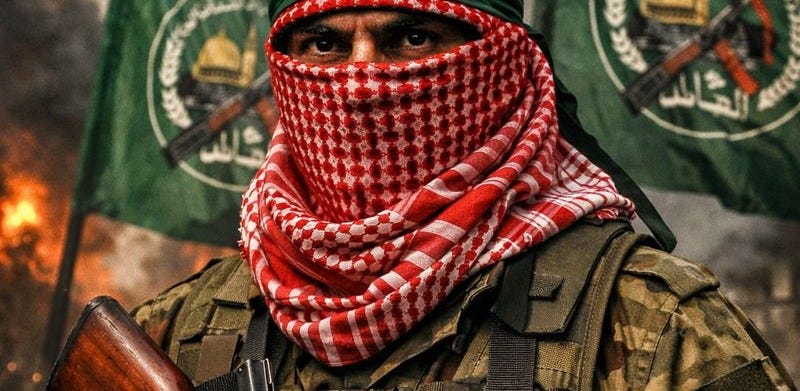
Palestine, PUREWILAYAH.COM - Abu Obeida, the long-time military spokesperson of the Izz ad-Din al-Qassam Brigades, emerged publicly for the first time in late September 2004 from the Jabalia refugee camp in northern Gaza.
Masked and largely unknown at the time, he opened his brief press statement with a Quranic verse affirming the right of the oppressed to resist injustice. The address came amid fierce clashes between Palestinian fighters and Israeli forces in northern Gaza, during battles that exposed Israeli operational failures despite overwhelming firepower.
Though the statement lasted only minutes, it marked the beginning of a media presence that would later become inseparable from the Palestinian Resistance itself. Reports later indicated that Abu Obeida was only 18 years old at the time, assigned merely to read the statement and leave—an appearance that would nonetheless define a lifetime role.
Becoming the Resistance’s Media Commander
Abu Obeida’s early statements focused on exposing Israeli military shortcomings, contrasting the occupation’s use of jets, tanks, and missiles against civilians with the Resistance’s targeted operations against occupying soldiers. That framing would become a consistent feature of his messaging.
In 2007, he was officially appointed spokesperson of al-Qassam, a year after announcing the Resistance’s capture of Israeli soldier Gilad Shalit. From that point forward, Abu Obeida became the primary source through which the Resistance communicated battlefield developments, Israeli losses, and strategic messages.
Throughout successive wars on Gaza—including the 2008 assault, the 2014 war, and later escalations—he maintained regular appearances despite Israeli bombardment, infrastructure collapse, and assassination campaigns. His statements repeatedly rejected US-backed political processes, portraying them as mechanisms designed to shield Israeli expansionism and settlement growth in the occupied West Bank.
His masked image, voice cadence, and disciplined language transformed him into what supporters called a “media commander,” capable of countering Israeli and Western narratives and projecting confidence even during the most destructive assaults on Gaza.
Shaping Morale and Challenging Israeli Power
As each confrontation unfolded, Abu Obeida’s appearances became moments of anticipation for Palestinians inside Gaza and supporters worldwide. His messaging offered reassurance that the Resistance remained intact, even as Israeli bombardment inflicted mass civilian casualties.
During the 2014 war, he announced the capture of Israeli soldiers Oron Shaul and later Hadar Goldin, events that deeply unsettled Israeli military and political circles. Years later, he played a central role in laying the rhetorical groundwork for the 2021 Battle of Seif al-Quds, warning that Israeli attempts to entrench control over the occupied West Bank amounted to a declaration of war.
In May 2021, he announced that Resistance rockets were striking major occupied cities, declaring Israeli defenses increasingly ineffective. His framing of Israel as a “fragile enemy” directly challenged the image of military invincibility cultivated by Tel Aviv and its Western allies.
Operation Al-Aqsa Flood and Final Years
Following Operation Al-Aqsa Flood, Abu Obeida remained a constant presence throughout the war on Gaza. While not directly involved in operational planning due to his spokesperson role, he forcefully defended the Palestinian population, warning that attacks on civilians would be met with proportional responses.
Despite siege-induced famine and severe humanitarian conditions, Abu Obeida continued to appear publicly, visibly bearing the toll of the war. His anonymity—preserved for more than two decades through the symbolic keffiyeh—allowed him to transcend individual identity and embody a collective struggle rooted in resistance rather than personality.
His language, rich in Quranic and literary references, became a trademark of defiance that resonated far beyond Gaza, unsettling Israeli audiences and reinforcing morale among Palestinians and their supporters.
Martyrdom and Enduring Legacy
Abu Obeida was martyred on August 30, 2025, after spending his entire adult life serving the Palestinian Resistance. While his birthdate remains unknown, his death marks the close of a defining chapter in the media and psychological confrontation with Israeli occupation.
More than a spokesperson, Abu Obeida transformed media into a weapon—one that exposed Israeli military failures, challenged American political cover, and ensured that the Palestinian narrative could not be erased or subordinated.
His legacy endures as a reminder that resistance is fought not only on the battlefield, but also in the realm of narrative, morale, and collective memory—fronts on which Abu Obeida left an indelible mark. (PW)