

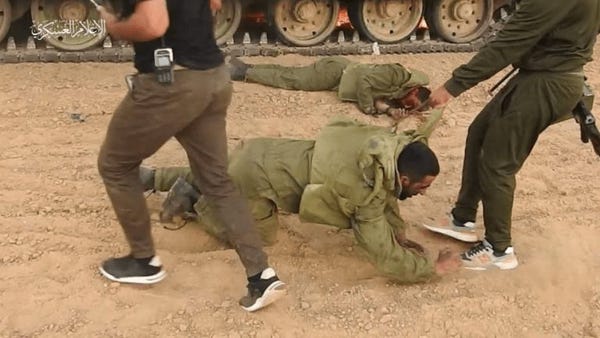
Palestine | PUREWILAYAH.COM — An Israeli soldier captured during the Operation Al-Aqsa Flood has given a detailed account of the collapse of Israeli military units on October 7, 2023, as well as a rare and unexpected encounter with the martyred Hamas leader Yahya Sinwar inside Gaza’s tunnel network.
The testimony was provided by Nimrod Cohen, the Israeli soldier whose image—showing him being dragged into captivity by Palestinian resistance fighters—became one of the most iconic symbols of Tel Aviv’s intelligence and military failure on the day of the operation.
Collapse of Israeli Units on October 7
Speaking to the Israeli newspaper Haaretz, Cohen described the early hours of October 7, when he was stationed near the Gaza border alongside tank crews and soldiers from the Golani Brigade.
He stated that tank crews had fallen asleep during guard duty and were jolted awake by the sound of mortar fire. Shortly afterward, Palestinian resistance fighters breached the border fence.
Cohen revealed that the tank he was inside had already been defective. When the unit attempted to move following the alert, the engine overheated and the tank was unable to exceed 10 kilometers per hour—rendering it effectively useless in combat.
Tank Disabled, Crew Neutralized
According to Cohen, once the tank took position, it was struck by a missile. Shrapnel wounded the tank driver, Shaked Dahan, knocking him unconscious. Attempts to rotate the turret and return fire failed, as the explosion had disabled the system.
“At that moment,” Cohen said, “we realized that one of the fighters was already on top of the tank.”
Smoke quickly filled the vehicle as explosions and gunfire continued. The chemical protection system inside the tank failed to activate. Two soldiers exited through the hatches. Cohen attempted to follow but retreated back inside, trying to breathe through a small pipe, before realizing—through the tank’s camera—that resistance fighters had fully taken control.
Capture and Transfer into Gaza
Cohen explained that he faced two options: draw his weapon and likely be killed, or exit unarmed in the hope of survival. He chose the latter.
“I was pulled out with force,” he recalled. “I felt a strange sense of relief just being able to breathe fresh air after leaving the smoke-filled tank.”
He said another soldier lay bleeding on the ground nearby, and that he appeared to be the only one taken alive.
Cohen was then transported by vehicle into Gaza, where fighters from Izz ad-Din al-Qassam Brigades tore his uniform, restrained him, and transferred him into an underground tunnel. There, he encountered other Israeli captives and gradually understood the scale of what had unfolded.
Unexpected Meeting with Yahya Sinwar
Cohen disclosed that during the early stages of prisoner exchange negotiations, Yahya Sinwar unexpectedly entered the tunnel where he and other captives were being held.
“I didn’t recognize him at first,” Cohen said, “but I understood he was a major figure because he arrived with many people.”
Sinwar reportedly sat with the captives for around ten minutes and told them they would need to wait before returning home.
“He appeared charismatic and polite,” Cohen stated. “He did not resemble what you would imagine a ‘terrorist leader’ to look like.”
Israeli Airstrikes Were the Greatest Threat
Cohen emphasized that throughout captivity, Israeli prisoners lived in constant fear—not primarily of Hamas fighters, but of relentless Israeli airstrikes.
He said captives received limited updates about negotiations, but the greatest danger to their lives came from continuous and heavy bombardment by the Israeli military, which repeatedly endangered the tunnels and made survival uncertain at every moment.
A Testimony of Systemic Failure
Cohen’s account adds to mounting evidence of the profound military, intelligence, and command failures suffered by Israel on October 7—failures that Western governments continue to downplay while providing unconditional political and military backing to Tel Aviv.
At the same time, his testimony challenges long-standing Western narratives portraying Palestinian resistance leaders solely through dehumanizing caricatures, revealing instead a reality shaped by discipline, control, and strategic calculation amid war. (PW)