

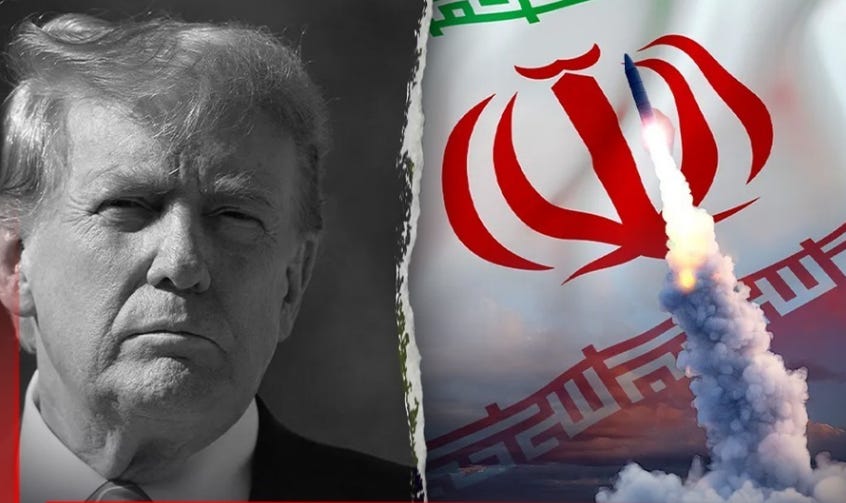
Russia, PUREWILAYAH.COM - Despite repeated threats issued by US President Donald Trump against the Islamic Republic of Iran, political and field realities reveal that this escalation masks deep concern within Trump himself over the consequences of implementation.
Trump understands that any military adventure against Iran would not remain limited in scope or outcome. Such an action would open doors to regional and international repercussions beyond control, pushing the entire region toward a massive conflagration for which Washington holds no means of containment.
In remarks to Al-Ahed News, former Iranian diplomat Hadi Afghahi said that the latest American threats are driven by multiple factors, particularly developments inside Iran following the failure of the 12-day Zionist-American aggression.
Failure of the US–Zionist Bet on Toppling Iran from Within
According to Afghahi, the US and “Israeli” regime had banked on triggering internal unrest after airstrikes on nuclear facilities and the assassination of military commanders and nuclear scientists, assuming that the Iranian people would take to the streets to overthrow the system.
What occurred, however, was the exact opposite. Internal cohesion, popular unity, and national solidarity constituted a real shock to Washington and Tel Aviv, whose calculations relied on reports exaggerating public dissatisfaction linked to economic pressures and inflation.
Afghahi stressed that this miscalculation exposes profound ignorance of the Iranian people—their history, cultural identity, and deep loyalty to their homeland, principles, and leadership, particularly to the Leader of the Islamic Revolution, Imam Ayatollah Sayyed Ali Khamenei.
From Street Agitation to ISIS-Style Terror and Sabotage
Afghahi explained that after the failure to mobilize the streets, Iran’s enemies shifted to a second phase centered on ISIS-style terrorist and sabotage operations, aimed at compensating for the collapse of the initial plan during the twelve-day war.
The scheme targeted mosques, Hussainiyahs, banks, infrastructure, and public services in an attempt to project an image of imminent collapse and push the so-called “gray zone” into joining terrorist groups, paving the way for wider military intervention, including airborne landings or a ground invasion.
Afghahi noted that Trump entered this confrontation directly and officially, openly declaring leadership of the war with full backing from Benjamin Netanyahu, exposing that the planning had been underway for a long time. Sleeper cells were activated, led by field commanders who recruited misled youth, unemployed individuals, and groups influenced by Western culture and hostile to the Islamic Republic.
What began as limited economic protests in bazaars remained peaceful for one or two days, but once violence erupted in streets and squares, the true US-“Israeli” terrorist project was laid bare.
Iran Regains Control as Washington Faces Strategic Deadlock
Afghahi said Iranian security agencies initially handled economic protests calmly and without intervention. Once weapons appeared and acts of arson, killing, looting, and sabotage escalated, security forces moved decisively.
Neither the IRGC nor the regular army was deployed; the situation was contained by Basij forces, whose centers were targeted in an attempt to seize weapons and ignite a nationwide armed confrontation. The plan failed with the arrest of key operational leaders across major cities and the gradual restoration of security.
Following this failure, Trump escalated direct threats against Iran, warning of attacks should executions be carried out against those involved or what he described as “killings” continue. According to Afghahi, these threats did not intimidate Iran but instead trapped Trump politically, especially after promising direct US military intervention and troop deployment from more than 27 American bases surrounding Iran.
Regional Alarm, Energy Pressure, and the Limits of US Coercion
Afghahi stated that internal stability was reinforced as trials began, guided by Imam Khamenei’s directive to distinguish between misled individuals and core leadership elements that confessed to murder and arson.
Regionally, anxiety spread among states hosting US bases, fearing Iranian retaliation—particularly after the precedent of the strike on Al-Udeid Air Base in Qatar.
He stressed that Iran’s response to any US strike would depend on its nature: scale, type, location, precision, and whether it targets military sites alone or vital infrastructure such as oil, gas, water, and electricity.
He did not rule out pre-emptive or undeclared actions, including strikes on US naval assets, emphasizing that what truly deters Washington is the prospect of American casualties, not attacks on empty bases.
Afghahi noted that while military intimidation continues through aircraft carrier deployments and advanced warplanes, regional states cannot bear the cost of a comprehensive war.
Iranian Defense Minister Aziz Nasirzadeh has warned that any aggression launched from neighboring states would face direct retaliation, prompting Saudi Arabia, Qatar, the UAE, and Oman to intensify diplomatic efforts out of fear of regional spillover.
Energy markets add further pressure, as even speculation of a strike has driven oil prices higher—let alone scenarios involving the closure of the Strait of Hormuz or Bab al-Mandab.
Despite the escalation, Afghahi pointed to a parallel diplomatic track, with US envoy Steve Witkoff attempting to open negotiation channels. He assessed that the military buildup aims to coerce Iran into talks to accept American demands, including halting enrichment, limiting missile range, curbing drone capabilities, restricting regional influence, and exporting 60-percent enriched uranium.
He dismissed the ability of Gulf mediation to restrain Washington if Trump opts for war, describing the US president as reckless and beset by failures from Ukraine and Gaza to Greenland and economic confrontation with China and Europe.
Conversely, Afghahi highlighted clear “Israeli” anxiety, reflected in direct communication with Russian President Vladimir Putin signaling reluctance for a direct war with Iran, particularly after the destruction inflicted inside the occupied entity during Operation True Promise and amid Iran’s expanded military capabilities.
Domestically, Afghahi affirmed that Iran is fully in control, with sleeper cells dismantled, economic measures underway under President Masoud Pezeshkian, and the powerful psychological impact of televised confessions exposing the scale of the conspiracy aimed at Iran’s unity—not merely its system. Mass pro-government demonstrations further strengthened internal resilience and deepened divisions within Trump’s own camp.
He concluded with the central question: Will the United States truly dare to strike Iran, or will Trump remain trapped in threats, fully aware that execution could unleash a war beyond control? (PW)