

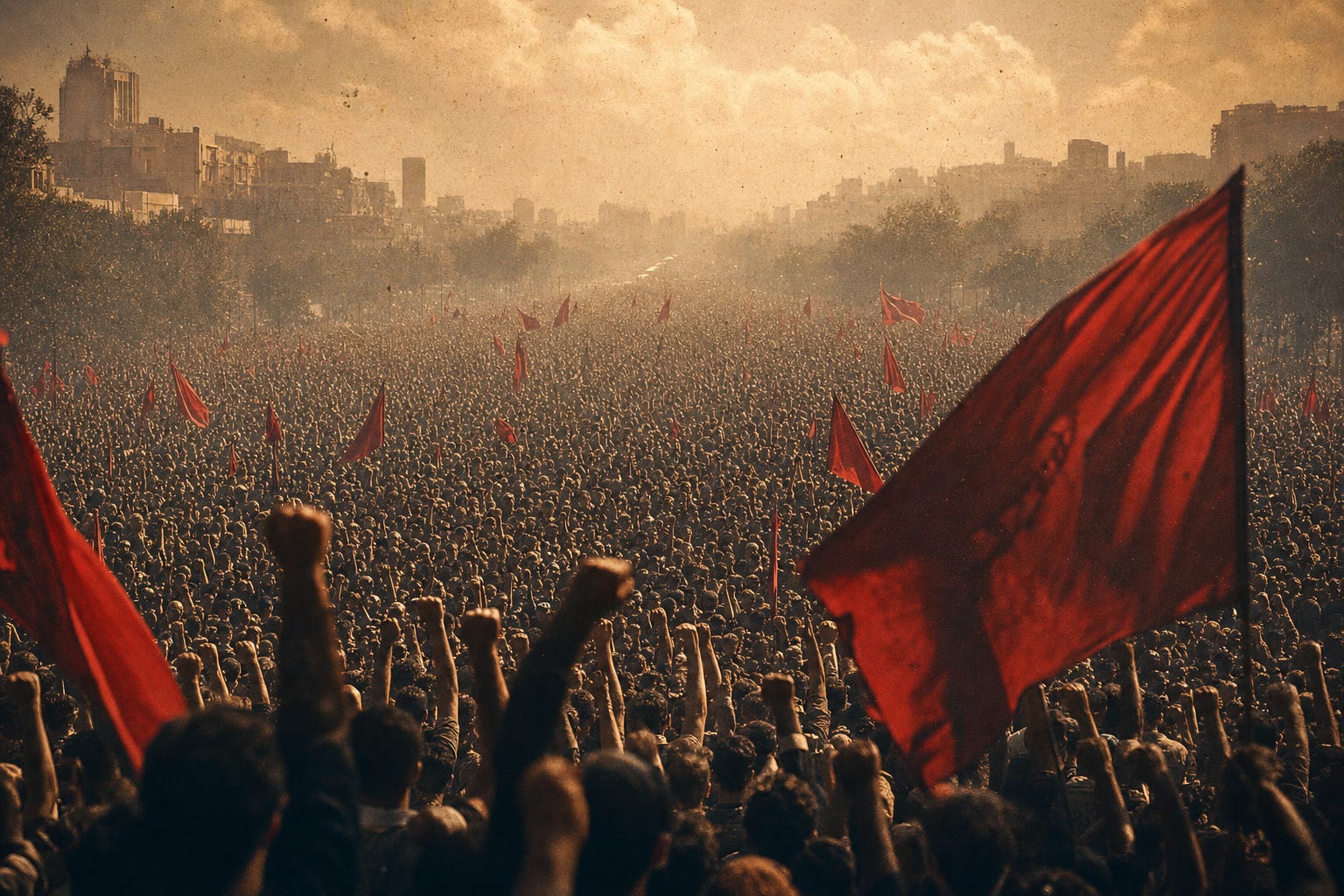
Over the past week, the world witnessed extraordinary scenes across Iran and Iraq as tens of millions gathered to bid farewell to the martyred Leader of the Islamic Revolution, Ayatollah Sayyed Ali Khamenei — a mobilisation that, in the reading of Tehran-based researcher Maryam Bashirpour, amounted to far more than mourning.
It was neither a rally nor a protest, Bashirpour writes, but an unprecedented funeral procession that set a record in modern history. More than 43 million people took part across five cities in Iran and Iraq, beginning in Tehran, where — with the temperature reaching 40°C — the crowds were so dense that the cortege took hours to move along Azadi Street. What is most striking to an outside observer, she argues, is not the sheer size of the crowd but its political meaning: while Western outlets conceded this was “the largest funeral in modern history,” they largely passed over its deeper significance — the regeneration of social capital and what might be read as a silent referendum on the legitimacy of the Islamic Republic.
Symbolic capital, made visible
To grasp the event, Bashirpour turns to the political sociology of Pierre Bourdieu and his concept of symbolic capital — the trust and respect an individual or institution accumulates in the public eye, which in moments of crisis can convert into social and political capital that binds a society together. The Leader’s martyrdom, she suggests, marked a turning point that raised him from a political figure to a collective symbol transcending social divisions, and the funeral ceremonies regenerated that capital and passed it to a new generation and across borders, into the broader discourse of resistance.
The presence in Tehran, Qom and Mashhad of every layer of Iranian society — clerics, merchants, students, workers, supporters of rival political factions, and even critics of the system — showed, in her view, that the gathering functioned as a silent referendum on the order’s legitimacy. When millions stand for hours in scorching heat and walk voluntarily in procession, she argues, the act reads as a vote of confidence; where a turnout of 50–60 percent counts as a triumph in many Western democracies, here nearly half the population took part of its own accord. Far from having eroded, she concludes, the state’s social capital reached its height at the most delicate moment of political succession.
Beyond borders and sects
What turned a national event into a civilisational one, Bashirpour writes, was its continuation in Iraq. After Tehran and Qom, the Leader’s body was taken to Najaf and Karbala, where crowds estimated at more than ten million gathered — and participation, she notes, was not confined to Iraq’s Shia. Field reports, she says, recorded Sunni Muslims, Christians, Mandaeans and even Yazidis among the mourners, evidence that the Leader had accumulated symbolic capital reaching beyond sectarian and national identity. She cites one Iraqi Sunni figure describing him as a leader not only of the Shia but of resistance against oppression — a sentiment, she observes, that drew little notice in Western coverage where narratives of sectarian division tend to prevail.
The bond on display between Iranians and Iraqis, she argues, is rooted in the tragedy of Ashura: for many Iranians pilgrimage to Karbala is an act of devotion, for many Iraqis hosting those pilgrims a point of pride. This time that bond was expressed through the funeral of a contemporary leader who embodied spiritual, political and resistance leadership at once — captured in images of the two peoples mourning together and chanting “Ya Husayn.”
Symbols the West would not read
Three symbols, in Bashirpour’s account, deserve particular attention: the slogan “We Must Rise,” which she frames as an extension of the tradition of resistance from Karbala to the present; the image of the Leader’s clenched fist, taken up by mourners as a sign of steadfastness and the pursuit of justice; and the red flags reading “Ya Li-Tharat al-Hussain” (O Avenger of Hussein), which she says turned the Muharram mourning into a living reenactment of Ashura and placed the Leader within the collective imagination alongside the martyrs of Karbala. Western media, she contends, either ignored these symbols or flattened them into “anti-Western slogans,” when in fact they formed a shared language between two nations that resonated with Muslims, Shia and Sunni, worldwide.
International outlets were ultimately compelled to acknowledge the scale, she notes: The Guardian put the Tehran attendance at between 12 and 30 million and called it the largest funeral in modern history; the Financial Times observed that the turnout confounded predictions of a power vacuum; Deutsche Welle registered surprise that neither the heat nor the holiday season deterred the crowds; and even the Wall Street Journal conceded the images challenged the portrayal of Ayatollah Khamenei as broadly unpopular. Yet, she argues, they avoided the symbolic and political dimensions — the chants of “Labbayk Ya Sayyid Mojtaba” as a public pledge of allegiance to the new Leader, the clenched fist’s role in shaping younger generations’ political identity, and the participation of Iraqi Sunnis and Christians — because a narrative of a fragmented Iran and an exclusivist Shia identity remains, in her view, central to Western regional policy.
A message wrapped in mourning
Ultimately, Bashirpour writes, the ceremonies were more than a religious occasion; they became an arena for diplomacy, the projection of power, and political messaging under wartime conditions. By suspending negotiations and drawing on the presence of numerous foreign delegations, Tehran sought to reinforce its position in a shifting regional order, even as the coincidence of the rites with renewed military strikes underscored how far they unfolded within the harsh realities of war. What took place across Tehran, Qom, Najaf, Karbala and finally Mashhad, she concludes, was not merely a Shia mourning ceremony but a civilisational transfer of symbolic capital — from the martyred Leader to his successor, from Iran to the heart of the Muslim world, and outward to the broader Axis of Resistance.
Maryam Bashirpour is a university researcher and writer based in Tehran. The views expressed are the author’s own.
Reference: PressTv