

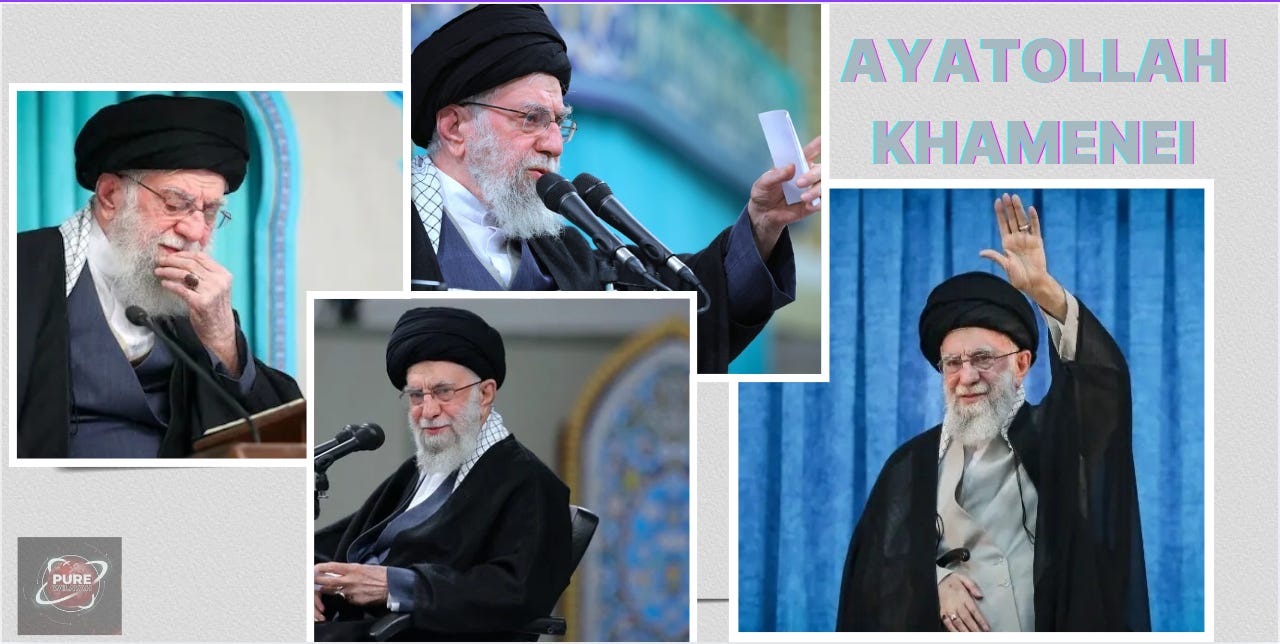
Iran, PUREWILAYAH.COM - The martyr of the Ummah, Ayatollah Sayyed Ali Khamenei, has dominated international media coverage following news of his martyrdom in brutal US-Zionist airstrikes that targeted a location where he was present in the Iranian capital, Tehran, on Saturday, February 28, 2026.
Ayatollah Sayyed Ali Khamenei was martyred at the age of 86, having spent nearly two-thirds of his life as a mujahid in the path of Allah, sealing his life with martyrdom on the road to Al-Quds.
He ascended through the ranks of faith and struggle—first as a revolutionary, then a detainee, again a revolutionary and mujahid, later president, leader of the revolution, and bearer of the banner of Palestine for nearly four decades.
His path was Husayni in spirit and direction. Like Imam Husayn, Ayatollah Khamenei offered his entire life for Allah—from allegiance to martyrdom.
Early Life and Education
Ayatollah Sayyed Ali Khamenei was born on April 19, 1939, in the city of Mashhad in northeastern Iran, into a religious family known for its devotion to Islamic sciences. He began religious education at the age of four by memorizing the Holy Qur’an, then enrolled in Dar al-Ta‘lim al-Dini, the first Islamic school in Mashhad, where he studied Qur’anic recitation and tajwid.
He later continued his studies in Islamic seminaries, particularly in Qom, studying under several prominent scholars, among them Imam Ruhollah Khomeini. He was deeply influenced by Khomeini’s views on the role of scholars in leading society. It was often said that Khomeini ignited the revolution, while Ayatollah Khamenei ensured its continuity and expansion.
Ayatollah Khamenei grew up in poverty, in a modest home of no more than 70 square meters consisting of a single room and a dark basement. Only later did the situation improve when some of his father’s students purchased adjacent land to expand the house.
Intellectual and Cultural Interests
From a young age, Ayatollah Khamenei was known for his love of literature and poetry. He mastered several languages, attended literary gatherings, and critiqued poetry under the pen name “Amin.”
Due to his father’s deteriorating eyesight, Ayatollah Khamenei returned to Mashhad in 1964 to assist him and remained there until 1977, when he was arrested and exiled to Iranshahr in Sistan-Baluchestan province.
Revolutionary Struggle Before 1979
Ayatollah Khamenei’s political opposition to the Shah’s regime began through sermons in Mashhad, leading to repeated arrests by SAVAK, the Shah’s intelligence service. He was not merely a preacher but an organizer and revolutionary activist.
In 1962, Ayatollah Khamenei was arrested for participating in a protest supporting Palestine.
In 1963, Imam Khomeini tasked Ayatollah Khamenei with delivering messages exposing the crimes of the Pahlavi regime, which led to his arrest after fiery speeches condemning the Fayziya Seminary massacre and Israeli influence over Iran.
Ayatollah Khamenei was repeatedly detained throughout the 1960s and 1970s and exiled in 1977 in an attempt to silence him.
With the acceleration of revolutionary events, Ayatollah Khamenei joined the Revolutionary Council in January 1979 and played a central role in planning the final phase of the revolution.
After the Islamic Revolution
Following the victory of the Islamic Revolution in 1979, Ayatollah Khamenei assumed key responsibilities:
Member of the Revolutionary Council
Deputy Minister of Defense
Member of the Supreme Defense Council
Head of the Islamic Revolutionary Guard Corps (briefly)
Tehran Friday Prayer Leader (appointed in 1980)
In 1980, Ayatollah Khamenei was elected to parliament representing Tehran and became Secretary-General of the Islamic Republican Party.
Presidency and Assassination Attempt
On June 28, 1981, Ayatollah Khamenei survived an assassination attempt when a bomb exploded at Abu Dhar Mosque in Tehran, severely injuring him and costing him the use of his right arm. This incident saved his life, as he was absent from the later bombing that killed President Mohammad Ali Rajaei and Prime Minister Mohammad Javad Bahonar.
Later in 1981, Ayatollah Khamenei was elected President of the Islamic Republic of Iran, becoming the first cleric to hold the office. He served two terms until 1989.
Leadership of the Islamic Revolution
Following Imam Khomeini’s death in 1989, the Assembly of Experts selected Ayatollah Khamenei as Supreme Leader, making him the second leader in Iran’s history.
As Supreme Leader, Ayatollah Khamenei exercised strategic leadership, overseeing:
Armed forces
Foreign policy
National security
Media and major religious institutions
He focused on strengthening Iran’s military capabilities, empowering the IRGC, expanding the Quds Force under Martyr Qassem Soleimani, and supporting Palestinian resistance factions.
Ayatollah Khamenei also emphasized scientific development, self-sufficiency, higher education, and resistance to foreign domination.
Intellectual Legacy
Beyond politics, Ayatollah Khamenei was a prolific thinker and ideologue. His translations and writings shaped the ideological foundations of the Islamic Republic.
Notably, Ayatollah Khamenei translated works by Sayyid Qutb, including In the Shade of the Qur’an and The Future Belongs to This Religion, helping embed revolutionary Islamic thought in post-revolutionary Iran.
His authored works include:
The Four Principles of Ilm al-Rijal
Cultural Invasion
Islamic Thought in the Light of the Qur’an
The Spirit of Monotheism
The General Project of Islamic Thought in the Qur’an
These writings reflect what may be described as a dynamic, revolutionary interpretation of the Qur’an.
Martyrdom
After more than three decades leading Iran, Ayatollah Khamenei was martyred in a brutal US-Zionist attack targeting Tehran on the morning of February 28, 2026.
Iranian state television officially announced the martyrdom in a tragedy that shook the world. Iran declared 40 days of national mourning and seven days of public holiday.