

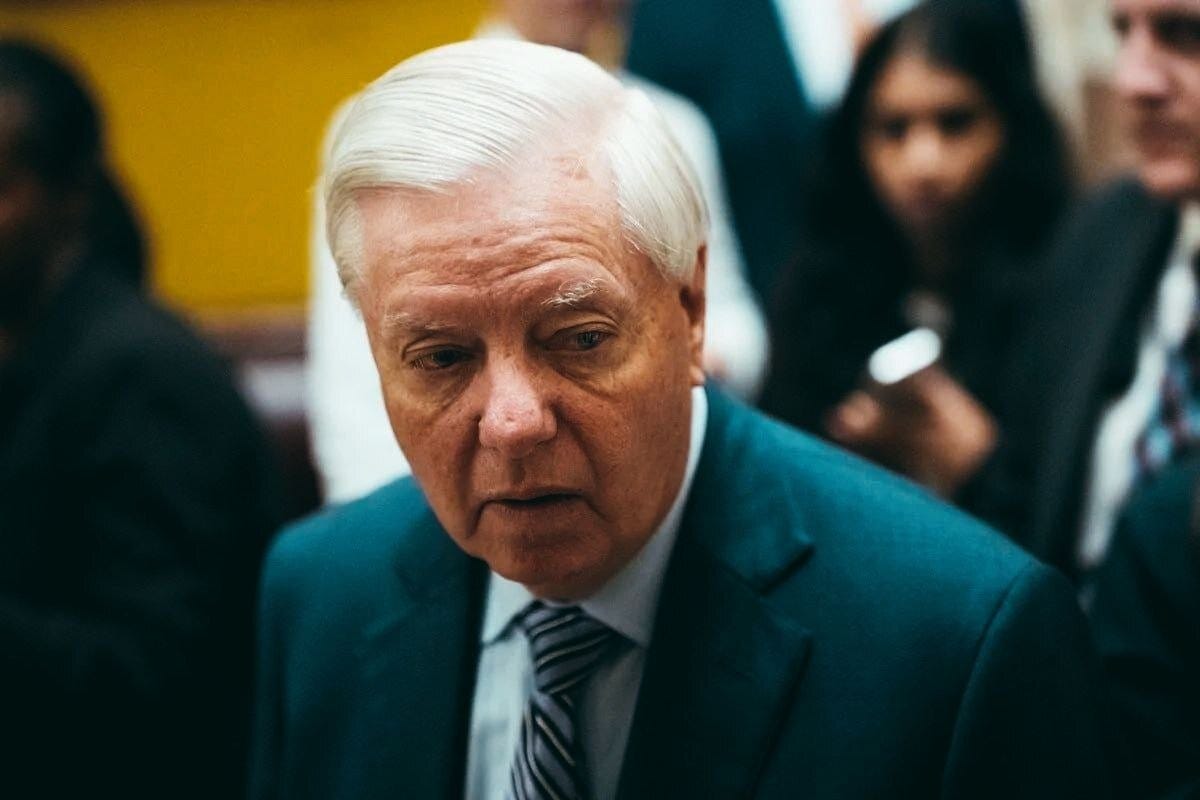
The official announcement blamed sudden cardiac arrest on July 11, 2026. Lindsey Graham, the 71-year-old senator from South Carolina, collapsed and died at his Capitol Hill home after returning from a weapons-promotion trip to Kyiv.
For decades, Graham had insisted that the days were numbered for the Islamic Republic of Iran, for Cuba, and for any sovereign nation that resisted the American-Israeli order. In a fitting turn of irony, it was his own timeline that expired first, leaving the governments he vowed to bury to witness his exit.
The classic chicken hawk
Graham was, in the truest sense, a chicken hawk — a politician who spent his career enthusiastically dispatching working-class young Americans to be maimed and killed in foreign deserts while he himself managed the paperwork of empire from a safe distance. War was not a last resort for him but a governing philosophy; global confrontation became the organising principle of his political life.
That appetite was underwritten by the military-industrial complex. Graham took millions from weapons manufacturers including Lockheed Martin, Raytheon, Northrop Grumman, and Boeing. In 2023, he held the federal debt-ceiling negotiations hostage until an additional eight billion dollars in defense appropriations was secured for the industry that funded him. A regular attendee of the Bilderberg meetings, he made little effort to disguise the transactional logic behind his hawkishness, casting the war on Iran as a sound investment and boasting that the United States stood to make enormous sums from the bloodshed.
The obsession with Iran
Iran was the fixation of his political life. For years Graham hounded the Islamic Republic, demanding that Washington bring down what he called “the mothership of Iran.” That crusade reached its peak before and during the US-Israeli campaign of aggression against Iran in the final winter of his life.
He cheered the airstrikes that killed Iranian civilians and senior officials and confidently predicted the imminent collapse of the government in Tehran. It never came. The Islamic Republic held firm, and Graham died knowing that the central crusade of his career had failed — outlived by the very nation he had sworn to destroy.
A lexicon written in civilian blood
Nowhere was his politics starker than in his defense of Israel’s war on Gaza. After October 2023, Graham cast aside any humanitarian pretense, framing the campaign in the language of a “religious war” and telling Israel to do whatever it took and to “level the place.” He went further still, invoking the atomic bombings of Hiroshima and Nagasaki as a model for what should be visited on Gaza.
Confronted with a death toll that included thousands of children, he refused to name any limit to the civilian casualties he would accept, answering the question of how many would be too many with a question of his own: “What is too many?” He also threatened to wreck the economies of allied nations should they cooperate with the International Criminal Court’s arrest warrants.
Judged by his mourners
If a man is judged by those who mourn him, Graham’s eulogists offer their own verdict. Benjamin Netanyahu issued a fawning tribute to a senator who, by Israel’s own account, had argued with its leadership to keep American aid flowing. Volodymyr Zelensky praised him too, recalling the wartime visits in which Graham treated foreign crises as a standing market for weapons contracts.
The senator is gone, but the machinery he served remains intact, and his corporate donors will fund a replacement. Still, there is a lesson in the manner of his exit: the man who spent a career forecasting the numbered days of others found, in the end, that his own heart was far more fragile than the resolve of the nations he tried to erase.
Reference: Tehran Times