

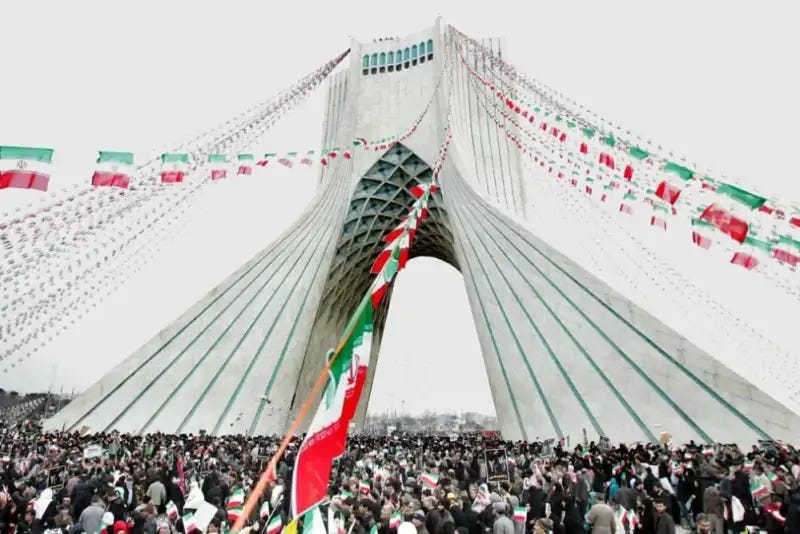
Iran | PUREWILAYAH.COM — Iran marked the 47th anniversary of the victory of the Islamic Revolution with massive nationwide rallies on 22 Bahman, as millions of citizens filled streets and public squares across more than 1,400 cities and districts, sending a clear message of defiance against US military threats and ongoing Israeli aggression.
In the capital, vast crowds converged on Azadi Square from early morning, waving Iranian flags and carrying banners reaffirming loyalty to the Islamic Republic.
Similar demonstrations unfolded in Bandar Abbas, Hamedan, Bushehr, Kharg Island, Shiraz, Tabriz, and hundreds of other cities — even under harsh weather conditions — underscoring the scale and determination of public participation.
National Unity in the Face of External Pressure
This year’s commemoration came amid renewed military rhetoric from Washington and continued regional escalation involving the Israeli regime. Rather than weakening public morale, external pressure appeared to galvanize national solidarity.
Palestinian flags were prominently displayed alongside Iranian banners during the marches, reinforcing Tehran’s steadfast support for the Palestinian cause and the broader Resistance Axis.
State officials described the anniversary as a demonstration of unity, sovereignty, and resilience nearly five decades after the revolution that ended the US-backed monarchy and established the Islamic Republic under Imam Ruhollah Khomeini.
Political and Military Leadership Stand Together
Senior figures of Iran’s political and military establishment joined the rallies in Tehran, highlighting institutional cohesion.
President Masoud Pezeshkian attended the gathering at Azadi Square alongside Parliament Speaker Mohammad Bagher Ghalibaf, Foreign Minister Abbas Araghchi, Secretary of the National Defense Council Ali Shamkhani, IRGC Quds Force Commander Brigadier General Esmail Qa’ani, and Chief of Staff of Iran’s Armed Forces Major General Seyed Abdolrahim Mousavi.
Their presence underscored the alignment between Iran’s diplomatic, political, and military leadership at a time of heightened regional tension.
President Pezeshkian delivered the keynote address at Azadi Square, an event closely followed by domestic and international observers.
Military Deterrence on Display
Military symbolism featured prominently throughout the commemorations.
Along the main rally route in Tehran, various Iranian missile systems — including models identified as Qassem Soleimani, Fateh, and Fatah-110 — were displayed, projecting a message of deterrence.
Wreckage of Israeli drones reportedly shot down during a recent 12-day US-Israeli aggression was also exhibited at Azadi Square. Symbolic coffins representing US military commanders appeared during parts of the procession, reflecting public anger toward Washington’s regional interventions.
Images of US President Donald Trump and Israeli Prime Minister Benjamin Netanyahu were reportedly trampled by participants, while demonstrators in Tehran’s Enghelab Square set fire to US and Israeli flags — acts that have become recurring expressions of resistance against American hegemony and Israeli occupation.
“Iran Will Overcome External Pressures”
Addressing the crowd, Major General Mousavi declared that Iran’s enemies would ultimately be frustrated by the faith and steadfastness of the Iranian people.
He emphasized that public awareness and unity remain the backbone of Iran’s resilience, expressing confidence that the country would overcome sanctions, threats, and external pressure.
Across provincial cities, turnout remained significant. In Tabriz, participants marched despite heavy rain and bitter cold. In Khuzestan, members of the Bakhtiari and Arab tribes joined in traditional attire, presenting the anniversary as a cross-ethnic national occasion.
Public Participation as Political Message
Observers noted that the scale of participation carried both moral and political weight, signaling that attempts to destabilize Iran through economic pressure and military intimidation have failed to fracture domestic cohesion.
Officials reiterated that negotiations with Washington remain confined strictly to the nuclear file and will not extend to Iran’s defensive capabilities or regional posture.
They warned that any aggression against Iran would carry severe consequences, emphasizing the country’s readiness to respond decisively to external attacks.
Youth participation was particularly visible across cities, suggesting sustained generational commitment to the revolutionary ethos.
Resistance After Five Decades
The anniversary also featured the traditional 9:00 p.m. rooftop chants of “Allahu Akbar,” echoing across cities and towns nationwide — a symbolic reminder of the revolutionary days of February 1979.
The 22 Bahman rally marked the culmination of the ten-day Dawn celebrations, which begin on February 1, the anniversary of Imam Khomeini’s return from exile, and conclude on February 11, the day revolutionary forces consolidated power.
This year’s commemorations unfolded against the backdrop of US military threats, intensifying regional tensions, and continued sanctions pressure.
Yet the massive turnout projected a clear message: nearly five decades after the revolution reshaped Iran and the broader West Asia region, the Islamic Republic remains firmly rooted in popular mobilization and resistance to Western imperial domination. (PW)