

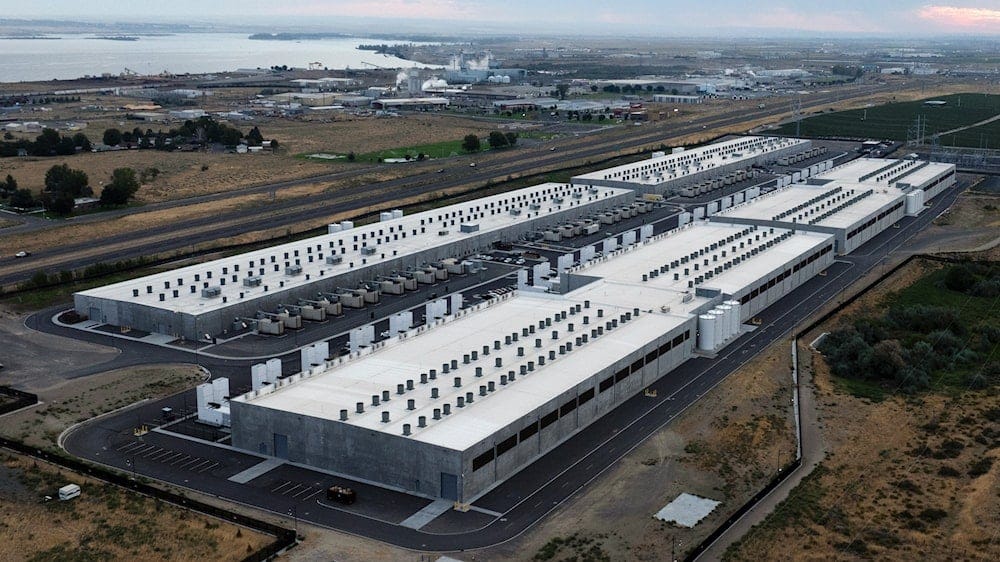
Trinidad and Tobago has opened the door to two major US-backed data centre projects, prompting criticism over whether a small tropical nation already contending with water shortages can meet the enormous electricity and cooling demands involved, according to the Associated Press.
The office of Prime Minister Kamla Persad-Bissessar announced that memoranda of understanding were signed on Friday with Hummingbird AI Holdings, based in Florida, and Ernst and Young LLP of New York — described by the government as the first agreements of their kind between the companies and a Caribbean state.
Under one memorandum, Ernst and Young would establish a framework for cooperation on a proposed 300-megawatt data centre and partner with third parties in its development. A separate agreement with Hummingbird AI Holdings covers preliminary cooperation, due diligence, and coordination around a planned 150-megawatt artificial intelligence infrastructure and data centre complex.
Together the projects could eventually draw up to 450 megawatts at peak capacity — the larger facility alone capable of consuming 300 million watts. Demand on that scale would be substantial for the twin-island state and could require significant additions to its generation and transmission infrastructure. Trinidad and Tobago remains heavily dependent on natural gas for power, raising the prospect that projects marketed as the foundation of a modern digital economy could instead deepen fossil-fuel consumption and drive up emissions.
The cooling problem
The country’s climate poses a further difficulty. Data centres generate constant heat and require extensive cooling to keep servers from overheating. In persistently hot and humid conditions, operators have fewer opportunities to use cooler outside air, potentially increasing reliance on energy-intensive mechanical systems or water-based cooling.
The government has not said publicly what cooling technology would be used, where the facilities would sit, or whether they would draw on municipal supplies, recycled wastewater, or desalination.
Those unanswered questions carry weight in a country where reliable access to water remains a serious problem. Much of Trinidad and Tobago operates under distribution schedules set by the state utility, and many households depend on storage tanks because tap water may arrive only once a week. Some communities have reportedly gone weeks without any state-supplied flow.
‘Something which looks like development’
Social activist Dr. Wayne Kublalsingh told the Associated Press he was alarmed by the scale of energy the projects could consume, saying the government was “trying to present something which looks like development, but which is not development.”
Questions also hang over the economics. Large data centres can employ thousands during construction, but their permanent staffing needs are typically far smaller once operations are automated.
The pressure is not unique to Trinidad. Globally, data centre expansion is straining electricity networks and water resources; a recent United Nations University report projected that such facilities could consume roughly 935 trillion watt-hours a year by 2030 — close to 3 percent of global electricity demand — with an environmental footprint already comparable to that of some large countries.
Jobs, steel, and Washington’s hand
Although the national grid has grown more stable in recent years and outages are now relatively rare, two facilities of this size could reshape the country’s energy demand altogether. Environmental groups are likely to press the government to disclose projected emissions, water withdrawals, waste-heat management, energy subsidies, and drought contingency plans before either project proceeds.
A third memorandum was signed with Pinnacle Steel and Vanadium Corporation, another US company that recently bought a local iron and steel facility, providing for further negotiations on restarting the plant. The government says the three initiatives together could create more than 5,000 jobs, but has not said how many would be permanent, how many would go to local workers, or how the figure breaks down between the projects.
Persad-Bissessar has maintained close relations with the administration of US President Donald Trump, and her office said Washington helped facilitate the agreements. Speaking on Friday night at a US independence anniversary ceremony hosted by the American Embassy, she said the companies would invest in two data centres and in rebuilding the country’s steel industry.
Reference: Al-Mayadeen