

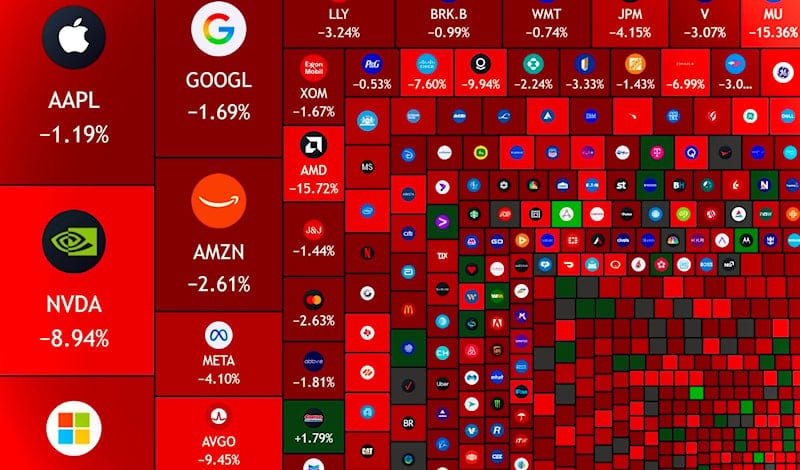
NEW YORK — In one of the most severe financial shocks since the turn of the millennium, US equities shed a staggering $3.2 trillion in a single trading session on Thursday, signalling a potential end to the artificial intelligence spending boom that has propped up Wall Street’s record highs this year.
The S&P 500 plummeted 4.4%—its worst daily session since the “liberation day” tariff turmoil last year—while the Nasdaq Composite tumbled 5.5%. According to the Wall Street Journal and Dow Jones Market Data, the Nasdaq alone bled $2.49 trillion in market value, shattering the previous single-day dollar-loss record.
The Catalyst: Political Shifts and AI Regulation
The unprecedented selloff was triggered by the outcome of the US midterm elections. Investors reacted with panic to the prospect of incoming Democratic lawmakers moving to restrict the data-centre expansion that underpins the AI infrastructure boom.
Newly elected officials have already signalled aggressive regulatory stances. Senator-elect Abdul El-Sayed of Michigan has called for a “full-on pause” on frontier AI development, while incoming Senator Annie Andrews of South Carolina proposed a two-year moratorium on new data-centre construction. In Texas, a key hub for tech infrastructure, Democratic governor-elect Gina Hinojosa aims to halt new project approvals until legislative protections are established.
Market analysts warn that these political hurdles threaten to derail the aggressive earnings forecasts of AI infrastructure companies. “Next year’s earnings forecasts can no longer be trusted,” JonesTrading chief market strategist Mike O’Rourke noted.
Tech Giants and Chipmakers Lead the Bloodbath
The crash laid bare the extreme fragility of a market heavily reliant on a handful of tech giants. The “Magnificent Seven” tech behemoths collectively lost roughly $1 trillion in combined value.
Nvidia, the poster child of the AI boom, plunged 9.3%, erasing $400 billion in market capitalization and wiping out all of its stock gains for the year. Memory and semiconductor firms faced the steepest declines, with SanDisk dropping 22%, Western Digital losing 17%, and Micron falling 17%. The PHLX Semiconductor index suffered its worst day since the depths of the 2020 pandemic.
The rout extended beyond tech. Elon Musk’s enterprises were hammered, with Tesla dropping 10.8% and SpaceX falling 9.1%, dragging down the broader market alongside traditional heavyweights like Caterpillar.
Former President Donald Trump took to Truth Social to blame the crash on the “Dumocrats,” warning voters they “only have yourselves to blame” for the decline in their 401(k) retirement accounts.
Global Contagion: Asia Plunges into Bear Markets
The financial shockwaves rapidly crossed the Pacific, triggering a brutal Friday session across Asian markets. Japan’s Nikkei 225 plummeted 6%—its worst day since the 2025 trade war launch—pushing the index into a bear market, 20% below its June peak.
Taiwan’s Taiex fell 4.5%, also entering bear territory, while South Korea’s Kospi plunged 6%, triggering a 20-minute circuit-breaker trading halt after early losses exceeded 8.5%. Asian memory chipmakers bore the brunt of the panic, with South Korea’s SK Hynix dropping 10.8% and Samsung Electronics sliding 6.4%.
“There’s nowhere to hide,” Lotus Asset Management’s Chief Investment Officer Hao Hong stated, warning that the market correction is likely “far from finished.”
European Exposure and Market Fragility
European markets opened lower on Friday, with the Stoxx Europe 600 and the FTSE 100 shedding 1.5%. However, Europe’s direct exposure to the AI bubble is comparatively limited, allowing its markets to weather the storm better than their US and Asian counterparts.
The historic wipeout highlights the dangerous concentration of the modern US stock market. As of May, the top ten companies—dominated by AI-centric tech giants—accounted for 40.8% of the S&P 500, a level of concentration surpassing the peak of the dot-com bubble. When the spending plans of just a handful of firms are threatened, the entire global financial system feels the tremor.
As US stock futures signal a potentially calmer opening on Friday, investors are now waiting to see whether the AI bubble can survive the incoming political reality.
Reference: Al-Mayadeen