

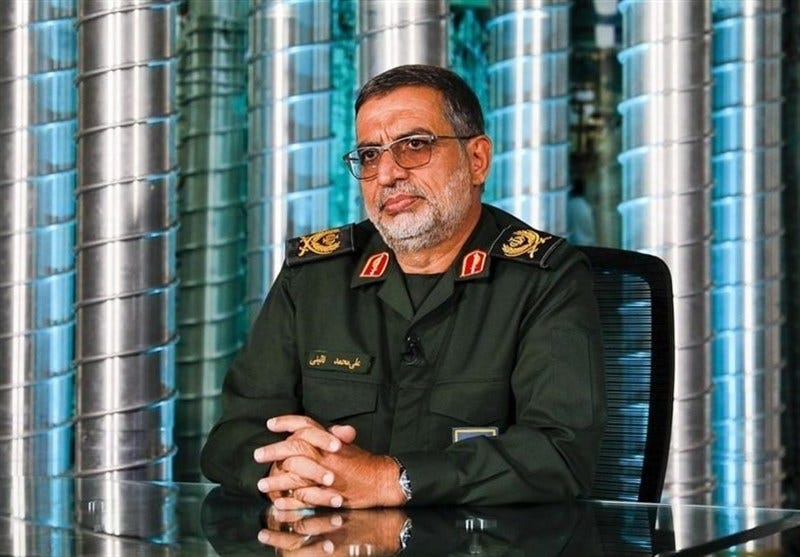
Iran, PUREWILAYAH.COM - Iran’s Islamic Revolutionary Guard Corps (IRGC) announced that more than 200 U.S. and Israeli targets have been struck by Iranian ballistic missiles and drones since the start of the war, delivering a severe blow to the military infrastructure used in the aggression against Iran.
IRGC spokesman Brigadier General Ali-Mohammad Naini said the large-scale strikes demonstrate the collapse of Washington and Tel Aviv’s war calculations and confirm Iran’s ability to respond rapidly and decisively across the region.
IRGC: U.S. and Israel Miscalculated the War Against Iran
Brigadier General Ali-Mohammad Naini, spokesperson of the Islamic Revolutionary Guard Corps (IRGC), said the strategic calculations of the United States and Israel in the war against Iran have failed as the country responded with unity and rapid military retaliation.
Speaking about the developments during the first week of the war, Naini expressed appreciation to the Iranian armed forces.
“Before anything else, I must offer a sincere salute to all our comrades in the armed forces who are making sacrifices these days,” he said.
He also referred to the martyrdom of Imam Ayatullah al-Uzma Sayyed Ali Khamenei, describing him as “the great leader of the Islamic world, the beloved leader of the free people of the world, the father of the Islamic Ummah and the pillar of the strength and resistance of Islamic Iran.”
Naini also honored the martyrdom of senior Iranian commanders, members of the armed forces, and civilians killed during enemy attacks.
He particularly referred to the killing of innocent students at the Minab girls’ high school, describing it as a crime committed by the enemy.
“The pure blood of these martyrs will certainly bring down the enemies of the Iranian nation,” he said.
“The great Iranian nation, through these martyrdoms, has stood more seriously and more united in support of the Islamic Republic.”
U.S.–Israeli War Began With Massive Military Assault
According to Naini, the war began with a large-scale military assault conducted jointly by the United States and Israel.
“Since last Saturday, seven days have passed since the beginning of a full-scale and comprehensive war and a military aggression in the contemporary history of the West Asia region,” he said.
He stated that the United States and Israel launched a joint operation involving more than 50,000 troops, strategic bombers, destroyers, missile launchers, and nuclear submarines.
“The terrorist army of the United States and the Zionist regime openly declared the Islamic Republic of Iran as their target and began a widespread aggression against Iranian territory.”
Three Major Miscalculations by Washington and Tel Aviv
Naini said the enemy entered the war based on three major miscalculations.
“First, they believed that by assassinating the Supreme Leader of the Islamic Revolution everything would collapse within 48 hours.”
“Second, they thought the war would end within three days.”
“Third, the Americans predicted that a regional and international coalition would form against Iran.”
He added that all three assumptions collapsed.
“All three calculations faced a historic and disgraceful failure,” Naini said.
“It became clear that the enemy does not have a correct understanding of the political, military, and social power structure of the Islamic Republic of Iran.”
Iran Responded Within Two Hours
Naini said Iran quickly regained operational momentum despite the initial shock of the war.
“The initial shock of the war was very serious, but it was quickly contained,” he said.
“Only two hours after the enemy’s aggression began, Iran’s missile attacks started outside the enemy’s calculations.”
Assassination Plot Failed to Collapse Iran
Naini said the first major strategic failure of the enemy was the assassination plot targeting Iran’s leadership.
“The first failure was the project to assassinate the Supreme Leader, which had been designed with the aim of collapsing the Islamic Republic system,” he said.
According to him, the American doctrine was based on the assumption that the Islamic Republic was a personality-centered system.
However, that assumption collapsed immediately.
“The initial shock was contained, power was restored, and the enemy faced a massive popular response,” Naini said.
“A temporary leadership council was quickly formed, orders to confront the enemy were issued, and offensive operations against the enemy began.”
Iranian Cities Did Not Collapse Under Pressure
Naini said another enemy plan aimed to create fear and force large-scale evacuations of Iranian cities.
According to him, the enemy expected panic and social collapse.
However, the opposite occurred.
“Not only were the cities not evacuated, but the people came to the field,” he said.
“The nightly presence of the people across the country became a symbol of national unity and cohesion.”
He added that public gatherings in some cities even exceeded the average turnout of the annual 22 Bahman revolution rallies.
Iranian Armed Forces Launched Massive Counterattacks
Naini said the Iranian Army fought alongside the IRGC during the first week of the war.
“The air, ground, naval, and air defense forces of the army stood alongside the IRGC and carried out effective attacks against the Zionist regime and American bases.”
He described these operations as “truly remarkable.”
CIA and Mossad Attempted to Activate Terrorist Groups
Naini said another element of the enemy strategy involved activating separatist and terrorist groups along Iran’s borders.
He said intelligence agencies including CIA and Mossad attempted to arm opposition groups.
“Even some global television networks such as CNN openly referred to the CIA’s role in arming hostile forces,” he said.
He added that Donald Trump personally contacted leaders of these groups and urged them to begin operations.
However, Iranian forces and intelligence services acted before those plans could materialize.
“With dozens of drone and missile operations, the headquarters of separatist and terrorist groups in northwest Iran and the Kurdistan region were targeted and crushed.”
600 Missile Operations and 2,600 Drone Attacks
Naini said the scale of Iranian military operations during the first week of the war has been unprecedented.
“So far about 600 missile operations including various types of ballistic and cruise missiles with solid and liquid fuel have been carried out,” he said.
He added that 2,600 drone operations have also been conducted during the first week.
According to him, the accuracy of the strikes has been extremely high.
“More than 200 points including facilities, targets, and American interests have been hit.”
Iranian Missiles Targeted U.S. Bases Across the Region
Naini said the main battlefield stretched from the northern Indian Ocean to the occupied territories.
He added that the operational area of the war covers approximately 2.5 million square kilometers.
According to the IRGC spokesman, Iranian missiles and drones have targeted numerous American bases across the region.
“The headquarters of the U.S. Fifth Fleet in the region as well as American naval and air bases have been targeted,” he said.
He confirmed that Al-Udeid Air Base was struck multiple times.
He also named several other bases targeted by Iranian attacks.
“American army bases in the region including Al-Jafair, Ali Al-Salem, Al-Dhafra, Al-Jofah, and Sheikh Isa, which were the origin of aggression against the Islamic Republic, were targeted multiple times by missile and drone attacks.”
Israeli Strategic Facilities Under Heavy Fire
Naini said Iranian strikes also targeted major Israeli strategic and military sites.
Among the targets were:
The Israeli government complex
The general command headquarters of the Israeli army
The Israeli Ministry of Defense and Ministry of War
An international airport
The David Air Base
The Israeli naval base in Haifa port, where warships are anchored
Military industries and strategic infrastructure
He said these targets were struck repeatedly during recent waves of attacks.
Iranian Strikes Blind Enemy Defense Networks
Naini said the most important military achievement of the first week of the war was crippling enemy intelligence and defense systems.
“The most important military achievement in the first week of the war was blinding the enemy’s strategic eyes and paralyzing the integrated air defense network of the United States in the region.”
Developing story…
Source: Tasnim